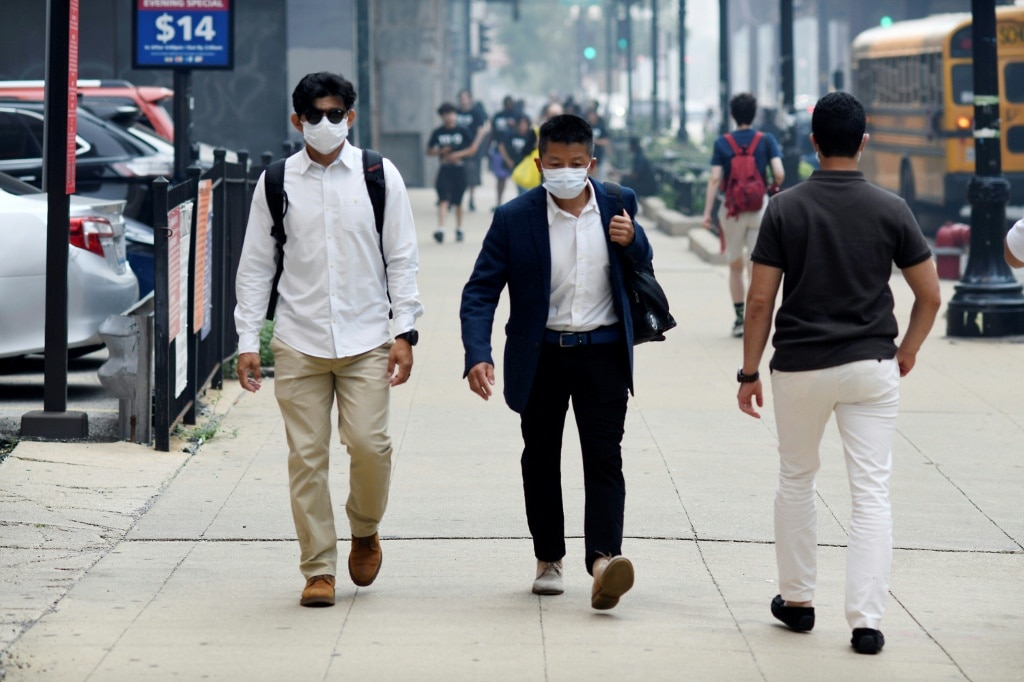
A thick, choking plume of wildfire smoke drifting south from Canada has triggered widespread unhealthy air quality alerts across a large swath of the United States, stirring last-minute uncertainty just two days before the 2026 World Cup final kicks off in an open-air stadium outside New York City. The toxic haze has already pushed major metropolitan areas across the Midwest and Northeast into some of the worst air pollution levels on the planet, raising public health alarms for millions of residents and forcing questions about potential impacts on Sunday’s high-profile match.
By Friday, Detroit and Chicago posted Air Quality Index (AQI) readings that fell into the official “hazardous” category, global air quality tracker IQAir ranked the two cities as the most polluted urban centers on Earth. Washington D.C., also caught in the southward drift of wildfire emissions, recorded “very unhealthy” AQI levels, prompting local officials to urge all residents to skip non-essential outdoor activity to avoid exposure to fine particulate matter linked to respiratory and cardiovascular harm.
In the New York City metro area and neighboring New Jersey, home to the stadium that will host Sunday’s final, regional air quality fell into the “unhealthy” range Thursday, with smog obscuring the iconic Manhattan skyline so thoroughly that landmarks were barely visible from across the Hudson River. Forecasters with the U.S. National Weather Service (NWS) warned that smoke concentrations could rise again overnight heading into Saturday, as shifting wind patterns carry additional Canadian wildfire emissions into the Northeast.
“What we should start to see is a return of northwesterly winds over the Great Lakes, and that’s going to pick up some of that smoke and push it over the Northeast,” Peter Mullinax, an NWS meteorologist, told Agence France-Presse. While hazy skies are expected to persist through match day on Sunday, Mullinax added that forecasters do not anticipate pollution levels will reach the dangerous highs recorded earlier in the week.
“I don’t believe that this should be as impactful as if you might be playing a game today,” he said. Mark Parrington, a senior scientist with the European Union’s Copernicus Atmosphere Monitoring Service, noted that forecast rain across the Northeast this weekend could also help clear the worst of the smoke from populated areas, though the long-term situation depends on whether Canadian wildfire activity continues at its current pace.
Across affected regions, millions of residents are already adapting to the hazardous conditions: people are donning protective filtering masks for any outdoor trips, and public facilities including New York City libraries and train stations have been distributing free masks to help at-risk communities. The upper Midwest, which lies closest to the active Canadian fire zones, has borne the brunt of the pollution, with large parts of Michigan, Minnesota, and Wisconsin recording “hazardous” AQI readings for multiple consecutive days. The NWS has extended its air quality alert for Chicago through Friday, noting that additional smoke could return to the area Saturday evening and persist through Sunday.
Climate and environmental advocates have highlighted this repeated wave of cross-border wildfire smoke as clear evidence of the link between accelerating climate change and worsening extreme wildfire risk. “Increasingly smoky skies underscore the importance of a rapid transition to clean energy rather than building more polluting fossil fuel infrastructure that further contributes to climate change,” said Paul Mathewson, science program director for Clean Wisconsin, an environmental advocacy group. Wisconsin has recorded a sharp rise in the number of smoky days annually in recent years, mirroring trends across much of North America.
Parrington confirmed that climate change has created far more favorable conditions for intense, long-lasting wildfire seasons across Canada, driving higher surface air temperatures and drying out soil and vegetation across vast regions. “When there’s an ignition we see these really large-scale, persistent burning where these fires can burn for weeks and weeks at a time through summer,” he explained.
As of Friday, Canadian authorities reported that more than 200 blazes were burning out of control across the country, with the most intense activity concentrated in Ontario. While the 2026 season has so far burned far less total area than 2023 — Canada’s worst wildfire season on record, which saw nearly 18 million hectares consumed — fire activity has escalated dramatically over the past seven days. Latest government data shows roughly 2.8 million hectares have burned across Canada since the start of 2026, up from just 1.6 million hectares a week earlier. No casualties have been reported from Ontario’s wildfires, but multiple remote indigenous and rural communities have already been evacuated to safer locations as blazes advance.