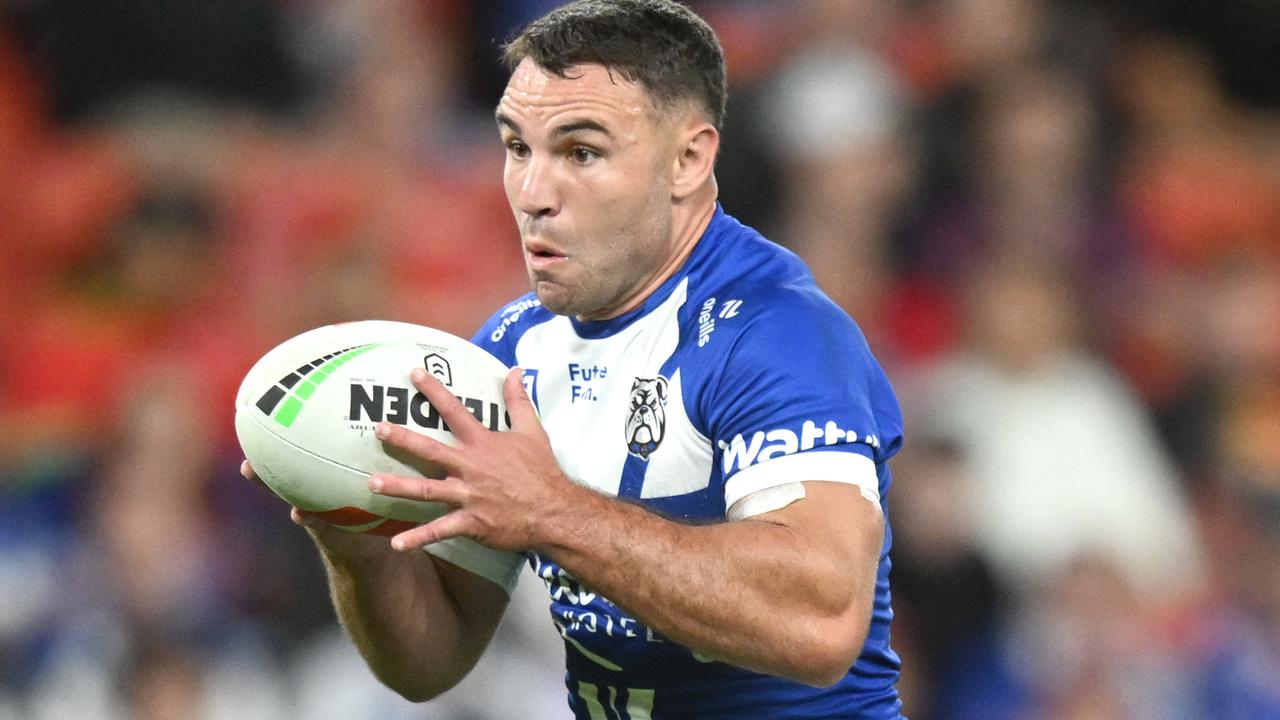
For nearly a decade, Sean O’Sullivan has flown under the radar as one of the National Rugby League’s most underrated talents, but a standout two-40/20 performance against the Wests Tigers on Saturday night has catapulted the experienced halfback into the spotlight, drawing widespread attention from rival clubs across the competition.
With star Canterbury Bulldogs back Stephen Crichton sidelined by injury, O’Sullivan got the call-up to step into the Bulldogs’ halves combination, and he did not waste his opportunity. Just 60 seconds into the contest, he nailed a crucial 40/20 kick to give his side early field position, and followed it up with a second game-changing 40/20 later in the match. The veteran playmaker’s controlled performance laid the foundation for the Bulldogs to dominate a struggling Tigers side, and he forged a dangerous on-field combination with young teammate Lachlan Galvin, allowing the rookie to play his natural attacking game while O’Sullivan steered the tempo of the match.
Now 27 years old, O’Sullivan has built a nine-year NRL career as a reliable backup playmaker, stints with six different clubs including the Sydney Roosters, Brisbane Broncos, New Zealand Warriors, Penrith Panthers, Dolphins and his current side Canterbury. Across those nine seasons, he has notched 65 first-grade appearances, but has never cracked more than 14 games in a single season, filling in as a depth option rather than the starting halfback he aspires to be.
O’Sullivan currently holds a mutual option with the Bulldogs through 2027, but rival clubs are already gearing up to make a play for his services as his standout performance proved he has the skill set to lead a side as a starting playmaker. When asked if he coveted an opportunity to become a starting halfback at an NRL club, O’Sullivan did not shy away from his ambition.
“I’d be lying if I said that wasn’t the case. I would love it,” O’Sullivan said post-match. “I am really super confident in what I can bring to a team, and I would obviously love that opportunity. But right now, whatever position I’m in, I just have to keep doing my role. I’m not bigger than anyone else in this club, and I’m not bigger than anyone else in this team. I can’t put my wants or needs in front of anyone else’s.”
The veteran added that every player in the league competes to earn a starting spot, and that ambition is only natural for his career. “But of course, we’re all competitors and it’s only natural for me to obviously want to be in that position too. I understand what my strengths are, and I’ll just have to bide my time and keep working hard. Whatever happens, happens, and I just keep putting my best foot forward and keep hoping that the boys get a win because, at the end of the day, we’re fighting for a top eight finish and we need as many wins as we can. Whatever ‘Ciro’ (Bulldogs coach Cameron Ciraldo) thinks is best, he’ll do.”
Ciraldo was quick to praise O’Sullivan’s match-winning contribution against the Tigers, but confirmed that Crichton will return straight to the halves combination for the club’s upcoming clash against the New Zealand Warriors this Saturday. For O’Sullivan, that means returning to a depth role, something he says he is comfortable with as he navigates the next chapter of his career.
O’Sullivan says he is happy to wait for his opportunity and prioritise what is best for the Bulldogs in the short term. “I think we’re sorting through a couple of things at the moment, but again, I’ll leave that up to my manager. He’s good at that, so I’ll just keep trying to put my best foot forward at whatever position I’m in and go from there,” he said. “I think for me it’s just really what’s best for myself and my career. Obviously, I’m super happy here, and I love being a part of the Bulldogs. Me and my missus are about to have our second kid, so for me it’s just not looking too far ahead. It sounds cliche, but really I’ll just keep working hard and keep looking for that opportunity.”