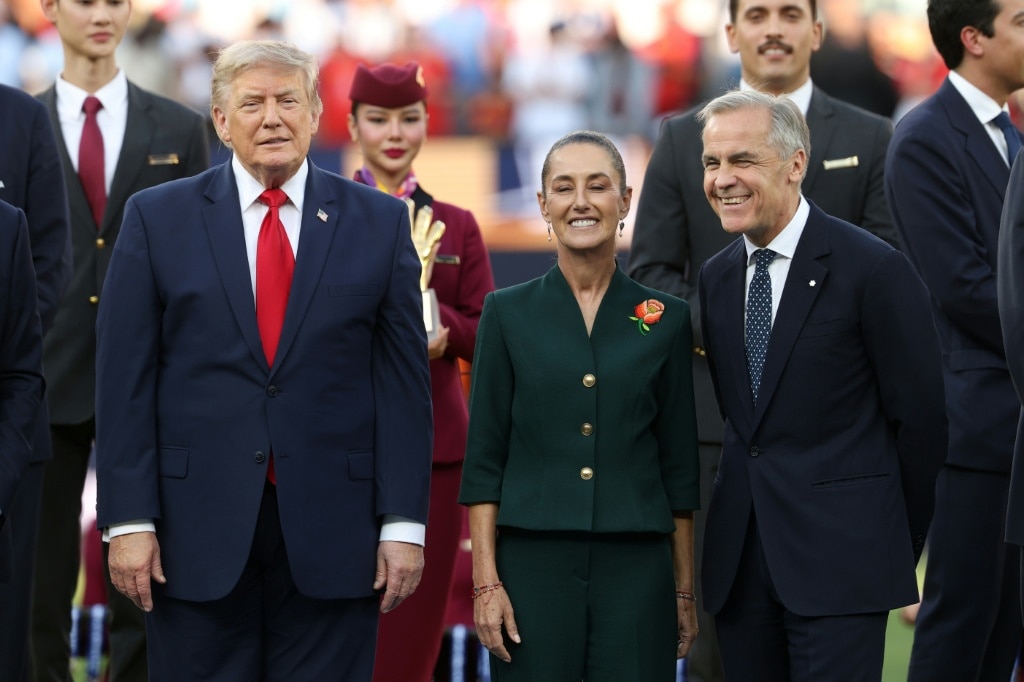
The 2026 FIFA World Cup final between Spain and Argentina, held on July 19 at the New York/New Jersey Stadium in East Rutherford, became the stage for an unexpected political spectacle when U.S. President Donald Trump chose to linger on the awards podium long after his scheduled appearance, soaking up global attention even as the Spanish championship team prepared to celebrate their historic victory.
Two U.S. Marine Corps helicopters, one carrying the sitting president, flew over the stadium ahead of kickoff, marking Trump’s arrival for the first World Cup match he has ever attended. Flanked by First Lady Melania Trump and FIFA President Gianni Infantino in the stands, Trump sat near two fellow North American leaders – Mexican President Claudia Sheinbaum and Canadian Prime Minister Mark Carney – whose nations co-hosted the 2026 tournament alongside the United States. Relations between the Trump administration and both leaders remain strained: just days before the final, Trump threatened new tariffs on Canada over wildfire smoke that drifted into the northeastern U.S. and raised air quality concerns during the event, while tensions with Mexico persist over Trump’s aggressive immigration crackdown and repeated threats of military action against cross-border drug trafficking networks. Despite these underlying frictions, the president exchanged brief pleasantries with both leaders, and also shook hands with Spanish Prime Minister Pedro Sánchez, even after recently criticizing Madrid for its perceived lack of support in the Iran conflict and failure to meet NATO defense spending targets.
Before the match kicked off, Trump offered his prediction for the game, stating that Argentine superstar Lionel Messi would give his side a competitive edge. He also praised Argentine President Javier Milei – who skipped the final out of a long-held sports superstition – calling the right-wing leader “a friend of mine” who “has done a terrific job” leading his country. When the U.S. national anthem played before the match, Trump stood and offered a formal salute to the flag.
When the final whistle blew, marking Spain’s 2026 World Cup victory over Argentina, Trump joined Infantino onstage to co-present the trophy to the winning Spanish side. As the team lifted the trophy aloft to celebrate, Infantino attempted to guide Trump off the podium to make way for the champions’ photo opportunity, but the 80-year-old president refused to leave, lingering in the spotlight and even performing a shortened version of his iconic signature dance in front of the assembled Spanish players. The moment echoed a similar controversy at the 2025 FIFA Club World Cup, also held at the New Jersey stadium, when Trump remained on the podium after handing the trophy to winning side Chelsea as the team tried to celebrate, and later falsely claimed the trophy was being kept in the Oval Office (FIFA later clarified it was only a replica).
This unscripted moment at the final is far from Trump’s first high-profile intervention in the 2026 tournament. Less than two weeks before the final, Trump sparked widespread outrage over accusations of improper influence when he called Infantino directly to ask FIFA to reverse a red card issued to U.S. striker Folarin Balogun, so the player could participate in the team’s round-of-16 match against Belgium.
Despite the repeated controversies, Trump has repeatedly lauded the 2026 World Cup as an unprecedented success. During a FIFA reception held at Trump Tower New York on the Friday before the final, Trump told attendees, “This has been the most successful sporting event maybe in the history of the world. It’s been amazing.” He added that the 104-match tournament had cemented soccer’s growing popularity in the U.S., noting, “It turned out we were a soccer country, and I think it’s going to remain.” Trump also mentioned that his 20-year-old son Barron is a passionate fan of the sport. Since returning to the Oval Office in January 2025, Trump has closely tied his political brand to the success of the co-hosted tournament, hosting Infantino at the White House on multiple occasions. The run-up to the tournament was not without its disruptions, however: Trump’s restrictive immigration policies created widespread visa delays and issues for international fans traveling to attend matches across the U.S. leg of the tournament.