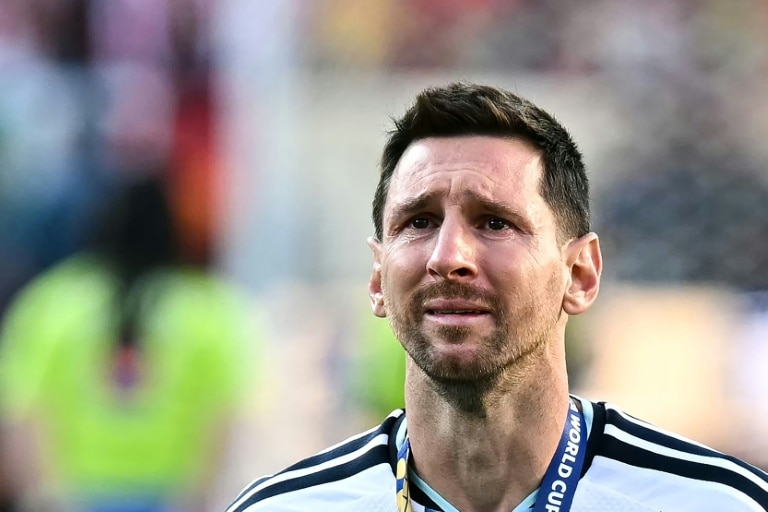
For soccer icon Lionel Messi, Sunday’s 2026 World Cup final was supposed to be the perfect coda to a legendary career: a second consecutive world title with Argentina that would silence any remaining debate over his status as the greatest men’s soccer player of all time. Instead, the 39-year-old left the pitch at MetLife Stadium in tears after a lopsided 1-0 extra-time defeat to Spain, bringing an underwhelming end to what had been billed as his final World Cup campaign.
Messi carried Argentina through the tournament, dragging the defending champions back to the final with a standout performance that included eight tournament goals, headlined by a dramatic late comeback against England in the semi-finals that included two assists from the captain. But from kickoff, the 2026 final never went Argentina’s way. Things turned for the worse when star midfielder Enzo Fernandez was shown a red card in first-half stoppage time, leaving the South American side down to 10 men for the entirety of the second half and extra time.
The undermanned Argentine side failed to mount any meaningful offensive pressure against a dominant Spanish side, struggling to string together coherent attacks and relying heavily on cynical fouling to disrupt Spain’s rhythm. The match stayed scoreless until the 106th minute, when Ferran Torres broke the deadlock to put Spain ahead, a lead they would not relinquish. For Messi, the match was particularly quiet: he recorded just 54 total touches on the ball, nearly half of which came in extra time, and never came close to scoring the goal that would have tied Kylian Mbappe’s all-time men’s World Cup scoring record of 22 goals.
Down a player, coach Lionel Scaloni opted to leave Messi on the pitch as a lone striker rather than bring on fresh-legged forward Lautaro Martinez, a decision that left many questioning whether the aging captain ultimately became a liability for his already stretched team. The defeat means Argentina failed to become the first men’s national team to defend a World Cup title since Brazil in 1962, a milestone that would have capped Messi’s international legacy perfectly.
Even in defeat, the 2026 final gave Messi a historic milestone to add to his collection. His appearance in Sunday’s match marked his third World Cup final appearance, tying the all-time record held by Brazilian great Cafu. Only Pele has won three World Cup titles, though he did not feature in the 1962 final due to injury, while Diego Maradona and Messi have both appeared in two winning and two losing finals. Critics of Messi’s GOAT status will likely point to this latest defeat, his second World Cup final loss following a 1-1 defeat to Germany in 2014.
A full-circle subtext hung over the match, as Sunday’s final was hosted at the same MetLife Stadium where a heartbroken Messi announced his first retirement from international soccer back in 2016. That same year, after losing a third major final with Argentina (a Copa America Centenario penalty shootout defeat to Chile that ended with Messi missing a decisive spot-kick), he told reporters “For me the national team is over.” What followed was one of the most remarkable late-career revivals in sports history: Messi led Argentina to back-to-back Copa America titles in 2021 and 2024, sandwiched around the iconic 2022 World Cup victory in Qatar that cemented his international legacy.
When the 2026 North American World Cup was announced, the tournament was framed as a victory lap for Messi, who opened his campaign with a hat-trick against Algeria and remained consistent in front of goal all tournament. He retires from World Cup play with a record 34 matches across six shared-record World Cup tournaments, and more than 200 senior caps for Argentina. With the 2030 World Cup set to take place when Messi will be in his early 40s, Sunday’s final is almost certainly the last World Cup appearance of his career. While he remains under contract with MLS side Inter Miami through 2028, leaving the door open for continued international play, this underwhelming defeat is widely seen as the quiet end to one of the greatest international careers in soccer history. It was a glorious run, but for Messi and Argentina, Sunday’s final was ultimately a step too far.