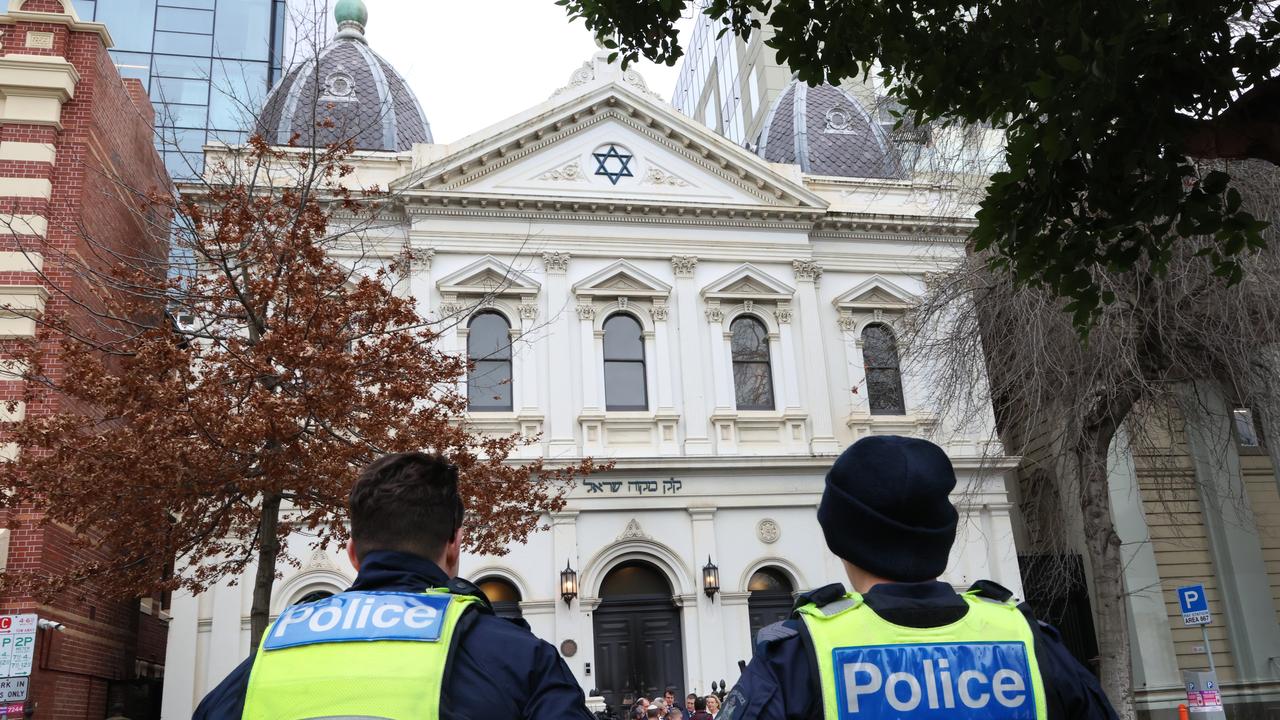
As Australia’s Royal Commission into Anti-Semitism and Social Cohesion continues its public hearings, disturbing new testimony has laid bare the extraordinary burden placed on Jewish communities across the country to defend themselves from rising hate violence and harassment. Central to the hearing’s latest session is the revelation that unpaid community volunteers have contributed hundreds of thousands of hours of uncompensated work over the past four years to shore up security at Jewish spaces, with the 2025 contribution already topping 113,700 hours.
A witness identified only by the pseudonym ACO, who represents community security organizations, told the commission that this year’s volunteer hour total marks a jump of more than 25,000 from 2024’s already record high. ACO emphasized that the 113,700 figure is almost certainly a substantial undercount, as it does not account for the many volunteers who remain on call around the clock to respond to emergency threats at short notice. The witness explained that as anti-Semitic rhetoric and attacks have intensified across Australia in recent years, community groups have ramped up their security posture to match the evolving threat landscape, putting immense strain on volunteer teams and organizational leaders.
“ We saw the rhetoric ratcheting up. We were highly concerned by that, and we all shared the same concerns,” ACO told the commission. “We ensured that our operational standing was relevant to the threat environment.” The witness added that the unrelenting demand for security coverage has created immense pressure for all participating volunteers and paid staff.
Beyond the massive volunteer labor contribution, counsel assisting the commission Richard Lancaster outlined the extreme financial and operational disruptions rising anti-Semitism has imposed on Jewish religious institutions. Many synagogues across the country have been forced to redirect funding from core community programs to cover security costs, and some have even cancelled weekly religious services when they cannot afford to hire additional paid security personnel. Lancaster noted that submissions received from dozens of synagogues nationwide uniformly cite security as the single largest drain on organizational time, budget, and energy that did not exist at the same scale just a few years ago.
Commission attendees also heard of the daily harassment facing Jewish community members outside their own institutions: groups of agitators regularly gather outside synagogue gates to shout abuse at congregants entering for services. Lancaster explained that this creates an impossible Catch-22 for community leaders: if they implement strict security barriers and limit public access to protect members, they are unfairly criticized for choosing to be deliberately insular, but without those protections, congregants are left unnecessarily vulnerable to harm. This tension comes after a series of high-profile anti-Semitic attacks in 2024, including a violent assault on Melbourne’s Adass Israel Synagogue and vandalism of the Melbourne electorate office of federal Attorney-General Mark Dreyfus.
Dreyfus, who is Jewish and whose great-grandparents were murdered in the Holocaust, testified before the commission about his own direct experiences of anti-Semitic abuse while serving in public office. He detailed two separate 2024 incidents that highlight the normalization of hate targeting Jewish public officials in Australia. In the first, Dreyfus said he offered a polite good morning to a stranger approaching him on Melbourne’s Latrobe Street, only to be called a “genocidal Zionist” and told he should be ashamed of himself. “It was so shocking and so striking to me that this should occur,” Dreyfus told the commission.
Weeks later, Dreyfus’s office in the Melbourne suburb of Mordialloc was vandalized: perpetrators smeared red paint across the building’s front facade and scrawled the phrase “who does A-G Dreyfus serve” alongside the damage. Dreyfus told the commission that this phrase deliberately invokes centuries-old anti-Semitic tropes about dual loyalty, a false conspiracy that claims Jewish public servants answer to a foreign power rather than the Australian public. “That invokes old anti-Semitic tropes about dual loyalty, about not serving Australia, about serving some other country, all of them grossly false,” he said. “No one ever should make that suggestion about a member of the Australian parliament, let alone someone who had been sworn to administer a portfolio as the Attorney-General of the Commonwealth.”
In his testimony, Dreyfus called for urgent legislative reform to better protect Jewish communal spaces, proposing new protest restrictions that mirror the existing buffer zone laws in place for abortion clinics across Victoria. Dreyfus clarified that the proposal does not seek to ban all political protest outside Jewish spaces, but rather to establish exclusion zones that protect congregants, students and other visitors from targeted harassment and intimidation. He argued that persistent protests outside synagogues, schools and other Jewish gathering places not only cause widespread anxiety among community members, but also create opportunities for more serious violence to occur under cover of public demonstration.
“It’s time to consider whether we need some similar restriction on protest activity outside synagogues, on protest activity outside schools, and Jewish places of gathering,” Dreyfus said. “Not to ban political protest, not to say that people cannot express their views in our community, but rather to protect Jews … which should be free of protests occurring.” He added, “(Protests) might be cover for some worse activity, for violence, for some actual physical threat to those places or people.”
The Royal Commission into Anti-Semitism and Social Cohesion is scheduled to continue examining a range of high-profile incidents in the coming weeks, including a controversial anti-Israel protest held on the steps of the Sydney Opera House that drew widespread condemnation for anti-Semitic rhetoric. Hearings have also been told of routine hate harassment targeting Jewish students and tutors at Australian universities, including common verbal abuse labeling Jewish people as “baby killers.”