标签: Oceania

大洋洲

  • Westpac hikes fixed rates twice in 3 weeks, 6.29 per cent starting point

    Westpac hikes fixed rates twice in 3 weeks, 6.29 per cent starting point

    One of Australia’s four largest domestic banks has taken the unusual step of raising fixed mortgage interest rates for a second time in just three weeks, piling additional financial pressure on home loan borrowers just days ahead of a highly anticipated monetary policy meeting from the Reserve Bank of Australia (RBA).

    On Thursday, Westpac Banking Corporation confirmed it would lift its fixed interest rates across all loan terms spanning one to five years by 0.15 percentage points, marking its second upward adjustment in 21 days. Following the change, the bank’s lowest available fixed rate now sits at 6.29% for a two-year fixed home loan. Cumulatively, Westpac has increased its fixed mortgage rates by a total of 45 basis points over the three-week period. Even after the consecutive hikes, analysis from financial comparison platform Canstar confirms Westpac still offers the most competitive fixed rate pricing among Australia’s big four banking institutions.

    Industry analysts note this move is far from an isolated adjustment, pointing to a widespread trend of repricing across the Australian lending sector driven by growing expectations of persistently high inflation and additional RBA rate increases. Sally Tindall, Canstar’s director of data insights, explained that most major and minor lenders have been revising their pricing upward repeatedly in recent weeks as concerns mount over a resurgence in Australia’s annual inflation rate. “Our analysis shows more than 90 per cent of lenders have adjusted fixed rates higher since the RBA’s last policy decision, including all four of the major banks. Westpac and the National Australia Bank have both implemented two separate hikes in this window,” Tindall noted.

    The scale of the repricing shift is stark: just 19 Australian lenders currently offer at least one fixed home loan product with a rate below 6%, down from 83 lenders offering sub-6% fixed rates at the same time last year. For home borrowers already struggling with soaring borrowing costs, this rapid round of adjustments sends a clear message: the window for locking in a relatively competitive fixed rate is rapidly closing, Tindall added.

    Westpac’s rate hikes come as the bank’s economic team forecasts three more official RBA cash rate increases in 2026, starting with a hike at the central bank’s upcoming May policy meeting. Luci Ellis, Westpac’s chief economist, linked the expected monetary policy tightening to ongoing geopolitical instability in the Middle East, specifically the conflict that has disrupted shipping through the Strait of Hormuz — a strategic waterway that carries roughly 20% of global oil trade. Since the outbreak of hostilities in late February 2026, global crude oil prices have nearly doubled, climbing from roughly US$56 per barrel to around US$100 per barrel. For Australian motorists, this translates to an extra 10 cents per litre of fuel for every US$10 per barrel increase in crude prices.

    Ellis explained that Westpac’s updated forecast accounts for extended fuel supply disruptions, as the Strait of Hormuz has remained effectively closed for eight weeks, with shipping only gradually returning to normal volumes. She added that the pass-through of higher fuel and energy costs to broader consumer prices in Australia has happened far faster than many economists previously projected. “We believe the RBA will respond to this accelerated pricing behavior by tightening monetary policy more aggressively than it would have if these cost increases had not filtered into broader inflation so quickly,” Ellis said.
  • Inter ready to pounce for Serie A title glory as Milan host Juve

    Inter ready to pounce for Serie A title glory as Milan host Juve

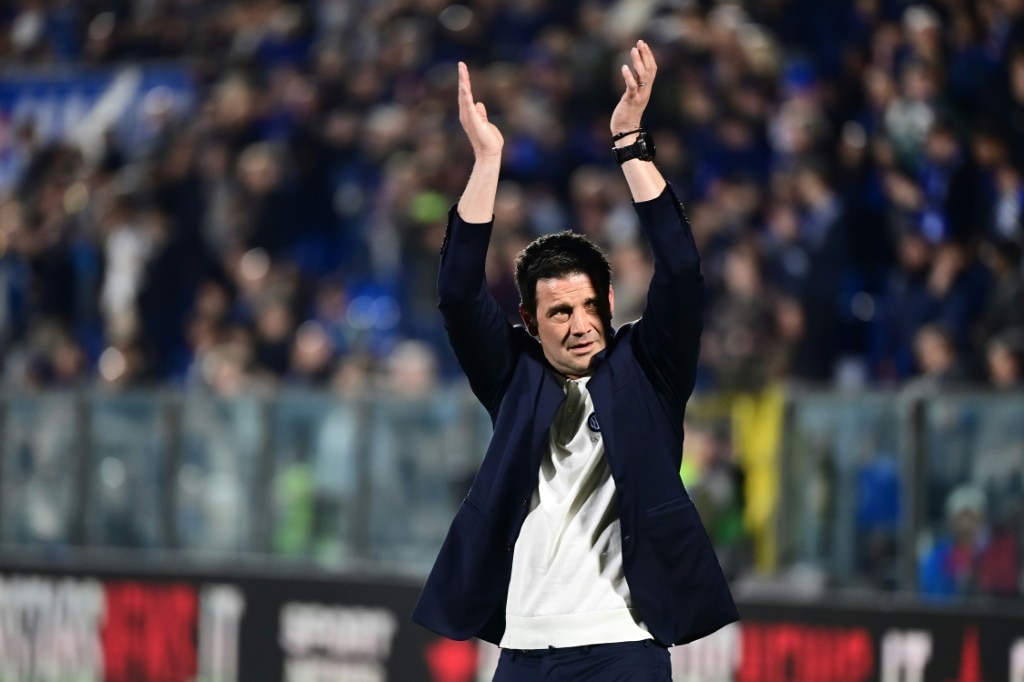
    With just five matches left in the 2024-25 Serie A campaign, Italian football’s biggest domestic prize is on the brink of being claimed, as Inter Milan stands 12 points clear at the top of the table and could seal their 21st Scudetto as early as this weekend. The race for the title, the final Champions League qualification spots, and relegation safety all converge on a critical matchweek that kicks off Friday evening, when title holders Napoli host relegation-battling Cremonese.

    Cristian Chivu’s Inter side hold a commanding advantage over both second-placed AC Milan and last season’s champions Napoli, putting the Nerazzurri in a position where even the slightest slip from Napoli on Friday will open the door for Inter to wrap up the league crown with four matches still to play. If Napoli fails to pick up all three points against Cremonese, a victory for Inter away to Torino on Sunday would confirm Inter as champions. Even if Napoli does win, the math remains firmly in Inter’s favor: the leaders only need four more points from their remaining five fixtures to secure the Scudetto regardless of other results.

    Inter’s path to this point has defied early expectations from just a month ago. Ahead of the most recent international break, the side appeared to be wobbling, with both Napoli and AC Milan closing the gap and threatening to knock them off their perch at the top. But since domestic club football resumed after the break, Inter have been unstoppable, picking up all nine available points and hitting 12 goals across three matches to restore their unassailable lead. Compounding their rivals’ woes, Inter are also targeting a domestic double: a recent thrilling win over Como booked their place in next month’s Italian Cup final, where they will face Lazio.

    All eyes will also turn to San Siro on Sunday evening, where second-placed AC Milan hosts Juventus in a clash that will have major implications for next season’s Champions League. While Milan can mathematically gift the Scudetto to their cross-city rivals if results go against Napoli and in Inter’s favor, the Rossoneri have their own top-four target to secure. AC Milan currently hold an eight-point lead over fifth-placed Como, meaning even a defeat on Sunday would likely leave them in a top-four spot. Juventus, by contrast, are in a far more precarious position: sitting fourth, they hold just a five-point lead over both Como and sixth-placed Roma, making three points a near-necessity to solidify their Champions League hopes.

    The headline player to watch in the San Siro clash is French midfielder Adrien Rabiot, who will line up against his former club Juventus this weekend. Signed by AC Milan last August after an acrimonious exit from Marseille that followed a violent altercation with teammate Jonathan Rowe, Rabiot has repaid Massimiliano Allegri’s faith in him in spades this season. Across 25 league appearances, the 31-year-old has notched six goals and four assists, with his recent strike against Verona highlighting his trademark powerful running and clinical finishing. Rabiot was a key part of Juventus’s last Serie A title win in 2020, and went on to spend four more seasons with the Turin giants before moving to Marseille, adding extra narrative weight to his return on Sunday. Alongside Luka Modric, he is expected to lead Milan’s midfield charge against his old side.

    Elsewhere in the matchweek, Como will face a tough test away to in-form Genoa, who can secure their own top-flight safety with a positive result this weekend. Como, who threw away a two-goal lead before being eliminated from the Italian Cup by Inter earlier in the week, will be looking to close the gap on Juventus and keep their own Champions League dream alive.

    The full matchweek fixture list (all times GMT) is as follows: Friday sees Napoli host Cremonese at 1845. On Saturday, Parma faces Pisa at 1300, Bologna takes on Roma at 1600, and Verona hosts Lecce at 1845. Sunday’s action kicks off at 1030 with Fiorentina vs Sassuolo, followed by Genoa vs Como at 1300, Torino vs Inter Milan at 1600, and the headline AC Milan vs Juventus clash at 1845. The matchweek wraps up on Monday with Cagliari vs Atalanta at 1630 and Lazio vs Udinese at 1845.

  • Fresh paint, careful choreography as pope visits African prison

    Fresh paint, careful choreography as pope visits African prison

    The air was thick with the unmissable stench of sweat and urine inside Bata Prison, despite fresh coats of salmon-pink paint covering the facility’s outer walls to spruce it up for Pope Leo XIV’s high-profile visit on Wednesday. This notorious correctional facility in Equatorial Guinea played host to the leader of the global Catholic Church, who is in the middle of a 10-nation African tour, and the day was defined by a sharp contrast between carefully stage-managed hospitality and longstanding international criticism of the country’s prison system.

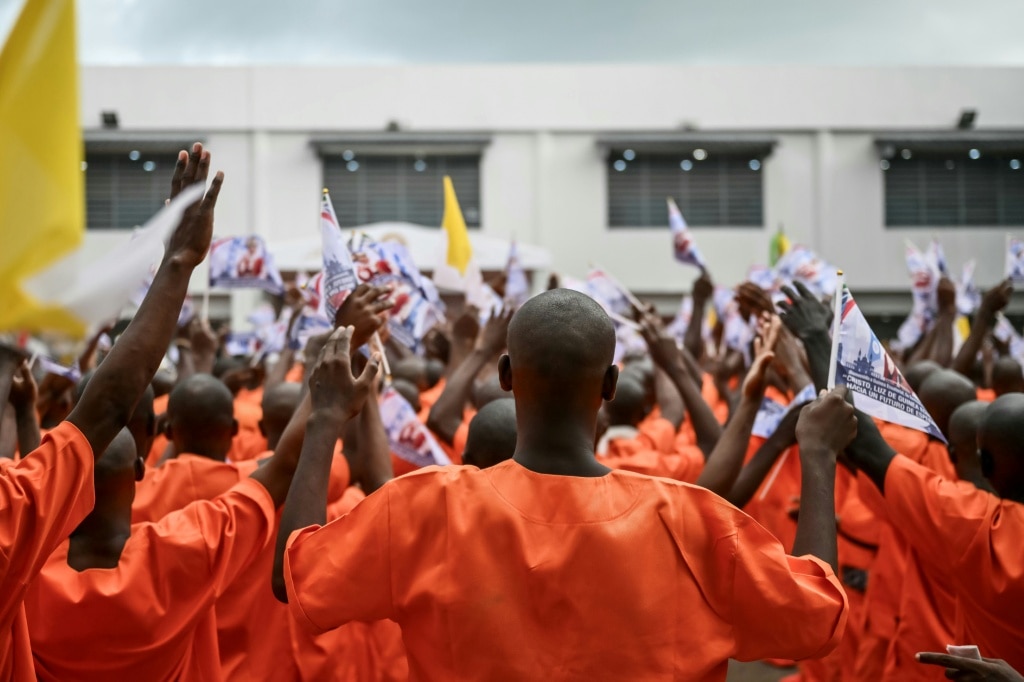
    Hundreds of incarcerated people gathered in the prison’s open courtyard, greeting the pontiff with chants of “freedom” as heavy tropical rain poured down across the complex. Around 600 inmates, 30 of whom were women, lined up in neat rows for the visit, all with shaved heads, wearing standard-issue bright orange or khaki-green uniforms, cheap plastic sandals, and in some cases, cloth face masks. Their coordinated jumps and chants were part of a carefully choreographed welcome planned ahead of the papal arrival, a public relations push for a prison system that has faced decades of global condemnation.

    Equatorial Guinea, a Spanish-speaking Central African nation of roughly 2 million people, has been under the authoritarian rule of President Teodoro Obiang Nguema Mbasogo since 1979. The regime has been repeatedly accused by international human rights organizations of systematic violations across all sectors of public life, including its detention network. For Obiang’s government, Pope Leo’s visit represented a rare chance to reframe the global image of its widely criticized prison operations.

    This polished, red-carpet welcome stood in stark opposition to multiple independent reports documenting brutal conditions inside the country’s prisons. A 2023 U.S. State Department human rights report detailed widespread accounts of torture, severe overcrowding that leaves cells crammed beyond capacity, and unsanitary conditions that pose constant health risks to detainees. A 2021 report from Amnesty International echoed these findings, noting that official population data for Equatorial Guinea’s prisons is rarely made public and almost always outdated. The organization added that hundreds of incarcerated people are held for years without access to visits from legal counsel or family members, leaving relatives with no information about whether their loved ones are even alive. For Pope Leo’s visit, reporters were barred from conducting independent interviews with inmates, and only government-approved statements were permitted. Justice Minister Reginaldo Biyogo Mba spoke to reporters at the prison entrance, framed by a guard tower patrolled by two armed officers, and praised what he claimed were safe, humane conditions at the facility.

    When the pope arrived, upbeat rhythmic music blared over prison loudspeakers as inmates performed a coordinated song and dance routine under the watchful eye of uniformed prison guards. Without warning, a heavy tropical deluge broke out, drenching the entire crowd. Rather than brush off the downpour, Pope Leo framed it as a meaningful symbol in remarks delivered to the assembled detainees. “Rain is a sign of God’s blessing,” the 70-year-old U.S.-born pontiff declared in Spanish, drawing loud cheers and applause from the crowd.

    In his address to incarcerated people, Pope Leo struck a carefully balanced but pointed tone. “The administration of justice aims to protect society,” he told the gathering. “To be effective, however, it must always promote the dignity of every person.” He added a message of solidarity, telling detainees “you are not alone” in their experiences of incarceration. Analysts note that these comments, while delivered with diplomatic restraint, represent an unprecedented public critique of government policy in a country where freedom of expression is heavily suppressed.

    The Bata Prison stop came on the 10th day of Pope Leo’s African tour. Earlier the same day, he led a large open-air mass in Mongomo, a city near Equatorial Guinea’s border with Gabon, with President Obiang in attendance. During that service, the Catholic leader also called explicitly for “greater room for freedom” and the universal protection of human dignity for all people in the country.

  • Albanese warns of Iran war ‘tail’ as fuel reserves reach 46 days

    Albanese warns of Iran war ‘tail’ as fuel reserves reach 46 days

    In the wake of the recent ceasefire between Iran, Israel and the United States, Australia’s top political leaders gathered for the first post-ceasefire national cabinet meeting on Thursday, where Prime Minister Anthony Albanese issued a stark warning: the nation will face a long-drawn economic “tail” from the ongoing Middle East conflict, even with domestic fuel reserves now sitting higher than they were before hostilities erupted.

    Albanese told reporters following the meeting that while Australia’s near-term fuel supply outlook remains secure, the federal government is actively developing contingency plans to counter potential future disruptions to both fuel and fertilizer imports. He credited voluntary behavior changes from Australian motorists and consumers for the steady growth in national petrol reserves, which now stand at 46 days of coverage. While this is still only 51% of the 90-day minimum reserve requirement set by the International Energy Agency, it marks a notable improvement from the 36-day reserve level recorded when the conflict first began in late February.

    Even a complete, immediate end to hostilities and a full reopening of the strategically critical Strait of Hormuz would not erase the lingering economic impacts, Albanese explained. There is an inevitable time lag before global supply chains reset after two months of disrupted trade: clearing the waterway to restore safe passage, repositioning dozens of diverted or stuck cargo vessels from the Persian Gulf, unloading shipments, and returning vessels to their collection points to restart the regular supply cycle will take weeks of coordination. “So, there will be a long economic tail here,” the prime minister emphasized.

    Currently, six fuel cargo vessels are en route to Australia carrying more than 300,000 litres of diesel, and the federal government is exploring options to secure additional cargoes through the global spot market. Albanese also highlighted that the government has made significant progress in diversifying Australia’s import sources to reduce reliance on traditional Middle Eastern suppliers: the U.S., which has historically not been a major fuel provider to Australia, now accounts for roughly 18% of the nation’s fuel imports, while Argentina – once a negligible supplier – now contributes double-digit percentages of imports, and Algeria has also joined the list of active fuel exporters to Australia.

    Climate and Energy Minister Chris Bowen echoed the prime minister’s caution, noting that Australia still faces strong international headwinds, ongoing risks, and persistent market uncertainty over the medium term, but added that the government is leaving no stone unturned to position the nation to withstand any future shocks.

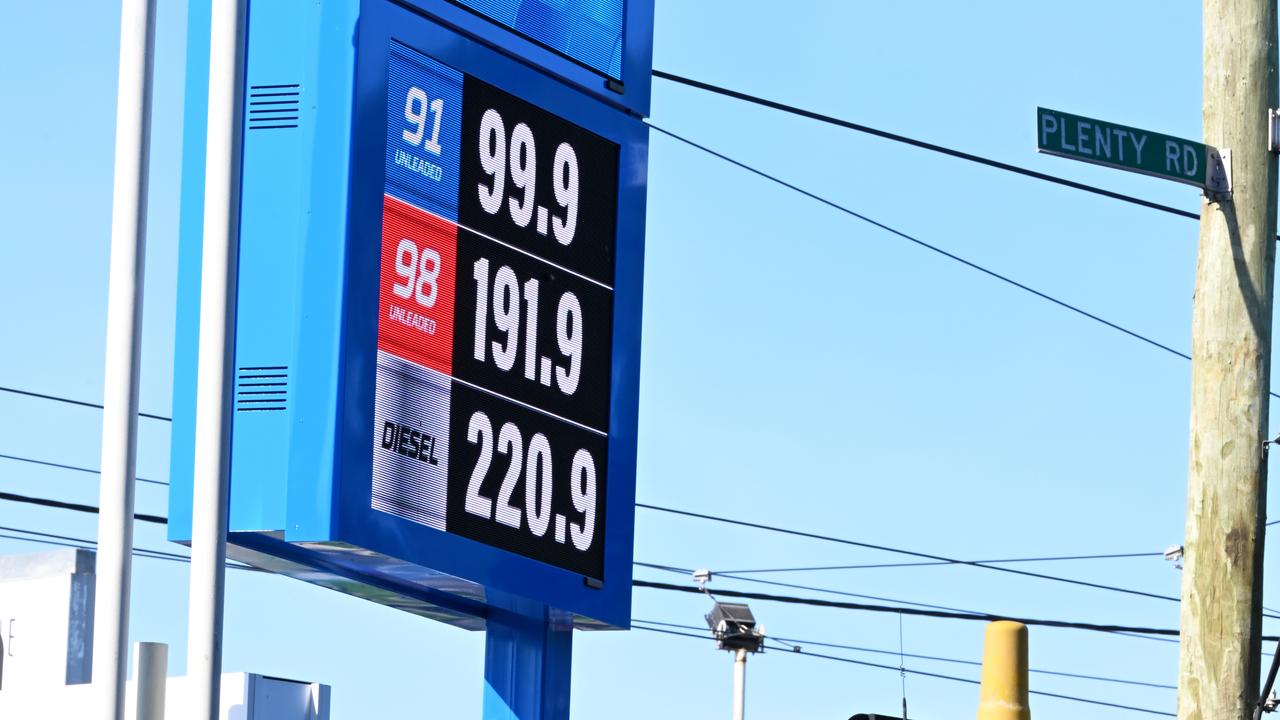
    Amid the broader economic concerns, there are small signs of relief for Australian motorists heading into the upcoming Anzac Day long weekend. Wholesale fuel prices have been falling steadily for several weeks, and these declines are now being passed on to consumers at the pump, according to Peter Khoury, a spokesperson for the NRMA motoring association. Over the past three weeks, wholesale diesel prices have dropped by one Australian dollar per litre, while wholesale unleaded petrol has fallen by 70 cents per litre.

    “Some good news finally for motorists,” Khoury said Thursday from Sydney. NRMA price tracking shows the majority of Australian retailers are now in the lower half of the national price range, with half of all Sydney service stations selling unleaded petrol for less than $1.90 per litre. “It is very clear that we’re in a better position than we were a couple of weeks ago, and that should continue into the long weekend, although looking at what is going on over the Middle East who knows how long that will last,” he added, urging motorists to compare prices using dedicated fuel price apps to lock in the lowest possible rates.

    Even with recent price declines, however, industry analysts warn that the threat of sky-high fuel prices has not passed. New modelling from Primera Research shows that Australian diesel prices were on track to hit $3.90 per litre earlier this month, a crisis that was only averted by two temporary interventions. First, the federal government implemented a temporary cut to fuel excise and paused 32 cent-per-litre heavy vehicle road user charges for three months. Second, fuel retailers voluntarily absorbed massive losses to keep prices from spiking, collapsing their average profit margins to just 1.7% – far below the standard 9.8% margin.

    “The $3.90 moment passed. But the costs that prevented it didn’t disappear; they were deferred,” said Robert Beerworth, managing director of Primera Research. The temporary federal excise cut is set to expire on July 1, which will trigger an overnight 32-cent-per-litre price increase that will ripple through the entire national economy. “Diesel moves every truck and every delivery in the country. When its price goes up, so does everything on the shelf,” Beerworth explained. Already, retailer profit margins are starting to recover to pre-crisis levels, pushing already absorbed costs back onto pump prices gradually – and the July excise cut expiry will bring all deferred costs to consumers at once. “The threat of $3.90-per-litre diesel had not evaporated,” he added.

  • ‘Dancing in their hands’: Japan wig masters set stage alive

    ‘Dancing in their hands’: Japan wig masters set stage alive

    Beneath the bright lights of Tokyo’s iconic Kabuki-za Theatre, before a packed audience leans in to watch centuries of traditional drama unfold, one quiet craftsperson lays the final foundation for a performer’s transformation. For kabuki, the iconic Japanese performing art famed for its dramatic stylized makeup, lavish period costumes and expressive storytelling, the wig is not just an accessory—it is the critical bridge between an actor and their character.

    Sixty-year-old Tadashi Kamoji, a fourth-generation master kabuki wig artisan known as a tokoyama, knows this weight of responsibility better than most. Ahead of a recent performance, he carefully positioned a handcrafted topknot wig on 33-year-old rising performer Nakamura Tanenosuke, who stars in a new production centering on a 19th-century noble family feud. “A kabuki actor cannot step onto stage as his ordinary self,” Kamoji explained in an interview with AFP. “It is only when the wig is in place that he truly becomes the character he is meant to play. That is why we carry such a heavy responsibility for our work, and why we hold such pride in what we do.”

    For decades, these skilled artisans have worked largely out of public view, tucked away in backstage ateliers far from audience applause. But the unsung craft of kabuki wig making has recently stepped into the international spotlight after the hit Japanese drama *Kokuho* earned an Oscar nomination for Best Makeup and Hairstyling. The film, which follows the lives of two onnagata—male actors who specialize in playing female kabuki roles—has brought long-overdue attention to the hidden craft that underpins every kabuki performance.

    Kabuki itself dates back to 17th-century Japan, blending dynamic dance, emotional drama and traditional music into a performance form that remains a cultural cornerstone of the country. Every element of a kabuki production is intentional: from the archaic dialect actors use to the elaborate hand-painted sets, each detail works together to transport audiences to another era. Nowhere is this intentionality more clear than in the wigs.

    After master craftsmen construct each wig from raw human hair, tokoyama like Kamoji take over to shape, style and customize the piece to fit both the actor and their character. This work goes far beyond simple hairdressing, Kamoji explains. “To create a wig that feels true, you have to first understand the core of the character,” he said. Kamoji joined the family trade when he was just 18, following in the footsteps of multiple generations of artisans, and he still learns new techniques from his 85-year-old father today.

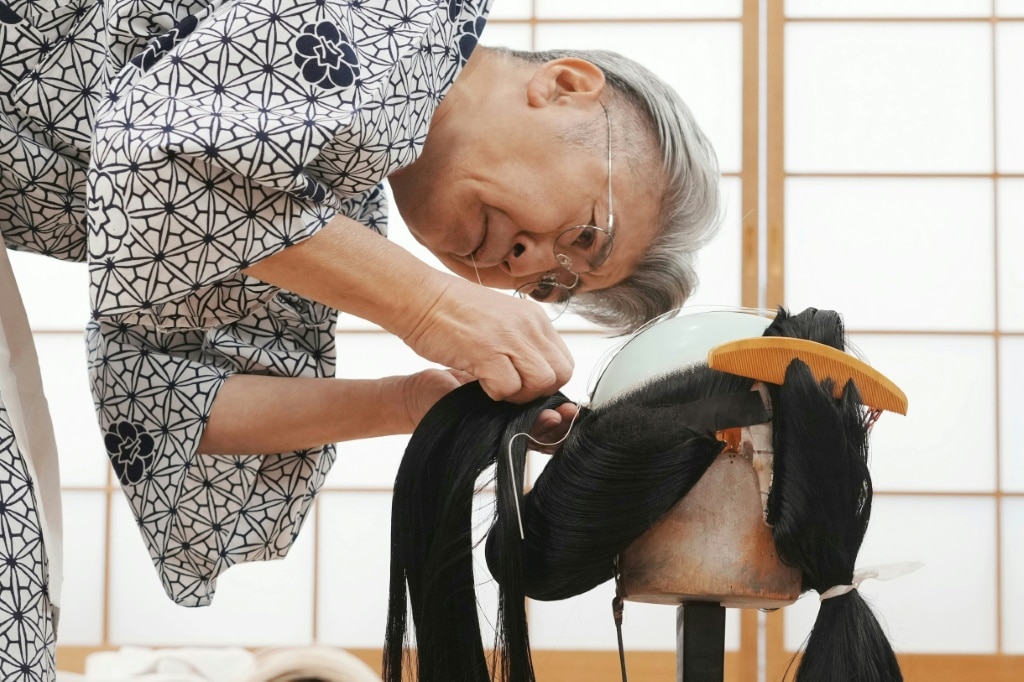
    Whether the role calls for a righteous middle-aged samurai, a high-ranking Edo-era courtesan or a professional sumo wrestler like Tanenosuke’s recent part, each wig is designed to communicate specific details about the character’s age, social standing, occupation and personality to the audience before the actor even speaks a line. For Tanenosuke’s sumo role, Kamoji spent two hours in his atelier shaping the wig into the traditional curved mage topknot, a hairstyle that fell out of common use in Japan more than a century ago. Working kneeling on a traditional tatami mat, he sectioned the hair with hand-carved wooden combs, smoothed strands with heated steaming irons, and pulled tight securing knots with his teeth—a technique that has been passed down through generations of tokoyama.

    For performers like Tanenosuke, who has worked with wig masters since he began training in kabuki at age five, these artisans are entirely irreplaceable. “There is almost no traditional kabuki performance that does not rely on handcrafted wigs,” he said. “The wig is the final touch that completes the transformation into character. Every step of getting into costume and makeup is a switch that prepares you, but it is not until the wig is set that you fully step into the role. The audience’s enjoyment of kabuki depends on the skill of the actors, yes, but also on the beauty of the costumes, sets and wigs—our work would not be complete without the masters.”

    The scale and diversity of the craft is staggering: there are roughly 400 distinct wig styles for female roles alone, and more than 1,000 unique variations for male parts. Every wig is custom made from scratch for each production and tailored to fit the individual actor who will wear it, with simple pieces taking only a few hours to complete and complex, one-of-a-kind designs requiring up to a month of meticulous work.

    Even after 42 years in the profession, Kamoji says he is still honing his craft. “To this day, I still learn new things from my father,” he said. “This is a craft of endless improvement. When I watch the most senior masters work, it looks like the hair is dancing in their hands. I have not reached that level yet; I think I will only truly master that control when I am my father’s age.”

    Still, all the long hours of meticulous work feel worthwhile to Kamoji when the curtain rises and the audience erupts in applause for the performer on stage. “When the audience cheers that the actor looks brilliant, I feel a part of that success,” he said. “To know that the wig we created helped bring the character to life, that suited the actor perfectly—that brings me a huge sense of joy.”

  • Climate scrubbed from G7 meeting to appease US, host France says

    Climate scrubbed from G7 meeting to appease US, host France says

    A high-stakes two-day G7 environment ministerial gathering kicking off in Paris this week will deliberately sideline discussions on climate change, a move explicitly designed to avoid open conflict with the United States, according to the French government.

    The office of French Ecology Minister Monique Barbut confirmed the controversial decision Wednesday, noting organizers opted to center the agenda on what it called less divisive environmental topics in order to accommodate the stance of the G7’s most economically and politically powerful member. “We chose not to address the climate issue head-on… because the United States’ positions on this subject are well known,” the ministry stated in a formal comment. “We wanted to prioritise G7 unity, particularly to protect this forum.”

    This exclusion comes against the backdrop of major shifts in U.S. climate policy under the second Donald Trump administration, which has formally withdrawn the country from international climate accords and rolled back a raft of domestic environmental protections since taking office in 2025.

    Senior environment officials from the other six G7 members – France, Italy, Canada, Japan, Germany and the United Kingdom – will attend the gathering, while Washington will send Usha-Maria Turner, assistant administrator for the Office of International and Tribal Affairs at the U.S. Environmental Protection Agency, to represent U.S. interests.

    In place of climate negotiations, delegates will deliberate on a suite of other environmental priorities: ocean conservation, financing for global biodiversity protection, and the growing crisis of desertification of arid drylands. France is leading a major push to secure G7 backing for a new cross-sector public-private funding initiative for biodiversity. Sources familiar with the planning indicate the ministry aims to announce an $800 million commitment to support national park expansion and protection across roughly 20 African nations during the meeting.

    The gathering is also scheduled to work toward a formal political declaration linking desertification prevention to global security, advance a global alliance for expanding marine protected areas, and host working sessions on reducing global water pollution. On the opening day Thursday, delegates will also travel to the Fontainebleau forest south of Paris for a dedicated session on forest conservation.

    Environmental and climate activists have roundly criticized the decision to drop climate from the official agenda, arguing it undermines the group’s ability to address what is widely recognized as the defining environmental crisis of the 21st century. Gaia Febvre, a representative of the global activist network Climate Action Network, told reporters that “a G7 moving at the pace of the United States cannot claim to respond to the crises of the century. By yielding to pressure, it weakens collective action and renounces its potential leading role.”

    Even conservation advocates who praised G7 plans for biodiversity funding have raised cautions about the new initiative. Jean Burkard, advocacy director for WWF France, noted that while the biodiversity funding pledge was a welcome step, all new financing “must be additional and not compensate” for cuts to existing public nature conservation budgets elsewhere. This exclusion of climate from the G7 agenda comes just one week before more than 50 nations gather in Bogotá, Colombia for the first ever global summit focused exclusively on phasing out fossil fuels – the primary driver of accelerating human-caused global climate change.

  • Trump, his ‘low IQ’ slur, and the right’s race obsession

    Trump, his ‘low IQ’ slur, and the right’s race obsession

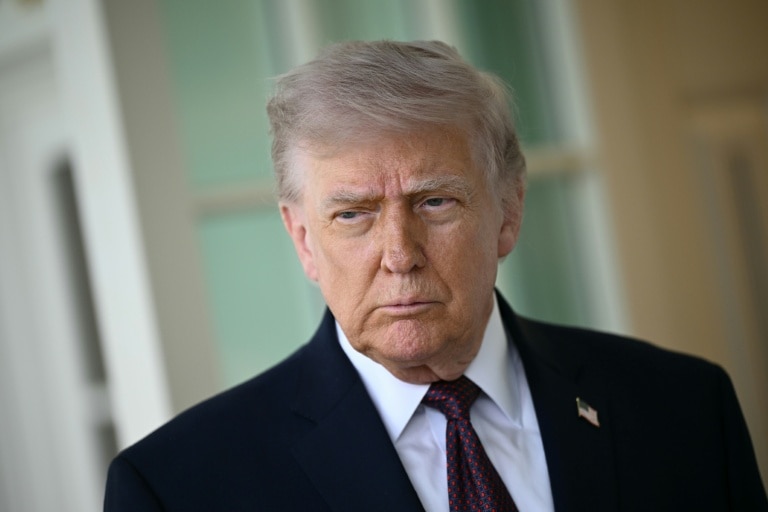
    In a fresh round of inflammatory rhetoric this week, former U.S. President Donald Trump targeted two of the nation’s most high-profile Black leaders — Supreme Court Justice Ketanji Brown Jackson and House Democratic Leader Hakeem Jeffries — with a uniquely derogatory label: “low IQ person.”

    While insulting opponents across the political spectrum has become a trademark of Trump’s public persona, deployed across social media, campaign rallies, official statements and even in direct exchanges with reporters, this particular jab carries uniquely sharp racial baggage in the American context that makes it stand out as particularly jarring.

    Jackson, a double Harvard graduate who made history as the first Black woman to serve on the nation’s highest court, drew Trump’s ire on Wednesday, when he dismissed her as “that new, Low IQ person, that somehow found her way to the bench.” She is far from the only person of color in Democratic politics to face this specific attack from Trump. Other targets have included U.S. Representatives Jasmine Crockett, Alexandria Ocasio-Cortez, Al Green, Rashida Tlaib and Maxine Waters. When targeting Minnesota Representative Ilhan Omar, who was born in Somalia, Trump extended the slur beyond the lawmaker to broadly brand all immigrants from the Horn of Africa nation as “low IQ people.” He has also applied the label to his 2024 presidential election rival Kamala Harris, calling her “a moron,” “stupid” and “a very low IQ individual.”

    Though Trump has occasionally used the same insult against white political opponents and critics — including former Georgia Representative Marjorie Taylor Greene, once a loyal ally, and conservative commentators Tucker Carlson and Megyn Kelly, who have broken with Trump over his stance on the Iran conflict — the phrase is deployed far more often against people of color, and particularly Black women.

    Experts emphasize that the slur is deeply offensive to the Black American community due to its long ties to white supremacist ideology that has falsely claimed Black people have inherently diminished cognitive capacity, justifying their forced exploitation for manual labor throughout centuries of slavery and oppression.

    “Trump’s characterization of people of color as ‘low IQ’ is a racist dog whistle with a long history in the US,” Karrin Vasby Anderson, a communication studies professor at Colorado State University, told Agence France-Presse. During the era of colonialism and 19th-century chattel slavery, Anderson explained, “white male elites took for granted that they were cognitively superior to women and people of color and, thus, divinely appointed for leadership.”

    Trump’s repeated recent use of the phrase aligns with a growing preoccupation among the American far-right with discredited pseudosciences including phrenology — the debunked field that claims skull size and shape can be used to measure a person’s intelligence — and race-based pseudoscience around genetics. “An interest in phrenology has resurged during Trump’s second presidential campaign,” Anderson noted.

    This discredited “race science,” which claims IQ is inherently tied to racial characteristics, has long festered in private far-right online chat groups. But in recent years, it has increasingly moved into mainstream right-wing media platforms that reach audiences of millions. Earlier this month, right-wing podcaster Benny Johnson, who counts six million YouTube subscribers, hosted a Republican lawmaker for a discussion claiming that many migrants from “third world” countries are incompatible with American culture. Johnson explicitly suggested that lower average cognitive capacity should be a reason to restrict immigration from these nations, claiming “The average IQ in Somalia hovers around 70, and that’s the threshold for mentally handicapped.”

    Robert Sternberg, a psychology professor at Cornell University, told AFP that IQ tests are widely overvalued in public discourse, and only offer “moderate” utility for predicting real-world professional and personal success. Even so, their reputation as a rigorous scientific metric gives bigoted claims about racial differences in IQ a false veneer of academic credibility, lending cover to openly racist arguments.

    While some high-profile far-right figures — including white nationalist Nick Fuentes, who has dined with Trump at his Mar-a-Lago resort — openly promote extremist racial ideology, Trump has generally steered clear of explicitly racist language. Anderson explains that coded phrases like the “low IQ” slur offer a key rhetorical benefit: built-in deniability for both the speaker and their audience. “So, Trump and his audience can say that there’s nothing racist about ‘low IQ’ because that label could be applied to anyone,” she said. “When Trump uses it primarily against Black people, however, and when it’s connected to this very specific history of how Black people have been framed in US culture since the 19th century, the white supremacists and casual racists in Trump’s audience will respond favorably.”

    For his part, Jeffries — who Trump called a “totally low IQ person” earlier this week — pushed back quickly against the attack. “What’s so ironic is that Donald Trump is clearly the dumbest person ever to sit at 1600 Pennsylvania Avenue,” he told MSNBC.

  • Australian private sector cost inflation hits highest point since August 2022

    Australian private sector cost inflation hits highest point since August 2022

    Freshly released purchasing managers’ index (PMI) data from S&P Global has painted a mixed but largely concerning picture of Australia’s private sector economy, revealing stubborn and faster-than-expected inflationary pressures fueled by ongoing conflict in the Middle East. The April survey, which polls 400 manufacturers and 400 service providers across the country, shows that business activity stabilized this month following a contraction in March, but cost and consumer price inflation have both surged to 3.5-year highs, far outpacing economist forecasts.

    Supply chain disruptions stemming from the Iran-centered war that broke out in late February have been the primary driver of rising costs, with the closure of the Strait of Hormuz cutting off roughly 20% of global oil supplies and choking off shipments of key raw materials from the Persian Gulf, including fertilizer and medical-grade helium for MRI machines. S&P Global economist Eleanor Dennison explained that Middle East conflict has put intense strain on manufacturing supply chains, pushing supplier lead times out to their longest since mid-2022. “Greater outlays on fuel and freight also pushed cost inflation to its highest in just under four years,” she added.

    The data confirms that rising input costs are not being absorbed by businesses, but are instead being passed directly to end consumers, pushing “charge inflation” – the rate at which businesses increase prices for customers – to its highest level since late 2020. While the overall manufacturing benchmark edged back into growth territory in April after contracting in March, both manufacturing output and service sector activity registered sub-50 readings (the threshold that separates growth from contraction), with manufacturing output falling from 49.4 to 48.2. The service sector, meanwhile, bounced back from March’s sharp decline to stabilize near neutral, driven by modest job creation even as demand remains soft.

    The biggest takeaway from the data, according to Judo Bank senior economist Matt De Pasquale, is that inflation is becoming more broad-based across the Australian economy than most analysts predicted. That outcome significantly increases the likelihood that the Reserve Bank of Australia will implement additional interest rate hikes to curb price growth, he argued. “What the data suggests is that inflation could be picking up broadly and more than was initially anticipated given that growth is holding up. That would support the RBA focusing on inflation, getting ahead of it with further interest rate rises,” De Pasquale told NewsWire.

    There are limited bright spots in the latest snapshot: the overarching composite PMI, which measures combined private sector activity, bounced back into neutral territory after contracting in March, when the outbreak of war first sent shockwaves through global markets. New business orders did decline for the second consecutive month in April, as widespread economic uncertainty dented domestic sales, but export orders to key markets including North America, Asia, and New Zealand saw a small uptick.

    Dennison warned against overstating the modest growth in the headline manufacturing index, noting that underlying indicators remain weak. “To understand how manufacturers are faring, we must look beneath the positive headline index print, as output, new orders, employment and stocks all fell at modest rates,” she said. “Despite growing price pressures and persistent weakness in domestic demand, latest data saw output stabilise following March’s decline.”

    The conflict-driven supply shock is also rippling through regional trade networks, affecting Japan – Australia’s third-largest import supplier, which shipped $23 billion worth of goods to Australia in 2025, according to UN trade data. Japanese manufacturing output surged from 52.1 to 55.4 in April, hitting its fastest pace of growth in 12 years, as manufacturers rushed to produce goods ahead of expected further supply chain disruptions. That surge has however amplified input cost competition and extended delivery times, pushing Japanese business inflation to its highest in nearly four years. S&P economist Annabel Fiddes noted that “there were reports that some manufacturing firms boosted output due to concerns and uncertainty surrounding the war in the Middle East and the potential for further supply chain disruptions. The latter contributed to not only a much sharper rise in costs but the most pronounced increase in average delivery times for manufacturers’ inputs for nearly four years.”

  • Tears and smiles at tribute concert for Swiss fire victims

    Tears and smiles at tribute concert for Swiss fire victims

    Nearly four months after a devastating New Year’s Day fire claimed 41 lives at a popular Swiss alpine ski resort, hundreds of people gathered Wednesday for an emotional tribute benefit concert to honor those lost and support survivors of the tragedy.

    The blaze broke out in the early hours of January 1 at Le Constellation bar, a nightlife venue in the upscale resort town of Crans-Montana. Most of the fatalities were teenagers, and 115 more people were injured in the inferno; 38 survivors remain in hospitals and rehabilitation centers receiving ongoing care for physical and psychological trauma. Wednesday’s concert, held at Lausanne’s Salle Metropole theatre, welcomed victim family members and survivors, creating a space for collective mourning and shared solidarity.

    As the event opened, performing artists walked onto the stage to *Etoile de nos coeurs* (“Star of our Hearts”), a ballad written in memory of the victims, and lined up across the platform holding pure white roses. Before the performances began, family members gathered in the theatre’s foyer, where hugs mingled with soft tears and faint, bittersweet smiles.

    Laetitia Brodard-Sitre, a mother who lost her 16-year-old son Arthur in the fire, described the gathering as an act of enduring remembrance. “It’s about solidarity. To all the victims, up there or here on Earth, it means one thing: we haven’t forgotten you,” she told reporters. “We’re in survival mode. Half of our hearts have been ripped away. This event keeps alive the memory of all those who were hurt, both physically and emotionally.”

    Vincianne Stucky, whose 17-year-old son Trystan Pidoux died in the blaze, shared the same priority: preventing the young victims from fading from public memory. “I truly don’t want the children to be forgotten; that’s my greatest fear,” she said. “I find tonight’s concert magnificent because it will help, in particular, the burns victims.” For one badly injured survivor, the concert marked their first public appearance since the fire.

    All participating artists performed pro bono, and ticket prices ranged from 90 Swiss francs ($115). All proceeds from the event will go to Swisshearts, a support association founded by parents who lost children in the tragedy.

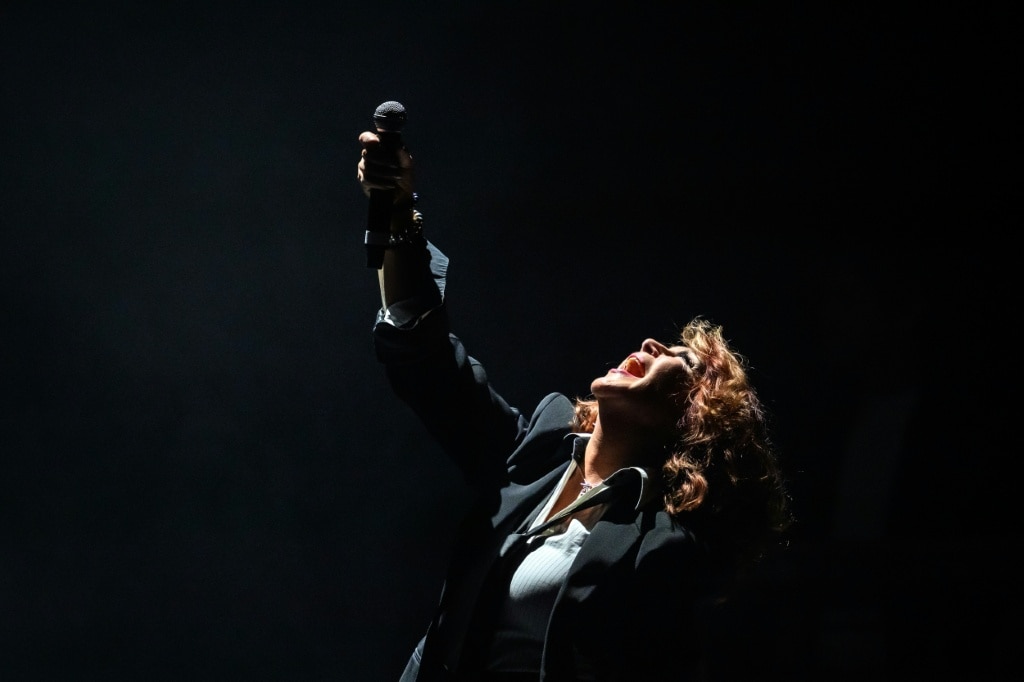
    Among the featured performers was Gjon’s Tears, the Swiss vocalist who placed third at the 2021 Eurovision Song Contest. At 27, he said he felt a particularly close connection to the victims, most of whom were young adults and teens out celebrating a holiday. “These were young people who just wanted to party and have fun,” he said. “Being close in age to the majority of the victims… I think we can relate to it.”

    Veteran French-Italian singer Richard Cocciante, 80, also took the stage, noting music’s unique power to comfort grieving communities. “We need to think about the people who are no longer here,” he said. “Music certainly helps; I don’t know if it can heal, but it helps.”

    The concert was organized by Olivier and Corine Uzan, event managers based in Crans-Montana who were hosting a New Year’s Eve event just 200 meters (656 feet) from Le Constellation the night of the fire. “We were shocked, because we knew some of the victims,” Corine Uzan said. “It’s a tragedy that could have been avoided — that’s the worst part. What we want is to bring a little light and joy… music brings people together.”

    In the aftermath of the disaster, 13 people are currently facing criminal investigation linked to the fire. The list includes the bar’s owners and several current and former local government officials, as authorities work to determine what safety failures led to the deadly blaze.

  • ‘Big loss’ for F1 if Verstappen quits, say McLaren rivals

    ‘Big loss’ for F1 if Verstappen quits, say McLaren rivals

    Two of Max Verstappen’s current on-track rivals from the McLaren team have issued a stark warning: if the four-time Formula One world champion makes good on his repeated hints to leave the sport, the entire series would be significantly worse off.

    The 28-year-old Dutch driver, who claimed four straight consecutive drivers’ titles between 2021 and 2024 after a narrow miss of a fifth championship the season before, has had a rocky start to the 2025 campaign with Red Bull, as Mercedes, Ferrari and his current rivals McLaren have closed the performance gap on his team.

    Verstappen’s growing frustration with F1 centers largely on the sport’s sweeping 2026 regulatory overhaul, a set of rule changes that will shift competition to prioritize electric energy management during both qualifying sessions and grand prix races, while also imposing new limits on maximum car speeds. He has not shied away from public criticism, even comparing the new direction of F1 to “Formula E on steroids” and the casual arcade racing video game Mario Kart. Beyond rule changes, he has also openly voiced dissatisfaction with the performance of his 2025 Red Bull race car, and hinted at a growing desire to shift focus to endurance racing to spend more time with his family, comments he made most recently following last month’s Japanese Grand Prix.

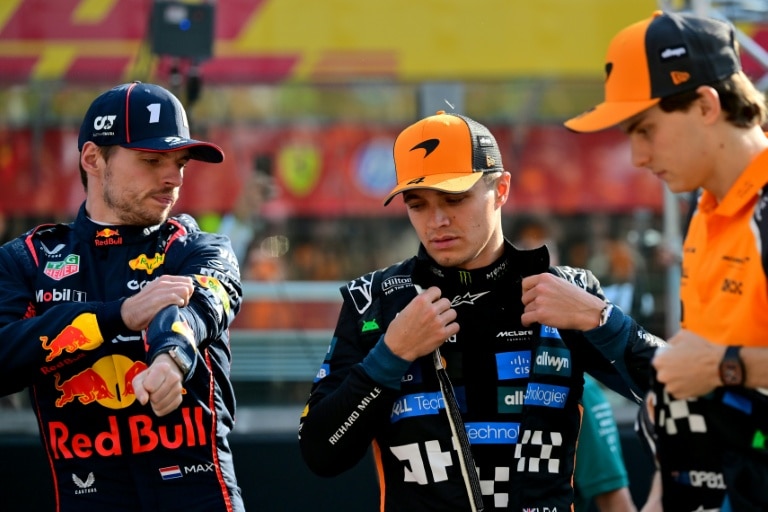
    Speaking to reporters this Wednesday, McLaren’s young driver line-up of Lando Norris and Oscar Piastri both echoed the same sentiment: losing Verstappen would be a major blow to the sport. 25-year-old Australian Piastri argued that every driver on the grid wants to test themselves against the best competition possible, and Verstappen has more than earned that status over the past decade.

    “I think it would be a big loss for the sport as a whole. I think for us as drivers we want to race against the best and try and prove ourselves against the best,” Piastri said. He added that Verstappen has “shown his calibre in the last 10 years” and has stood as the benchmark for F1 performance “for the last five or six” seasons.

    Norris, the 2025 defending world champion, echoed that assessment, noting that Verstappen’s legacy already places him among the greatest drivers to ever compete in F1. He also praised the Dutchman’s candid approach to speaking his mind, a trait that has made him a distinct, compelling figure for fans even among those who disagree with his views.

    “It would be a shame for the sport, it would be a miss for the sport if that does happen, because he probably is one of the best drivers you’ll see in Formula One ever,” Norris said. “He’s always been very open to say what he thinks, whether you agree or not.”