标签: Oceania

大洋洲

  • Trump unloads on allies as Davos showdown looms

    Trump unloads on allies as Davos showdown looms

    In an extraordinary prelude to the World Economic Forum in Davos, U.S. President Donald Trump has unleashed a barrage of diplomatic provocations targeting key Western allies, potentially destabilizing transatlantic relations to their most precarious state since the Second World War.

    The presidential offensive unfolded through a combination of social media revelations and inflammatory remarks to journalists just hours before his scheduled departure for the elite Swiss gathering. In a remarkable breach of diplomatic protocol, Trump publicly disclosed purportedly private text exchanges with French President Emmanuel Macron and NATO Secretary General Mark Rutte.

    The confrontation with France escalated dramatically when Trump responded to Macron’s refusal to participate in the proposed ‘Board of Peace’ conflict resolution body by threatening to impose 200% tariffs on French wine and champagne. ‘Nobody wants him because he’s going to be out of office very soon,’ Trump declared to reporters at Florida’s Palm Beach International Airport.

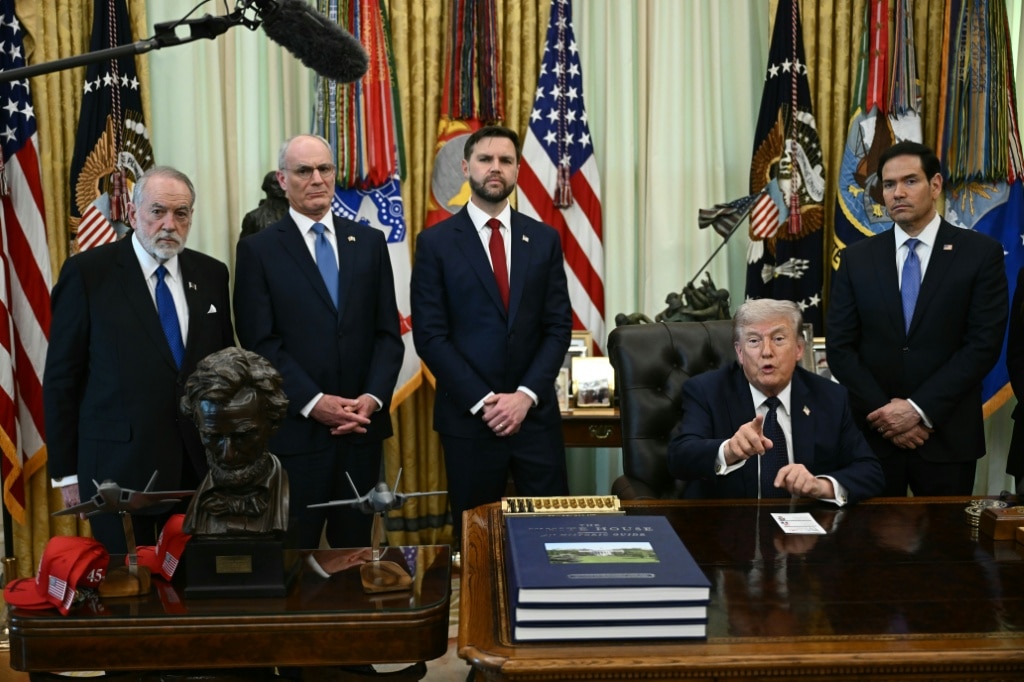
    The administration’s persistent campaign to acquire Greenland has emerged as the central flashpoint, with Trump sharing an digitally altered image aboard Air Force One depicting the Oval Office with American flags superimposed over maps of not only the United States but Canada and Greenland as well. This visual provocation was accompanied by a fabricated territorial sign reading ‘Greenland. US Territory, Est 2026’ featuring Vice President JD Vance and Secretary of State Marco Rubio.

    Britain subsequently became the next target of presidential ire, with Trump condemning what he termed London’s ‘great stupidity’ in its agreement to transfer the Chagos Islands to Mauritius—a strategically significant archipelago housing the critical Diego Garcia military installation. The president explicitly connected this criticism to his Greenland ambitions, citing it as justification for acquisition on national security grounds.

    Amid the diplomatic onslaught, a singular conciliatory note emerged through the revelation of NATO chief Rutte’s message, which expressed commitment to ‘finding a way forward on Greenland’ and anticipation for their Davos meeting. This contrasted sharply with Macron’s leaked text questioning Trump’s Greenland strategy while proposing a Paris-based G7 summit with Russian participation.

    The cumulative effect of these developments suggests a deliberate strategy to assert American dominance ahead of the international forum, leaving European leaders scrambling to preserve alliance structures that have underpinned Western security for eight decades.

  • How popularity overwhelmed Eala – and the Australian Open

    How popularity overwhelmed Eala – and the Australian Open

    Melbourne Park witnessed an extraordinary spectacle during the 2026 Australian Open as thousands of Filipino fans created unprecedented queues not for established champions, but for their emerging tennis sensation Alexandra Eala. The 20-year-old phenom, currently ranked 49th globally, generated a level of fan enthusiasm that eclipsed even the tournament’s biggest stars, revealing the powerful cultural significance of her breakthrough performance.

    Eala’s practice sessions and matches became focal points of Filipino national pride, with the Melbourne-based Filipino community of 60,000 turning out in remarkable numbers. Her pre-tournament press conference attracted 171,000 online viewers—dwarfing the audiences for Carlos Alcaraz (29,000), Coco Gauff (29,000), and Aryna Sabalenka (9,000). The overwhelming support created logistical challenges as organizers underestimated her drawing power, scheduling her opening match on Court 6 with capacity for just 1,500 spectators.

    The cultural significance of Eala’s participation cannot be overstated. As the first Filipina to win a WTA Tour match (2021) and a junior Grand Slam title (2022 US Open), she represents a new era for Philippine sports beyond boxing legend Manny Pacquiao. Her stunning victory over six-time Grand Slam champion Iga Swiatek at the 2025 Miami Open catapulted her to national hero status, with fans describing her as “the sporting symbol of the next generation.”

    Despite the overwhelming support, Eala’s main-draw debut ended in a hard-fought three-set defeat to American Alycia Parks (0-6, 6-3, 6-2). The match showcased Parks’ remarkable mental fortitude as she overcame both a disastrous first set and a crowd overwhelmingly supporting her opponent. British BJK Cup captain Anne Keothavong praised Parks’ composure, noting the exceptional challenge of competing against what felt like “every single fan.”

    The tournament organizers acknowledged the scheduling miscalculation, responding to fan complaints with commitments to “take it as a learning” for future events. While some observers criticized the enthusiastic Filipino fans for occasionally cheering Parks’ errors, the American player ultimately demonstrated championship mentality in navigating both the match and the charged atmosphere.

  • Long-delayed decision due on Chinese mega-embassy in London

    Long-delayed decision due on Chinese mega-embassy in London

    The UK government is poised to deliver a long-awaited verdict regarding China’s proposed expansive embassy complex in central London, a decision carrying significant implications for bilateral relations and national security concerns. The controversial project, situated on the historic former Royal Mint site adjacent to the Tower of London, has encountered substantial delays since China’s acquisition of the property in 2018.

    If approved, the new diplomatic compound would become Britain’s largest embassy by area and rank among the most substantial embassy installations within any Western capital. The proposed relocation from China’s current mission in Marylebone has sparked intense opposition from local residents, human rights organizations, and critics of China’s Communist Party leadership, who express apprehension that the facility could facilitate surveillance activities and harassment of dissidents.

    The embassy decision emerges as a particularly sensitive issue in UK-China relations, coinciding with Prime Minister Keir Starmer’s anticipated visit to China later this month—the first by a British premier since 2018. This diplomatic engagement aims to reset relations that deteriorated under the previous Conservative administration, though the embassy controversy complicates these efforts alongside other bilateral tensions.

    Security concerns have been amplified by revelations from The Daily Telegraph regarding unredacted plans showing 208 underground rooms, including a concealed chamber, and the embassy’s proximity to critical internet infrastructure serving London’s financial district. Hundreds of protesters, including Hong Kong expatriates fearing transnational repression, demonstrated against the project over the weekend.

    The British government must balance these security apprehensions against diplomatic consequences, as China has previously expressed ‘strong dissatisfaction’ with decision delays. Opposition leader Kemi Badenoch has characterized the proposed facility as a ‘spy embassy,’ while legal challenges threaten to follow if approval is granted.

  • Almost half of Kyiv without heat, power, after Russian attack: govt

    Almost half of Kyiv without heat, power, after Russian attack: govt

    A massive overnight Russian aerial assault has crippled Ukraine’s capital, leaving nearly half of Kyiv’s residential buildings without heating and running water amidst subzero temperatures of -14°C. This latest bombardment represents a severe escalation in Russia’s systematic campaign against Ukrainian energy infrastructure.

    Ukrainian authorities reported the attack involved an extensive barrage of 339 long-range combat drones and 34 missiles targeting energy facilities across multiple regions. Kyiv’s air defense systems engaged throughout the night, with explosions heard across the city as they responded to the incoming threats.

    The aftermath has been devastating. Mayor Vitali Klitschko confirmed approximately 5,635 apartment blocks—roughly half the capital’s residential buildings—were left without heating, primarily affecting structures still recovering from the January 9 attack that marked the most significant strike on Kyiv’s energy grid since the invasion began. Much of the city also lost running water access.

    Tragically, the assault claimed at least one life—a 50-year-old man killed near Kyiv. Additional damage was reported in multiple regions: Rivne faced critical infrastructure damage affecting 10,000 households, Odesa reported drone impacts on residential buildings and energy facilities, while Poltava experienced fires at industrial sites following attacks.

    Ukrainian leadership responded with vehement condemnation. Foreign Minister Andriy Sybiga characterized Putin’s actions as ‘genocidal war against women, children and elderly’ and urgently appealed for enhanced air defense support from allies. President Volodymyr Zelensky noted the timely arrival of ammunition shipments just one day prior to the attack, which he said ‘helped significantly’ in defense efforts.

    The International Criminal Court has previously issued arrest warrants for two top Russian military officials regarding strikes on Ukraine’s energy grid, classifying these attacks as war crimes due to their deliberate targeting of civilian welfare. Meanwhile, the Kremlin maintains it only targets military facilities and blames Ukraine for refusing its peace demands.

    Kyiv has implemented emergency measures including school closures until February and reduced street lighting to conserve dwindling energy resources as the city battles both winter temperatures and continued aggression.

  • Jittery Keys opens Melbourne defence as Sinner begins hat-trick quest

    Jittery Keys opens Melbourne defence as Sinner begins hat-trick quest

    Melbourne’s Rod Laver Arena witnessed a tale of two champions on Tuesday as Madison Keys navigated a turbulent title defense while Jannik Sinner prepared to launch his campaign for a historic third consecutive Australian Open crown.

    The American ninth seed, Madison Keys, confessed to overwhelming nerves during her opening match against Ukraine’s Oleksandra Oliynykova. After dropping the first four games, Keys staged a remarkable recovery to secure a 7-6(6), 6-1 victory. ‘I’ve been anticipating this moment for essentially a year,’ revealed the 2024 champion. ‘The initial nerves were palpable, but I’m thrilled to return to Melbourne.’

    While Keys struggled with the pressure of defending her maiden Grand Slam title won against Aryna Sabalenka last year, other contenders demonstrated more commanding form. Kazakhstan’s Elena Rybakina, seeded fifth, delivered a polished performance to defeat Slovenia’s Kaja Juvan 6-4, 6-3.

    The day produced a historic breakthrough for Indonesian tennis as Janice Tjen achieved her nation’s first Australian Open match victory in 28 years. The unseeded 59th-ranked player stunned 22nd seed Leylah Fernandez 6-2, 7-6(1), continuing her rapid ascent from 413th in the rankings just twelve months prior.

    In men’s competition, attention turned to Jannik Sinner’s impending quest for a Melbourne hat-trick. The Italian second seed, who dominated Alexander Zverev in last year’s final, could join Novak Djokovic as the only Open-era man to claim three successive Australian titles. Sinner’s opening challenge came against French world number 93 Hugo Gaston.

    The tournament’s narrative also featured notable exits and advancements. Brazilian teenager Joao Fonseca, heralded by Roger Federer as a future star, suffered elimination against American Eliot Spizzirri. Meanwhile, eighth seed Ben Shelton advanced decisively against France’s Ugo Humbert 6-3, 7-6(2), 7-6(5).

    All eyes remain on the developing rivalry between Sinner and world number one Carlos Alcaraz, who seeks his first Australian Open title to complete a career Grand Slam at just 22 years old. Sinner has refined his game since their US Open final encounter, focusing on net transitions and service variations that could prove decisive in Melbourne.

  • AI reshaping the battle over the narrative of Maduro’s US capture

    AI reshaping the battle over the narrative of Maduro’s US capture

    The digital information landscape has become a central battleground in the political conflict surrounding Venezuelan leader Nicolas Maduro’s January capture by US forces. Since his detention alongside wife Cilia Flores during operations in Caracas on January 3rd, artificial intelligence has emerged as a powerful weapon in shaping public perception of these events.

    Social media platforms are now inundated with AI-generated content that blurs the line between reality and fiction. These digital creations range from humorous memes to elaborate fictional scenarios, including one depicting an animated courtroom illustration of Maduro declaring himself ‘a prisoner of war’ and another showing an AI-generated version of the leader attempting a prison escape only to find himself dancing with former President Donald Trump and a judge to music by rapper Ice Spice.

    According to Leon Hernandez, researcher at Andres Bello Catholic University, this represents the development of sophisticated ‘disinformation labs’ that deliberately flood platforms with conflicting narratives. ‘The idea was to create confusion and generate skepticism at the base level by distorting certain elements of real things,’ Hernandez explained to AFP.

    The strategy extends beyond independent creators to include state media. Venezuela’s VTV television channel notably broadcast an AI-animated video narrated by a child recounting Maduro’s capture, demonstrating the institutional adoption of these techniques.

    Professor Elena Block of the University of Queensland notes that AI has become ‘the new instrument of power for autocrats to confuse, combat, and silence dissent.’ This digital propaganda builds upon existing media strategies employed by Maduro’s government, including the earlier ‘Super Bigote’ (Super Mustache) cartoon character that depicted the leader as a superhero fighting monsters representing political opponents.

    The phenomenon isn’t limited to Venezuelan leadership. Former President Trump has also utilized AI-generated content featuring ‘antagonistic, aggressive, and divisive language,’ according to Block, who warns that ‘AI today is the greatest threat to democracy’ through its capacity to trivialize political discourse.

  • Australian lawmakers back stricter gun, hate crime laws

    Australian lawmakers back stricter gun, hate crime laws

    In a decisive response to the Bondi Beach mass shooting that shocked the nation, Australian lawmakers have approved comprehensive security legislation targeting both firearms regulation and hate crime enforcement. The House of Representatives passed the dual measures during a special parliamentary session, creating a unified front against violence and extremism.

    The legislative package addresses critical vulnerabilities exposed by the December 14 attack, where assailants targeted a Jewish Hanukkah celebration, resulting in 15 fatalities. Prime Minister Anthony Albanese emphasized the dual nature of the threat, stating, ‘The terrorists had hate in their hearts, but they also had high-powered rifles in our streets. We’re taking action on both fronts simultaneously.’

    The hate crime provisions establish aggravated offenses for religious leaders and adults who radicalize children, while significantly strengthening penalties for hate dissemination. Immigration protocols will be enhanced to deny or revoke visas for individuals suspected of terrorism or hate-based activism.

    Concurrently, firearm reforms introduce a national gun buyback program, stricter import controls, and expanded background checks incorporating intelligence agency input. The measures represent Australia’s most significant security overhaul since the 1996 Port Arthur reforms.

    The legislation now moves to the Senate, where approval is anticipated later today. The parliamentary action precedes Thursday’s national day of mourning for the Bondi victims, as authorities continue investigating potential intelligence failures regarding the perpetrators.

  • MP family reunion flights to be capped, economy fares only after expenses scandal review

    MP family reunion flights to be capped, economy fares only after expenses scandal review

    Australia’s parliamentary travel entitlements system has undergone a substantial transformation following an expenses scandal that exposed questionable use of taxpayer funds by high-ranking officials. The Commonwealth Remuneration Tribunal has implemented stringent new regulations that dramatically restrict family reunion flight benefits for parliamentarians.

    Under the newly adopted recommendations, elected officials will now be limited to just one economy-class fare annually for family travel outside Canberra. The comprehensive reforms also mandate that all family travel—including for spouses—must be booked in economy class exclusively. Additionally, parliamentarians must now seek pre-approval from the Independent Parliamentary Expenses Authority before arranging any family reunion travel.

    The tribunal’s decision came after Prime Minister Anthony Albanese requested a review last year, prompted by revelations that several ministers—including Communications Minister Anika Wells, Trade Minister Don Farrell, and Attorney-General Michelle Rowland—had utilized taxpayer funds for family travel to high-profile events like the Australian Open tennis tournament.

    In justifying the reforms, the tribunal acknowledged the challenges parliamentary life presents for family dynamics, noting that “parliamentarians are required to live interstate for long periods” while emphasizing the importance of maintaining family connections. However, the body established strict criteria requiring that travel must be predominantly for parliamentary business purposes and directly facilitate family life.

    The scandal gained significant traction when it was revealed that Sports Minister Anika Wells had charged taxpayers tens of thousands of dollars for family attendance at prestigious sporting events including the Boxing Day Test cricket match, Melbourne Grand Prix, and a skiing trip to Thredbo during a Paralympics event.

    According to tribunal data, the majority of parliamentarians (194 out of 226) did not utilize any Australia-wide family reunion travel during the 2024-25 period, suggesting the reforms will primarily affect a minority of elected officials. The tribunal has urged implementation of these recommendations “as soon as practicable” to restore public trust in parliamentary spending practices.

  • ‘Rising tensions’: Australia’s sharemarket falls from eleven week high after ‘trade bazooka’ fears

    ‘Rising tensions’: Australia’s sharemarket falls from eleven week high after ‘trade bazooka’ fears

    The Australian equity market experienced a pronounced downturn during Tuesday’s trading session, primarily driven by escalating geopolitical friction between the United States and European nations. The benchmark S&P/ASX 200 index declined by 58.60 points, representing a 0.66 percent decrease to close at 8,815.90, while the broader All Ordinaries index fell 56.30 points (0.61 percent) to settle at 9,138.60.

    Market analysts attributed the bearish sentiment to renewed transatlantic trade tensions following former President Trump’s tariff threats against several European countries. The confrontation centers on the United States’ strategic interest in acquiring Greenland, with the administration threatening 10 percent tariffs against Denmark, Norway, Sweden, France, Germany, the Netherlands, Finland, and Great Britain. European authorities have responded with countermeasures potentially affecting €100 billion ($174 billion) in U.S. goods.

    Financial and materials sectors led the decline, with all four major banking institutions recording losses. Commonwealth Bank shares decreased by 1.81 percent to $150.48, Westpac dropped 0.98 percent to $38.59, NAB fell 0.85 percent to $41.86, and ANZ finished 1.15 percent lower at $36.94.

    The resources sector faced significant pressure despite BHP reporting substantial commodity price improvements, including a 32 percent annual increase in copper prices and a 4 percent rise in iron ore. BHP shares declined 1.99 percent to $47.78 following revelations that the first phase of its Jansen potash project would exceed initial estimates by over $1 billion, reaching $US8.4 billion. Rio Tinto decreased 2.04 percent to $146.34, while Fortescue slid 0.58 percent to $22.26.

    Market performance showed sector divergence, with seven of eleven industry sectors finishing lower. Utilities and technology stocks provided some offsetting gains, led by Origin Energy’s 2.62 percent surge to $11.34 after announcing an extension of operations at Australia’s largest coal-fired power plant until 2029.

    Individual company performances varied considerably. ARB Corporation shares plummeted 12.04 percent to $28.42 following unaudited sales revenue of $358 million for the first half-year, approximately 1 percent below previous corresponding periods. Conversely, Bellevue Gold rallied 5.01 percent to $1.78 after reporting strong sales metrics, and Hub24 shares advanced 3.1 percent to $101.21 following record net inflows of $5.6 billion.

    The Australian dollar demonstrated resilience amid market volatility, strengthening against the U.S. dollar to trade at 67.29 US cents.

  • Penguins bring forward breeding season as Antarctica warms: study

    Penguins bring forward breeding season as Antarctica warms: study

    A groundbreaking ecological study reveals that Antarctic penguin species are dramatically accelerating their breeding schedules in response to the continent’s accelerated warming trends. Published in the Journal of Animal Ecology, the research documents the most rapid breeding season shift ever recorded in avian species, with some colonies advancing their reproductive cycles by nearly one month.

    The international scientific team, utilizing time-lapse photography across multiple Antarctic locations from 2012 to 2022, observed three penguin species exhibiting significant behavioral changes. Gentoo penguins demonstrated the most pronounced adaptation, advancing their breeding season by 13 days on average—with some colonies shifting up to 24 days earlier. Adélie and Chinstrap penguins followed similar patterns, moving their breeding schedules forward by approximately 10 days.

    According to lead researcher Ignacio Juarez Martinez of Oxford University, the scale of temporal adjustment exceeded scientific expectations. “The magnitude of change is so substantial that penguins across most regions are now breeding earlier than any historical records indicate,” Martinez noted in statements to AFP.

    The behavioral shifts appear directly correlated with Antarctica’s warming climate, which the EU’s Copernicus climate monitoring service confirms as one of Earth’s most rapidly warming regions. Reduced sea ice has created extended periods of accessible hunting grounds and snow-free nesting areas, fundamentally altering the penguins’ reproductive calculus.

    However, the adaptation creates ecological winners and losers. Gentoo penguins, versatile foragers suited to temperate conditions, are expanding their populations and claiming nesting sites previously occupied by other species. Conversely, Adélie and Chinstrap penguins—which depend heavily on specific ice conditions and krill availability—face population declines amid increased competition for resources.

    Co-author Fiona Jones emphasized the broader implications: “As indicator species for climate change, these behavioral shifts signal potential impacts across global ecosystems.” The research team continues to monitor whether these accelerated breeding cycles ultimately produce successful chick-rearing outcomes or represent desperate adaptations to environmental stress.