标签: Europe

欧洲

  • Counting under way in Ireland by-elections

    Counting under way in Ireland by-elections

    On Saturday morning, vote counting officially kicked off for two pivotal by-elections that will select two new Teachtaí Dála (TDs), or members of the Irish parliament, to fill vacant seats in Dáil Éireann. The contests are taking place across two constituencies: Dublin Central and Galway West, where voters cast their ballots the previous day.

    The Dublin Central seat became vacant after former Fine Gael TD and ex-Irish Finance Minister Paschal Donohoe stepped down to take up a senior leadership position at the World Bank. In Galway West, the by-election was triggered by the resignation of local TD Catherine Connolly, who was recently elected to the role of president of Dáil Éireann.

    By-elections in Irish politics have long followed a well-established trend: sitting governing parties typically face a disadvantage, as voters often use these special contests to register dissatisfaction with the current administration’s performance. In Dublin Central, pre-count analysis had pegged candidates from the Social Democrats and Sinn Féin as the clear front-runners to claim the empty seat, and early tallies have done little to shift that projection.

    After all ballot boxes were opened and tallied in Dublin Central, unofficial vote projections show Social Democrat candidate Daniel Ennis holding a narrow lead over Sinn Féin’s Janice Boylan. Ennis has secured 19.6% of first-preference votes, according to preliminary tallies, while Boylan trails slightly at 17.7%. It is important to note that these early tallies only provide an indication of the initial count outcome, and the final result for both seats will depend heavily on the distribution of transferred votes from eliminated candidates, a key feature of Ireland’s single transferable vote system.

    In Galway West, with fewer than half of all ballot boxes processed as of Saturday, the race is also shaping up to be extremely close. Independent Ireland candidate Noel Thomas holds a thin lead with 21.3% of first-preference votes, while Fine Gael’s Sean Kyne is just one percentage point behind at 20.2% in the preliminary counts. Counting is expected to continue through the day as officials work toward finalizing official results for both seats.

  • Ukrainian drone attack triggers fire at a Russian oil terminal

    Ukrainian drone attack triggers fire at a Russian oil terminal

    As Russia’s full-scale invasion of Ukraine enters its fourth year, a wave of cross-border drone attacks has intensified over recent days, hitting two key targets in 24 hours: critical Russian energy infrastructure and a college dormitory in Russian-occupied eastern Ukraine, leaving multiple casualties and prompting sharp rhetoric from Moscow.

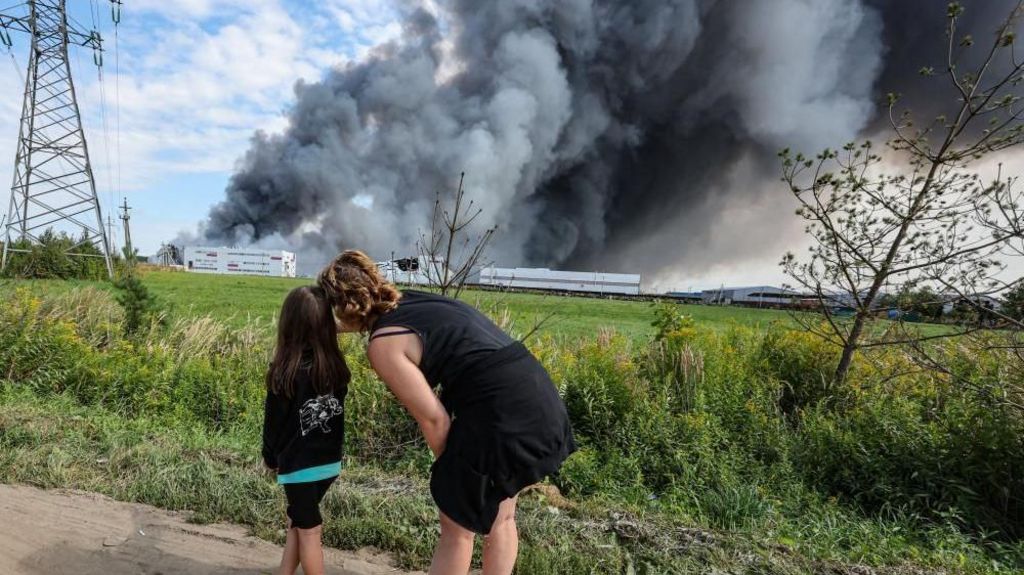
    On Saturday, regional authorities in Russia’s southern Krasnodar Krai confirmed that a Ukrainian drone assault sparked an overnight blaze at an oil terminal near the Black Sea port of Novorossiysk. According to local officials, falling wreckage from the downed drone ignited the fire, which also left two people injured. Officials did not immediately release the official name or exact location of the affected facility, but independent Russian news outlet Astra identified the terminal as Sheskharis, a major storage and export hub operated by Transneft, Russia’s state-run pipeline monopoly. The site serves as the final terminus for Transneft’s primary oil export pipelines running through southern Russia. Photographs shared by Astra show thick plumes of smoke rising above the terminal grounds, though the authenticity of the footage has not been independently verified. Ukraine has not yet issued an official statement confirming or denying responsibility for the Novorossiysk attack.

    This drone strike is part of a growing pattern of sustained attacks on Russian energy infrastructure, which analysts note is a core source of funding for Moscow’s ongoing invasion. In recent months, Kyiv has ramped up strikes on Russian oil and gas assets, a shift that comes as Ukraine has expanded its domestic development and deployment of mid- and long-range drone and missile systems to target Russian military and economic assets deep behind front lines. Attacks on key energy facilities linked to the Kremlin’s war budget have become a near-daily occurrence, according to open-source conflict tracking.

    In a separate development, pro-Moscow administrators in occupied Luhansk Oblast announced Saturday that the death toll from a Ukrainian drone strike on a college dormitory in Starobilsk, carried out overnight Friday, has risen to 11. Russian President Vladimir Putin condemned the attack during comments Friday, labeling it a deliberate “crime” against civilians and claiming that no military or law enforcement installations were located near the college building. Putin also ordered Russia’s top military leadership to draft a package of retaliatory measures in response to the strike.

    Russia requested an emergency session of the United Nations Security Council to address the Starobilsk attack, where the two countries traded sharp accusations over the incident. Ukrainian Ambassador to the U.N. Melnyk Andrii rejected Russian claims that Kyiv committed a war crime, dismissing the accusations as a “pure propaganda show.” He reaffirmed that Ukraine’s May 22 cross-border operations exclusively target infrastructure that supports Russia’s occupation and war effort.

    This escalation in drone operations on both sides comes amid ongoing international diplomatic wrangling over military and political support for Ukraine, with multiple Western powers debating new aid packages and potential pathways for peace talks. The Associated Press continues to cover all developments in the Russia-Ukraine war at its dedicated hub.

  • Pope Leo visits Italy’s ‘Land of Fires’ as families seek justice for children lost to toxic waste

    Pope Leo visits Italy’s ‘Land of Fires’ as families seek justice for children lost to toxic waste

    In the hard-hit region surrounding Naples, southern Italy, grieving families whose loved ones fell victim to pollution-linked cancer are gearing up to welcome Pope Leo XIV on a pastoral visit Saturday, bringing decades of pain, unaddressed anger and quiet demands for accountability after a massive mafia-controlled toxic dumping scheme destroyed their community.

    The pontiff’s trip to the infamously nicknamed Terra dei Fuochi — or Land of Fires — falls on the eve of the 11th anniversary of Pope Francis’ landmark environmental encyclical *Laudato Si’*, a clear signal that Leo intends to uphold the environmental justice agenda laid out by his predecessor. This long-overdue visit was first scheduled for Francis in 2020, but the COVID-19 pandemic forced its cancellation, leaving local families waiting four more years to share their story with the Vatican.

    The crisis at the heart of the visit stretches back more than 35 years. For generations, the region’s powerful Camorra crime syndicate has run a multibillion-euro illegal toxic waste operation, dumping, burying and burning hazardous materials across farmland and residential areas spanning 90 municipalities near Naples and Caserta, home to 2.9 million Italian residents. Last year, the European Court of Human Rights sided with local residents in a decades-long legal battle, confirming their claims that the mafia’s reckless activities caused sharply elevated rates of cancer and chronic life-threatening illnesses across the region.

    The court’s binding ruling delivered a sharp rebuke to Italian national authorities, finding that government officials had been aware of the widespread toxic contamination since 1988 but failed to intervene to protect public health, despite the Camorra’s well-documented control of the region’s waste disposal industry. The ruling ordered Italy to complete two key targeted actions within a two-year window: create a comprehensive public database mapping all known toxic waste sites, and conduct independent, verifiable assessments of the long-term health risks faced by people living in affected areas.

    For locals, the pope’s visit is not just a symbolic pastoral stop: it is a chance to put a human face on the environmental catastrophe that has decimated a generation of young people. In Acerra, the small city of 58,000 where the meeting will take place, local Bishop Antonio Di Donna estimates that roughly 150 young people have died from pollution-linked cancer over the past 30 years alone. Di Donna emphasized that these young deaths are not random health tragedies: they are direct, preventable consequences of criminal dumping and government inaction.

    “These children and young people who have died are, to all intents and purposes, victims of environmental pollution. There is a clear, proven correlation between the contamination here and the sky-high incidence of cancer,” Di Donna explained in remarks ahead of the visit.

    Among the families waiting to meet the pope is Angelo Venturato, whose 25-year-old daughter Maria died of cancer in 2016. Venturato says he does not seek personal comfort from the meeting — he wants to use the pontiff’s platform to push for change for the children and families who still live in the contaminated region.

    “I’d like to give these young people a future, so I’m asking for the pope’s help with this,” Venturato said. “That is, I’m making a strong appeal to him to go to those in power and say, ‘Look, let’s heal this land of fires.’”

    Filomena Carolla, who lost her 24-year-old daughter Tina De Angelis to cancer, will bring a handcrafted memory book filled with mementos of her daughter’s life to share with the pope. Carolla says she carries unending anger at the criminal actors and officials who allowed the poisoning to continue, robbing young people of their lives before they had a chance to grow up.

    “I’m just angry at the people who poisoned the soil, because what did our children have to do with it? What did they have to do with it, so young,” Carolla said.

    The visit marks one of the first high-profile actions signaling Pope Leo XIV’s commitment to environmental justice, an issue that has grown in priority for the Vatican in recent years, following Francis’ groundbreaking 2015 encyclical that tied care for the natural world to global social justice.

  • Fergie’s former racehorse enjoying a retirement with beaches and beer

    Fergie’s former racehorse enjoying a retirement with beaches and beer

    When Sir Alex Ferguson, the legendary former Manchester United manager, hung up his football coaching boots, he continued to find success across another sport: elite horse racing. Many of Ferguson’s former sporting champions have gone on to high-profile post-competition lives — from football icon Gary Neville’s prominent career as a television pundit to Eric Cantona’s unexpected turn as a Hollywood actor. But for one of Ferguson’s most decorated equine champions, retirement looks very different: quiet, relaxed days spent wandering Irish beaches and a small daily treat to cap off his dinner.

    Spirit Dancer, the powerful thoroughbred sired by racing legend Frankel, built a career that cemented his place as one of Ferguson’s most successful racehorses, racking up back-to-back victories at the Bahrain International Trophy in 2023 and 2024, and earning more than $2 million in total prize money along the way. But a career-ending fetlock sprain — an injury equivalent to a human ankle sprain — cut his racing days short in late 2024. After months of rest, rehabilitation, and medication, it became clear that the joint would never withstand the intensity of professional racing again, and the decision was made to retire the champion early.

    Rather than sending the gelding to a pasture in England, a personal connection brought him across the Irish Sea to the quiet coastal village of Rathmullan in County Donegal. That connection is Oisín Orr, the top jockey who partnered with Spirit Dancer for all of his biggest wins, and stepson of Donegal-based trainer Rachel Carton, who now cares for the horse. Orr, who grew up riding at Carton’s Rathmullan stables before taking a job with Spirit Dancer’s former English trainer Richard Fahey, arranged for the champion to retire at his childhood training grounds.

    Since arriving in Donegal, Spirit Dancer has adapted seamlessly to his new low-pressure life. Carton says the horse, who inherited the mellow, good-natured temperament of his famous sire Frankel (often called the “Usain Bolt of horse racing”), has settled in beautifully. He spends his days exploring the coastal countryside and strolling along sandy beaches, and has even picked up a unique new daily ritual: a few drops of locally brewed beer mixed into his dinner. Carton, who works at a well-known local brewery alongside training horses, says all of her horses enjoy the small treat, and Spirit Dancer is no exception.

    Carton describes Spirit Dancer as a step above most horses, noting that his steady temperament was just as much a key to his racing success as his natural talent. “Oisín was able to keep him calm and relaxed settled out the back of the field,” she explained. “He wasn’t using up any unnecessary energy, but when he was asked to go he would give it his all.” That same easygoing adaptability has made his transition to retirement smooth, with Carton saying he is curious, affectionate, and a pleasure to care for once he is out of the stables.

    Sir Alex Ferguson, who bred Spirit Dancer and watched him grow from a foal to a champion, has maintained a close connection to the horse. Carton says Ferguson, who spent decades working with elite human athletes in football, immediately recognized Spirit Dancer’s exceptional talent and temperament. Videos of the horse’s relaxed new routine are regularly sent back to Ferguson and former trainer Richard Fahey, and Carton says they’re sure the former football manager will be delighted to see his champion enjoying a well-earned retirement.

    For Orr, who credits his wins on Spirit Dancer with opening doors to international racing opportunities, moving the horse to Donegal was a natural choice. “Spirit Dancer has been a big part of my career since moving from Ireland to the UK. I was very fortunate to get on him,” Orr said, adding that he always knew the champion would love his new life on the Irish coast.

  • The Palme d’Or will be handed out Saturday in Cannes. Here’s what to look for

    The Palme d’Or will be handed out Saturday in Cannes. Here’s what to look for

    The 79th Cannes Film Festival, one of the most prestigious annual gatherings in global cinema, is set to conclude this Saturday with the coveted Palme d’Or award ceremony, the crowning honor of the international film calendar. This year, however, the race for the top prize has defied conventional expectations, with no clear favorite emerging from the 22 competing features – a dynamic that has left pundits and audiences guessing heading into the closing event.

    By widespread critical consensus, the 2025 edition of Cannes has not been considered among the festival’s standout years. Major Hollywood studios and A-list productions largely skipped this year’s lineup, draining some of the red carpet glitz and mainstream media buzz that typically surrounds the French Riviera event. Many of the officially selected competition titles also failed to deliver knockout reviews from attending critics, with the global cultural conversation that Cannes usually fuels far more muted than in past editions.

    Yet this lack of a consensus front-runner has opened up unprecedented flexibility for the nine-member jury, led by acclaimed South Korean director Park Chan-wook, who won the Palme d’Or himself in 2022 for *Decision to Leave*. A Palme d’Or victory is career-changing for any filmmaker: it instantly catapults a film’s global profile, brings major distribution offers across international markets, and often positions the winning work as an early contender for Academy Award recognition.

    Heading into the final days, several titles have risen to the top of critics’ prediction lists. These include Polish director Pawel Pawlikowski’s *Fatherland*, a black-and-white meditation on the intertwined fates of art and politics in post-World War II Europe; Japanese auteur Ryusuke Hamaguchi’s *All of a Sudden*, a sprawling three-hour tender drama centered on elder care; Russian filmmaker Andrey Zvyagintsev’s *Minotaur*, a gritty take on crime and moral reckoning in modern Russia; and Romanian director Cristian Mungiu’s *Fjord*, a tense thriller set in Norway that explores the failures of the country’s child welfare system.

    In a late twist on the festival’s penultimate day, a surprising dark horse candidate surged into contention. *The Black Ball*, directed by Spanish duo Javier Calvo and Javier Ambrossi, earned one of the most enthusiastic audience receptions of the entire 12-day event. The sweeping multi-generational drama follows the interconnected lives of three gay men from different eras, resonating deeply with viewers and emerging as a surprise fan favorite.

    Predicting the Palme d’Or has always been notoriously difficult, even when a clear favorite exists. Jury deliberations are held entirely behind closed doors, and any of the 22 competing films are eligible to take home the top honor. This year’s jury also boasts a diverse roster of global talent, including Oscar-winning director Chloé Zhao, actress Demi Moore and Swedish star Stellan Skarsgård, making their collective decision even harder to forecast.

    In the lead-up to Saturday’s ceremony, winning contenders are notified that they will receive an award but are not told which honor they will take home. In addition to the Palme d’Or, the jury will hand out awards for best actress, best actor, the Grand Prix, and other secondary honors, with standard festival practice dictating that only one award is granted per film.

    This year, one of the most remarkable streaks in modern cinema is also on the line: American independent distribution label Neon has backed the last six consecutive Palme d’Or winners. The streak includes 2024’s *Anora*, which went on to win the Oscar for Best Picture earlier this year, and 2025’s winner Jafar Panahi’s *It Was Just an Accident*. Whether the distribution company can extend its unprecedented run remains to be seen.

    The closing ceremony will also proceed with one notable absence. Legendary entertainer Barbra Streisand was originally scheduled to attend to receive an honorary Palme d’Or for her lifetime contribution to cinema, but a knee injury forced her to cancel her trip. Festival organizers have confirmed they will still proceed with the tribute to Streisand in her absence.

  • UK officials suggested single market for goods with Europe

    UK officials suggested single market for goods with Europe

    Months of public rhetoric from Prime Minister Keir Starmer and Chancellor Rachel Reeves calling for deeper post-Brexit economic integration with the European Union has now revealed an unexpectedly ambitious proposal from UK officials: the creation of a full single market for all goods trade between the two blocs, multiple sources familiar with the matter have confirmed to the BBC.

    The far-reaching plan was put forward by British negotiators as a potential core agenda item for the upcoming UK-EU summit scheduled for July, marking a sharp escalation of the UK’s ambition to unwind long-standing post-Brexit trade frictions. Until now, public discussions over the next phase of Brexit relations have centered on incremental improvements to existing arrangements, covering targeted sectors including agricultural products, food trade, electricity systems, and emissions trading. This newly disclosed proposal would go far beyond those incremental talks, aiming for full frictionless goods trade across the entire UK-EU economic border.

    However, the ambitious idea has failed to gain traction so far, after encountering significant skepticism from EU side. Industry leaders briefed on the negotiations say EU officials have already signaled the proposal is off the table under the UK’s current red lines, which include maintaining restrictions on the free movement of people – a core requirement for full single market membership. Negotiations are currently focused on working through the details of the more limited, sector-specific agreements already on the table, pushing the broader single goods market proposal to the back burner for the time being.

    Downing Street has not confirmed the exact details of private talks with EU representatives, but has acknowledged that a wide range of potential integration options have been presented to the bloc over recent months, and that constructive discussions are still ongoing. British business associations, which have long pushed for reduced post-Brexit trade barriers to cut costs for exporters and importers, have already been briefed on the proposal and the EU’s initial pushback.

    Some senior UK ministers have held out hope that shifting global political dynamics could create new flexibility for the plan down the line. They argue that recent changes to the United States’ strategic posture toward Europe have altered the geopolitical landscape, potentially making continental European capitals more open to revisiting closer economic ties with the UK.

    While a European Commission spokesperson declined to directly comment on the UK’s single market proposal when contacted by the Guardian, which first broke news of the plan, the spokesperson did note that the bloc sees room to deepen cooperation in areas including industrial defense, pointing to ongoing talks around a proposed loan package for Ukraine.

    The British government has already laid legal groundwork for deeper alignment with EU rules through the recently announced European Partnership Bill, unveiled in the latest King’s Speech. The legislation will create a formal framework to align UK and EU regulations in sectors covered by new post-Brexit agreements, starting with the ongoing food trade talks. The legal structure is designed to be flexible enough to accommodate alignment in additional sectors, if broader agreements are reached in future negotiations.

  • Race for French presidency sees ex-PM Philippe as early favourite to beat populists

    Race for French presidency sees ex-PM Philippe as early favourite to beat populists

    With exactly 12 months remaining until France heads to the polls to elect its next president, the most pressing question hanging over the race is whether any candidate can prevent the final runoff from devolving into a head-to-head clash between the hard left and hard right. As of now, polling consistently points to one figure as the answer: Emmanuel Macron’s former prime minister, centre-right politician Edouard Philippe.

    Recent public opinion surveys are unanimous: the 55-year-old leader of the small Horizons party is the sole centrist contender capable of defeating any hard-right National Rally (RN) candidate in the May 2026 second round, whether that be veteran party leader Marine Le Pen or her 30-year-old rising deputy Jordan Bardella. In every other projected matchup, all other centrist candidates would fall short, clearing the path for a populist-right head of state. Beyond that, Philippe is also the best-positioned candidate to block hard-left leader Jean-Luc Mélenchon from advancing to the runoff, eliminating the outcome that ranks as a nightmare for French business leaders and the country’s European Union partners: a binary choice between two far-flung radical extremes.

    For Philippe’s backers, these polling numbers make a clear case for him to emerge as the unified, natural candidate of France’s centre-right in the coming months. They expect other contenders occupying the same moderate political space to recognize his lead by the end of 2025 and gracefully exit the race to avoid splitting the centrist vote. Those potential rivals include former centrist prime minister Gabriel Attal, who formally launched his candidacy for Renaissance on May 23, and conservative Republicans hopeful Bruno Retailleau.

    The structure of France’s presidential election system makes this vote-splitting risk particularly catastrophic. In the first round of voting, all candidates appear on the ballot, with only the top two finishers advancing to the decisive runoff. When multiple candidates compete for the same demographic of voters, their support is fragmented, and all end up failing to qualify for the second round – a outcome that amounts to political suicide for the centre. This dynamic has existed throughout French political history, but it has grown far more acute in recent years as traditional mainstream left and right parties have been steadily displaced by populist movements on their ideological flanks.

    Mindful of the reality that early front-runner status in French presidential races is as often a curse as a blessing, Philippe has begun ramping up his campaign slowly and cautiously. Earlier this month, during a gathering in Reims, a city east of Paris, he unveiled his three senior campaign directors and launched his election slogan: “France Libre”, a distinctly Gaullist framing that nods to conservative French political tradition. On policy, Philippe leans clearly right on economic issues: he supports raising the retirement age beyond the current 64 years, and has proposed enshrining a requirement for balanced national budgets in law. Both policies would be put to early public referendums if he wins next year. In June, he plans an innovative campaign event: a mass “apartment meeting” that will beam his image directly into 1,000 private living rooms across the country, followed by his first official candidate rally in Paris on July 5.

    As a profile in Le Monde newspaper put it, Philippe’s core strategic goal is to cement a narrative of the race pitting him against the RN as the inevitable final matchup, casting himself as the only credible bulwark against far-right control of the presidency. But the path to the Elysee Palace is littered with far more unknowns than certainties, and it remains unlikely that the race will unfold as smoothly as Philippe’s supporters hope.

    First, there is no guarantee that his centre-right rivals will choose to step aside voluntarily. Even if they eventually exit, most are expected to stay in the race as long as possible to build their own political profiles, opening rifts within the centrist camp that radical candidates will be quick to exploit. For the moment, the challenge from the centre-left, made up of the Socialists and their allies, appears minor: the faction remains as divided as ever over candidate selection, with the real possibility that four or five different centre-left names will appear on the first-round ballot. But that could change: facing the threat of total electoral wipeout, the mainstream left could coalesce around a single unifying candidate such as MEP Raphael Glucksmann, leader of the small Place Publique party, who could draw moderate left-centre voters away from Philippe.

    Another complicating factor is the recently launched corruption investigation into Philippe’s conduct while serving as mayor of Le Havre, the major northern French port city. Philippe’s campaign team has denied the favoritism allegations outright and says they will contest the claims vigorously, but the cloud of investigation is unlikely to help his standing with voters.

    Most notably, any sober assessment of Philippe’s chances must acknowledge that the strongest political momentum in France ahead of next year’s election lies not in the moderate centre, but with the radical extremes – particularly on the right. Widespread anti-elite sentiment, persistent economic insecurity, rising social tensions, and declining access to public services have created fertile ground for candidates promising radical systemic change. For these movements, Philippe is an easy target: he is a walking symbol of the old established political order, having served as Macron’s prime minister from 2017 to 2020, and opponents never miss an opportunity to brand him as a loyal Macron loyalist.

    Two days after Philippe’s July 5 Paris rally, a critical pre-campaign milestone will arrive: an appeals court will deliver its verdict in the RN’s EU funds corruption trial, and the country will learn whether Le Pen will be found ineligible to run for office next year. Polling suggests that Le Pen’s eligibility status may barely shift the RN’s electoral fortunes; Bardella, the party’s young media-savvy leader, actually polls slightly better than Le Pen in hypothetical matchups. Philippe is widely reported to favor a Bardella candidacy, arguing that the 30-year-old’s relative inexperience will become a clear liability once full campaigning gets underway, in contrast to Le Pen – a 57-year-old seasoned campaigner with deep connections to voters across the country.

    The RN, a nationalist party, has campaigned on strict limits to immigration, including ending family reunification for migrant workers and repealing birthright citizenship. The party also officially supports rolling back the recent retirement age increase to return it to 62 years.

    On the opposite extreme, hard-left France Unbowed (LFI) leader Jean-Luc Mélenchon formally launched his candidacy earlier this month, promising that one of his first acts as president would be dismantling the media empires controlled by French billionaires such as Vincent Bolloré. The 70-year-old former minister is calling for steep new taxes on large corporations and France’s withdrawal from key EU rules, and has built a substantial support base in the high-immigration working-class banlieues surrounding major French cities, as well as among university-educated young people facing limited economic prospects. He came within a hair’s breadth of advancing to the 2022 runoff against Macron, and is convinced he will ultimately face off against Le Pen next year. “When the rest are gone, it’ll be me and her,” he has said.

    But if the race does end in that long-feared “battle of the extremes” pitting populist left against populist right, all polling points to one clear winner – and it is not Mélenchon.

  • Russia’s Putin vows retaliation after accusing Ukraine of hitting student dormitory

    Russia’s Putin vows retaliation after accusing Ukraine of hitting student dormitory

    A recent drone strike on the occupied Ukrainian town of Starobilsk has escalated cross-border tensions, with Russian authorities accusing Kyiv of targeting a civilian student dormitory and Ukrainian forces confirming the attack as a strike on an elite Russian military unit.

    According to Russian President Vladimir Putin, the overnight three-wave assault using 16 drones left six people dead, 39 wounded, and 15 others unaccounted for as of Friday. Putin emphatically rejected any suggestion that the damage to the building could have resulted from Russian air defense or electronic warfare countermeasures, claiming no military infrastructure was located near the collapsed structure in Luhansk Oblast. He has formally ordered Russia’s military leadership to draft immediate proposals for retaliation against Ukraine.

    Local officials installed by the Kremlin have released visual evidence showing the extent of the destruction, with emergency response teams combing through collapsed concrete rubble for survivors. Russian state media has also featured an interview with a 19-year-old identified as an injured student, Diana Shovkun, though no imagery has been released of the people Moscow says were killed in the incident.

    Kyiv’s account of the strike differs sharply from Moscow’s narrative. Ukraine’s military has openly acknowledged carrying out the attack, but says the target was the headquarters of Russia’s elite Rubicon drone unit. The Ukrainian statement adds that Rubicon forces have repeatedly launched attacks on Ukrainian civilian populations and infrastructure, and that Ukrainian military operations strictly follow international humanitarian law and the established customs of war.

    The Starobilsk strike follows just one day after Ukrainian President Volodymyr Zelensky announced another successful strike on Russian-occupied territory: a hit on a Federal Security Service (FSB) headquarters in Moscow-controlled southern Kherson Oblast. Zelensky claimed that the strike left roughly 100 Russian occupying personnel dead or injured. Russia’s military has not issued any official comment on the Kherson attack, though a pro-Kremlin Telegram channel has acknowledged unspecified casualties following what it described as a large-scale drone assault.

    Independent verification of either side’s claims has not been possible, as the BBC notes it cannot confirm details of the Starobilsk incident on the ground. This exchange of strikes comes amid a long-running war of words over civilian casualties that stretches back to the start of Russia’s 2022 full-scale invasion of Ukraine. Ukraine has repeatedly documented and condemned what it says are deliberate Russian strikes on civilian targets, a charge the Kremlin consistently denies. Just one week prior, Ukrainian officials reported that a Russian missile strike on a multi-story residential apartment building in Kyiv killed 24 people, including three young girls.

  • Senators from both parties push Hegseth for action on Ukraine aid

    Senators from both parties push Hegseth for action on Ukraine aid

    WASHINGTON — A cross-party coalition of U.S. senators is escalating pushback against the Department of Defense over unfulfilled congressional mandates to disburse $600 million in approved security assistance to Ukraine and three Baltic allies, delivering a formal demand letter Friday to Defense Secretary Pete Hegseth calling for the immediate release of the allocated funding. The standoff marks a deepening rift between Capitol Hill and the Trump administration, as lawmakers from both major political parties are demanding transparency and action on funding that was formally appropriated by Congress in the previous year: $400 million earmarked explicitly for Ukrainian defense capabilities, and an additional $200 million for regional defense programming in Estonia, Latvia, and Lithuania. Notably, even members of President Donald Trump’s own party have openly expressed frustration with the administration’s growing strategic disengagement from Ukraine and other Eastern European partner nations.

    In the joint letter led by top Democratic Sen. Dick Durbin and senior Republican Sen. Chuck Grassley, the lawmakers laid out the urgent case for unblocking the assistance: “Ukraine has persistently and bravely repelled a four-year Russian onslaught, but its military needs and deserves continued American support.” Four additional lawmakers — Republican Sens. Kevin Cramer and Thom Tillis, along with Democratic Sens. Michael Bennet and Catherine Cortez Masto — added their signatures to the bipartisan appeal.

    Weeks ago during a public congressional hearing, Hegseth informed lawmakers that the Ukraine funding had already been “released” and that a full spending outline would be delivered to Congress by mid-May. However, the senators confirm the Pentagon has missed its self-imposed May 15 deadline to share the mandated spending plan, prompting the formal protest.

    The coalition warned that further holdups carry severe strategic consequences, particularly amid reported plans for additional U.S. troop drawdowns in the region: “Any further delays — particularly as the Department reportedly plans troubling U.S. troops withdrawals from the region — risks our ability to adequately deter Russia.”

    This letter is the most recent public display of growing Republican discontent with the Trump administration within the Senate, coming on the heels of a week that saw the president endorse a primary challenger against incumbent Texas Sen. John Cornyn, a move that alienated dozens of sitting GOP lawmakers. In a public social media exchange with President Trump on Friday, Tillis pointed to the administration’s approach to Ukraine as one of several policies harming the Republican Party politically, specifically criticizing the White House for “Firing our very best generals and not holding Putin accountable for his systematic kidnapping, rape, torture, and murder of Ukrainian civilians.”

    Multiple Senate Republicans have also broken with Hegseth over his firing last month of Army Chief of Staff Gen. Randy George, a senior officer who had led efforts to update the Army’s battlefield doctrine to integrate modern drone warfare and had collaborated closely with Ukrainian military forces to incorporate battlefield lessons from the ongoing war.

    On the House side of Congress, a Democratic-led proposal that would impose sweeping new sanctions on Russia and authorize an additional $1 billion in military aid to Ukraine has been gaining traction among cross-party lawmakers. While the full House package is considered unlikely to pass into law in the current legislative session, it has amplified the growing pressure from Capitol Hill for sustained U.S. backing for Ukraine’s defense effort.

    Though the $400 million in blocked aid to Ukraine makes up a small share of the multi-billion dollar assistance packages Congress authorized in the immediate aftermath of Russia’s full-scale invasion, the standoff over the funding has taken on outsized symbolic importance for lawmakers as a public test of ongoing U.S. commitment to Kyiv and regional security in Eastern Europe.

  • Right-wing Slovenian politician confirmed as prime minister in shift from liberal government

    Right-wing Slovenian politician confirmed as prime minister in shift from liberal government

    After two months of political gridlock following a tightly contested parliamentary election, Slovenia’s national assembly has appointed veteran right-wing populist leader Janez Jansa to the post of prime minister, marking a sharp ideological shift for the small Alpine European Union member state previously led by a liberal administration.

    The 90-member legislative body cast 51 votes in favor of Jansa’s appointment, with 36 lawmakers voting against the nomination. The new prime minister-designate now has a 15-day window to put forward his proposed cabinet lineup, which will require a second confirmatory vote in parliament before the government can officially take office.

    The political stalemate that followed April’s election followed an almost evenly split result. Former liberal prime minister Robert Golob’s Freedom Movement secured a razor-thin plurality in the vote, but failed to cobble together a workable parliamentary majority to form a new government. This week, Jansa’s Slovenian Democratic Party broke the impasse by signing a formal coalition agreement with multiple aligned right-wing factions. The incoming government also secures outside support from the non-establishment Truth party, a group that originated as an anti-vaccination movement during the height of the COVID-19 pandemic.

    Friday’s appointment marks the fourth term as prime minister for the 67-year-old veteran politician, who is known for his open admiration of former U.S. President Donald Trump and long-standing close political alliance with Hungary’s populist former prime minister Viktor Orbán — who suffered a landslide election defeat just one month prior.

    In his post-appointment address to parliament, Jansa outlined his administration’s core priorities: revitalizing the national economy, cracking down on systemic corruption and bureaucratic red tape, and decentralizing state power to regional and local authorities. He has pledged to cut taxes for high-income earners and expand state support for private education and private healthcare providers. Jansa sharply criticized the outgoing liberal government for what he called widespread inefficiency, promising his leadership would transform Slovenia into “a country of opportunity, prosperity and justice, where each responsible citizen will feel safe and accepted.”

    Like his political ally Orbán, Jansa adopted a hardline anti-immigration stance during the 2015 European migrant crisis, and during his 2020-2022 previous term as prime minister, he faced repeated accusations of undermining independent democratic institutions and restricting press freedom. Those allegations sparked large-scale public protests across Slovenia at the time, and triggered formal oversight scrutiny from EU institutional bodies.

    Outgoing prime minister Golob used his address to parliament to issue a stark warning about Jansa’s leadership, framing the right-wing leader as “the greatest threat to Slovenia’s sovereignty and democracy.” Golob also claimed Jansa had previously threatened to have him arrested, arguing that Jansa’s vision of democracy “is that anyone who dares speak a word against you deserves only the worst.”

    Beyond domestic policy, Jansa is a vocal supporter of Israel, and has been a prominent critic of the outgoing Golob administration’s 2024 decision to formally recognize a Palestinian state. The April parliamentary election that set this political process in motion was marred by widespread allegations of foreign interference and campaign corruption, leaving the nation of roughly 2 million people deeply ideologically divided between liberal and conservative political blocs.