标签: Europe

欧洲

  • A barge carrying Timmy the humpback whale begins journey to the North Sea

    A barge carrying Timmy the humpback whale begins journey to the North Sea

    BERLIN – For nearly five months, a wayward humpback whale that wandered hundreds of kilometers off its natural migration route has captured global public attention, and on Wednesday, a long-planned rescue operation finally moved the ailing animal one step closer to its intended home in the Atlantic Ocean.

    Nicknamed Timmy by German media outlets, the young humpback was first spotted off Germany’s Baltic Sea coast on March 3, thousands of kilometers from the cool Atlantic waters that make up the species’ native habitat. Since its unexpected arrival, Timmy has faced repeated stranding events in the region’s shallow coastal waters, and its overall health has steadily declined. Multiple earlier attempts to guide the whale out to deeper open water failed, with every step of these efforts streamed live to audiences around the world, turning the stranded mammal into an international headline maker.

    According to Germany’s national press agency dpa, rescuers worked for hours on Tuesday to secure the whale with heavy-duty straps and pull it through a specially dredged channel onto a flooded cargo barge, marking the start of the most ambitious rescue attempt to date. By early Wednesday morning, the barge had already reached the northern German island of Fehmarn, which sits just a short distance from Danish territorial waters. From there, the vessel will travel around the northern tip of Denmark, through the Skagerrak Strait, before reaching the North Sea, where the whale is scheduled to be released to make its own way back to the Atlantic.

    The high-stakes operation has sparked widespread public and scientific debate across Germany, dividing experts, officials and animal welfare activists over the best course of action for the ailing whale. Till Backhaus, environment minister for the northeastern state of Mecklenburg-Vorpommern, where Timmy has been stranded, publicly threw his support behind the private rescue initiative that planned the transport, even saying Tuesday that he was “on the verge of jumping into the water to help the whale get through the last few meters.” Despite warnings from some scientific experts that the stress of the transport could be fatal for the already weakened animal, Backhaus greenlit the operation following sustained pressure from activists, who held public protests on Wismar beaches demanding the whale be rescued and returned to its natural habitat.

    Critics of the operation, however, argue that repeated rescue attempts have only caused unnecessary suffering for Timmy, who many scientists confirm is severely ill. Thilo Maack, a marine biologist with the environmental organization Greenpeace, told the Associated Press earlier in the month that the ongoing interventions have already placed extreme, harmful stress on the animal. “I believe the whale will die very soon now. And I would also like to raise the question: What is actually so bad about that?” Maack said. “Yes, animals live, animals die. This animal is really, really very, very, very sick. And it has decided to seek rest.” Many scientists have echoed this position, noting that Timmy likely sought out shallow coastal waters intentionally because his declining health left him too weak to swim further and he needed to rest. Still, the veterinary team working with the private rescue initiative maintains that the whale is healthy enough to withstand the multi-day journey to the North Sea, leaving the final outcome uncertain as the barge continues north.

  • EU chief warns billions could be wasted if energy aid is not well targeted as the Iran war bites

    EU chief warns billions could be wasted if energy aid is not well targeted as the Iran war bites

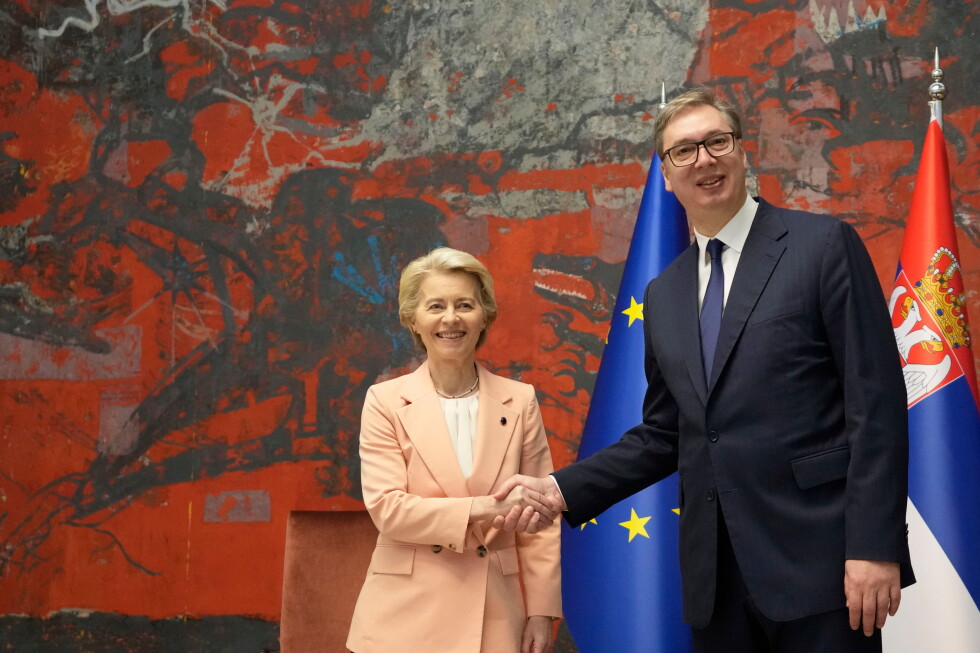
    STRASBOURG, France – As escalating Middle East tensions roil global oil and gas markets, European Commission President Ursula von der Leyen has issued a urgent warning to European Union member states: billions of euros in energy relief will go to waste unless aid is prioritized exclusively for vulnerable households and energy-reliant industries. Speaking to EU lawmakers in Strasbourg on Wednesday, von der Leyen framed the new energy volatility sparked by Middle East conflict as a critical test of the bloc’s ability to learn from costly mistakes made during the 2022 Russian energy crisis.
    The ongoing conflict in the Middle East, compounded by potential disruption to shipping through the Strait of Hormuz — a critical chokepoint through which roughly a fifth of the world’s daily oil supplies pass — is already extracting a heavy economic toll from the 27-nation bloc. Current estimates put the daily cost of elevated energy prices at close to 500 million euros (equivalent to $600 million), pushing up retail fuel prices for consumers and triggering widespread warnings that jet fuel supplies could run critically low within weeks.
    Von der Leyen stressed that the EU cannot repeat the missteps of 2022, when Russia cut natural gas exports to Europe in retaliation for the bloc’s support of Ukraine. At that time, member states allocated more than 350 billion euros to broad, untargeted energy relief programs that strained national budgets without delivering support to the groups that needed it most. “So let us not make the same mistake again, and let’s focus our support where it matters most,” she told the assembled legislators.
    Beyond short-term relief policy, von der Leyen used the address to double down on the bloc’s push for full energy independence, noting that just as Europe successfully broke its reliance on Russian fossil fuels after 2022, it must now cut broader dependence on imported fossil fuels by scaling up domestic low-carbon energy sources. “Our over dependency on imported fossil fuels makes us vulnerable,” she said, pointing to wind, solar, and nuclear power as the core of a secure domestic energy future.
    Progress in cutting Russian energy reliance already speaks to what the bloc can achieve, von der Leyen noted. Since 2022, Russian gas imports to the EU have plummeted from 45% of total imports to just 12% in 2023. Coal imports from Russia were fully eliminated via sanctions, while oil imports have dropped from 27% of the bloc’s total in 2022 to just 2% today — with only Hungary and Slovakia continuing to receive Russian crude under limited exemptions.
    Von der Leyen warned that the economic ripple effects of the current Middle East energy shock “may echo for months or even years to come.” The only long-term solution, she argued, is expanding “homegrown, affordable, clean energy supply from renewables to nuclear.” She called on member states to transition more end-uses — from passenger and air transport to residential heating and industrial production — to electricity generated from domestic low-carbon sources, a shift that would undercut global fossil fuel price volatility. Currently, electricity accounts for less than a quarter of the EU’s total final energy consumption, leaving massive room for expansion.
    The gravity of the current crisis has been clear from top EU energy officials for days. Last week, EU Energy Commissioner Dan Jørgensen emphasized that the current shock is far more than a temporary minor price blip. “This is a crisis that is probably as serious as the 1973 and the 2022 crises combined,” he said, noting that Europe has been forced into a defensive position with limited control over geopolitical developments in the Middle East. “Even in a best-case scenario, it’s still bad,” Jørgensen added. “Whether or not we will be in a security of supply crisis is primarily a result of what goes on in the Middle East. What we can do is to try and prevent, and limit the damage.”

  • Europol task force nets 280 arrests as ‘violence for hire’ spreads across Europe

    Europol task force nets 280 arrests as ‘violence for hire’ spreads across Europe

    THE HAGUE, Netherlands — In a landmark first year of operations targeting an emerging dangerous trend in European organized crime, an international law enforcement task force focused on dismantling ‘violence as a criminal service’ networks has secured 280 arrests, Europol, the European Union’s law enforcement cooperation agency, announced Wednesday.

    The widespread arrests have pulled back the curtain on a growing cross-continental criminal pattern: criminal organizations are increasingly recruiting people — disproportionately young people — through social media platforms and encrypted messaging apps to carry out violent attacks, from brutal physical assaults to targeted assassinations. Europol officials have framed this model as a disturbing, illicit twist on the gig economy, where violence is contracted out on demand rather than planned and executed by established local criminal gangs alone.

    In an official statement, Europol emphasized that this shifting criminal landscape has moved far beyond the traditional boundaries of isolated, local incidents of violence. “Violence is no longer confined to isolated acts or local dynamics. It is increasingly offered as a service: accessible, scalable and driven by online ecosystems that enable recruitment, coordination, and execution across borders,” the agency noted.

    Launched one year ago, the task force brings together specialized law enforcement units from 11 European nations: Belgium, Denmark, Finland, France, Germany, Iceland, the Netherlands, Norway, Spain, Sweden, and the United Kingdom. Over its first 12 months of coordinated investigations, the joint operation has identified more than 1,400 individuals tied to these transnational violence-for-hire networks.

    Among the high-profile arrests made through the task force’s work are a Dutch national charged with acting as a getaway driver for two minors suspected of carrying out a series of explosions across Germany in mid-2025. In a separate cross-border case, a minor was taken into custody in Sweden earlier this year in connection with a shooting outside a prison in the Dutch city of Alphen aan den Rijn.

    Beyond the arrests already completed, Europol has added three top suspected network leaders to Europe’s most-wanted online portal. Two of the men are Swedish nationals, and the third is German. All three are wanted on charges including murder, large-scale drug trafficking, and money laundering for their alleged leadership roles within the illicit violence-as-a-service structure.

  • Ferragamo expands leather mapping efforts as EU sustainability rules take shape

    Ferragamo expands leather mapping efforts as EU sustainability rules take shape

    MILAN – Iconic Italian luxury fashion house Ferragamo has announced a landmark progress for the global fashion industry: it has successfully mapped the country of origin for more than 80% of the leather used in its signature footwear and handbag lines, marking one of the most ambitious early moves toward full material traceability amid incoming European Union sustainability regulations.

    The milestone, detailed in the brand’s 2025 sustainability report released on March 31, represents the first time Ferragamo has published formal traceability data for its core material – a particularly challenging resource to track compared to common textile fibers like cotton, according to industry experts. The development comes as a growing wave of EU sustainability legislation is ratcheting up pressure on all fashion brands to map every step of their supply chains, from raw material extraction to end-of-life product disposal.

    A century-old family legacy of innovation
    Founded in Florence in 1927 by Salvatore Ferragamo, who built his reputation as a shoemaker for A-list Hollywood stars including Marilyn Monroe and Judy Garland after years working in the United States, the brand has long adapted to material constraints. During World War II, widespread leather shortages pushed the founder to experiment with unconventional alternatives, using wicker as a leather substitute and cork for shoe soles, notes James Ferragamo, the founder’s grandson and the brand’s current chief transformation and sustainability officer.

    Today, leather goods and footwear remain Ferragamo’s core business, accounting for 86% of the company’s 2025 total sales of €976.5 million ($1.1 billion). The brand first launched its leather traceability pilot in 2024, starting with the calf leather used for its iconic Fiamma handbag, tracking the material all the way from cattle breeding to final product assembly.

    Building traceability to meet upcoming regulatory demands
    For 2025, Ferragamo partnered with its key strategic tanneries – which collectively supply 80% of the hides the brand purchases – to roll out the origin mapping project, relying on standardized supplier declarations to document where raw materials are sourced. Across all materials, including cotton, silk and nylon, 81% of Ferragamo’s inputs are already third-party certified under global sustainability standards. The vast majority of the brand’s traced leather originates in Europe, and the company’s approach has already brought it further along the compliance path than many peers in the luxury sector.

    “Currently, there is no one-size-fits-all technological solution that can trace every single piece of leather all the way back to the individual birth farm of the cow,” explained Davide Triacca, Ferragamo’s sustainability director. “We achieved this result through a consistent, highly targeted effort, and today we can trace the origin of more than 80% of all the leather we source.”

    James Ferragamo emphasized that leather, when sourced responsibly, can be a leading sustainable material for fashion. “Most of our partner tanneries already manage water use responsibly, maintain fair labor practices, audit their own upstream suppliers to avoid sourcing from regions impacted by deforestation, and adhere to strict standards for animal welfare and responsible cattle breeding,” he said.

    Industry context: Traceability as the foundation of circular fashion
    Sustainability experts frame traceability as the non-negotiable first step for the fashion industry as it adapts to the EU’s upcoming sweeping sustainability framework, which will eventually require brands to prove their products are sustainable across every stage of their lifecycle, with compliance phased in over the coming years. Full implementation of the new rules will eventually require the industry to shift to a fully circular economy, with mandates to extend product lifespans through repair services, improve end-of-life management via recycling and upcycling, and ban the destruction of unsold inventory for large companies generating more than €40 million in annual revenue.

    “Traceability is an absolutely essential factor, but it is not the end goal on its own,” explained Francesca Rinaldi, a sustainability scholar at Milan’s Bocconi University and director of the Monitor for Circular Fashion. “It is the foundational requirement that makes broader sustainability and circularity practices possible. Any company that cannot trace its materials does not truly understand its own supply chain, and opens itself up to valid criticism of greenwashing.”

    Experts note that Ferragamo’s country-level origin mapping is an early-stage milestone, not full chain-of-custody traceability that the EU may eventually require, and the bloc does not currently mandate leather traceability at all. Still, the move positions Ferragamo ahead of regulatory deadlines and industry trends.

    Continuing experimentation for future sustainable materials
    Ferragamo’s traceability project is just the latest step in the brand’s decade-plus work on sustainability, which has included annual sustainability reporting for more than 10 years and ongoing experimentation with alternative materials. Past innovations include a 2017 capsule collection using silky textiles derived from orange citrus fibers, the Nova men’s tote crafted from nylon made from castor oil rather than fossil fuels, and the Back to Earth collection, which features the brand’s popular Hug handbag dyed with plant-based vegetable dyes.

    “Our research and development work is ongoing – it’s a constant process that never stops,” James Ferragamo said. “We are always testing new approaches and new materials, and not every experimental material will be ready for commercial release right away. But that doesn’t mean we stop experimenting.”

  • Russia to hold Victory Day parade without military equipment for 1st time since invading Ukraine

    Russia to hold Victory Day parade without military equipment for 1st time since invading Ukraine

    For the first time since Russia launched its full-scale incursion into Ukraine in 2022, Moscow will forgo rolling armored vehicles, artillery, and nuclear missile systems across Red Square for its iconic annual May 9 Victory Day parade, the Russian Defense Ministry announced in a statement released late Tuesday. The event, which marks the 81st anniversary of Nazi Germany’s defeat in World War II, will proceed without the traditional procession of military equipment and exclude cadet participants, with the ministry only citing the “current operational situation” as justification for the change and offering no additional details.

    The scaled-back parade will still include marching contingents of service members from all branches of Russia’s armed forces and the country’s military higher education institutions, as well as the signature ceremonial flyover of military aircraft, the ministry confirmed.

    Victory Day, which commemorates the Soviet Union’s victory over Nazi Germany in the 1941–1945 Great Patriotic War, stands as Russia’s most widely revered secular national holiday. Unlike many divisive events in modern Russian history, the legacy of World War II victory unites political factions across the ideological spectrum, and the Kremlin has long leveraged this shared national sentiment to bolster collective pride and reinforce Russia’s standing as a major global power. The Soviet Union suffered an estimated 27 million civilian and military casualties during the conflict, a catastrophic loss that remains etched deeply into the Russian national collective psyche.

    For more than 25 years of his leadership, President Vladimir Putin has elevated May 9 celebrations to a central symbolic pillar of his administration, and has repeatedly invoked the legacy of World War II to frame and justify his current military campaign in Ukraine.

    Last year’s parade marked the largest display of Russian military might since the full-scale invasion of Ukraine began, drawing more international heads of state to Moscow than any event in the previous decade. High-profile global leaders including Chinese President Xi Jinping, Brazilian President Luiz Inácio Lula da Silva, and Slovakia’s Prime Minister Robert Fico attended the 2025 event, which featured more than 11,500 marching troops and over 180 pieces of military hardware. The display included frontline equipment actively used in Ukraine, such as main battle tanks, armored infantry vehicles, and artillery systems, alongside strategic assets including Yars intercontinental ballistic missile launchers armed with nuclear warheads and military drones. A full squadron of fighter jets also conducted the traditional flyover over Red Square.

    In advance of last year’s parade, Putin announced a unilateral 72-hour ceasefire in Ukraine starting May 7, and Russian authorities shut down cellular internet access across Moscow for multiple days to reduce the risk of targeted Ukrainian drone strikes on the capital. The 2024 parade, by contrast, was already significantly scaled back, with a reduced troop contingent, far less equipment on display, and no aerial flyover component.

  • Can Griezmann end his Atletico love story in style?

    Can Griezmann end his Atletico love story in style?

    As Atletico Madrid gears up for a high-stakes first leg of the UEFA Champions League semi-final against Arsenal, all eyes in European football are fixed on Antoine Griezmann – the club legend who will bring his decades-long Atletico Madrid career to a close at the end of the 2024-2025 season to join MLS side Orlando City.

    The depth of the bond between Griezmann, the club, and long-time manager Diego Simeone was laid bare in an unscripted, rare moment before Atletico’s quarter-final clash against Barcelona. With the packed media room waiting for questions to begin, Simeone opened the press conference with an emotional, unscheduled tribute to the departing forward that left Griezmann visibly surprised.

    “I want to thank you for your hard work and your humility,” the Argentine manager said. “You are an admirable person in a society where young people need role models like you. Thank you for everything you have given us, everything you continue to give, and everything you still will.”

    While Orlando City had pushed for Griezmann to make the move to the United States earlier in the year, the 2018 FIFA World Cup winner with France insisted on staying in Madrid through the end of the campaign. The choice has allowed him to say a proper goodbye to the fanbase that has supported him through two spells at the club, where he has racked up 494 senior appearances and 212 goals to become Atletico’s all-time top goalscorer.

    Griezmann’s entire senior club career has been spent in Spain’s La Liga. He launched his professional journey at Real Sociedad in 2009, before a near-transfer that changed the entire trajectory of his career: in 2013, while still at Real Sociedad, he came agonizingly close to joining Arsenal under Arsene Wenger, as he revealed in his autobiography. After waiting through the entire transfer window for the move to materialize, Arsenal pulled out of the deal hours before the window closed. When the London side expressed interest again years later, Griezmann turned them down outright, still stinging from the earlier snub. A year later, he signed with Atletico Madrid for a reported €30 million fee, a move that would define his legendary career.

    After joining Atletico in 2014, Griezmann made a high-profile switch to Barcelona in 2019, only to return to Atletico on loan in 2021, before making the transfer permanent 12 months later. Despite the messy, unpopular nature of his first departure, his return won fans over entirely: he apologized for the exit, reconnected with the supporter base, and rebuilt his legacy as the heart of the club.

    As BBC Sport columnist Guillem Balague notes, Griezmann’s significance to Atletico extends far beyond his goal tally. He is widely regarded as the embodiment of everything the club stands for: perfectly matching Simeone’s ideal of a player who combines world-class talent with relentless work rate, total team commitment, and a willingness to prioritize collective success over individual glory. For an entire generation of Atletico fans, Griezmann *is* the club, and his leadership has lifted every player around him throughout his tenure.

    Unlike many modern legends whose legacies are defined by a long list of major trophies, Griezmann’s legacy is built on character and consistency rather than silverware. During his time at the club, he lifted the UEFA Europa League, UEFA Super Cup, and Spanish Super Cup, but his lasting impact comes from his alignment with Atletico’s underdog identity. Even when he left for Barcelona, he has since said he felt like he had left home, a testament to how deep his connection to the club runs.

    After Atletico secured their semi-final spot by beating Barcelona in the quarter-final, Griezmann gave fans one more unforgettable moment: as the rest of the squad headed down the tunnel after the final whistle, he ran back out onto the pitch at the Metropolitano Stadium to the roar of the crowd, applauding the stands before dancing and celebrating with his teammates, soaking in the moment with the fans who supported him through every chapter of his tenure.

    Now, with one of the biggest matches of his final season looming against Arsenal – the club that almost signed him 12 years ago – Griezmann is eyeing a fairytale ending. Neither Atletico nor Arsenal have ever won the Champions League; Atletico fell at the final hurdle in 1974, 2014, and 2016, and Griezmann has said that lifting the trophy this year would “heal a very deep wound” for the club.

    With his Atletico career winding down, the question remains: will the semi-final against Arsenal be the final chapter of Griezmann’s Champions League story, or will he carry Atletico through to the final in Budapest for one last shot at the biggest prize in European football?

  • King Charles III and Queen Camilla visiting 9/11 Memorial and other NYC landmarks as part of US trip

    King Charles III and Queen Camilla visiting 9/11 Memorial and other NYC landmarks as part of US trip

    LONDON, NEW YORK – Three days into their landmark first state visit to the United States as Britain’s reigning monarch and queen consort, King Charles III and Queen Camilla will arrive in New York City on Wednesday, a mid-trip stop that carries deep symbolic and diplomatic weight amid the 250th anniversary of American independence. This occasion marks the first time a sitting British monarch has visited New York since the late Queen Elizabeth II’s 2010 trip, drawing close international attention to the royal couple’s packed schedule of commemorative, charitable and diplomatic activities.

    The visit’s New York leg opens with a solemn wreath-laying ceremony at the National September 11 Memorial, timed ahead of the 25th anniversary of the 2001 terror attacks. During the event, the royal couple will meet with first responders who survived the attacks and family members of those killed, with New York City Mayor Zohran Mamdani and other high-ranking local and national dignitaries also in attendance.

    Following the memorial service, the royal pair will split for separate, themed engagements tailored to their individual public priorities. Queen Camilla will travel to the New York Public Library, where she will officially donate a new stuffed Roo doll to the institution’s iconic collection of original Winnie-the-Pooh toys. The donation comes as the beloved children’s literary franchise celebrates its centennial this year. The five original plush toys already on display at the library – Winnie-the-Pooh, Piglet, Tigger, Eeyore and Kanga – once belonged to Christopher Robin Milne, son of Winnie-the-Pooh creator A.A. Milne, and directly inspired the characters that appear in Milne’s classic 1920s children’s books. Donated to the library in 1987, the collection has become one of the most popular centerpieces of its world-famous children’s literature holdings. Roo, the young son of Kanga in the original stories, was the only original character plush that has not survived to the present day.

    For his part, King Charles will first tour a community after-school urban farming program that supports young people impacted by food insecurity, aligning with his long-standing focus on sustainability and youth opportunity. He will then hold a meeting with top business and finance leaders in Manhattan, before the couple reunites for a reception hosted by The King’s Trust, the global youth charity Charles founded in 1976 to support vulnerable young people across the Commonwealth and beyond.

    This four-day U.S. visit is King Charles’ first state visit to the country since he acceded to the throne following his mother’s death in 2022. The late Queen Elizabeth II completed four full state visits to the United States during her 70-year reign. The trip was scheduled to mark the 250th anniversary of the United States’ declaration of independence from British rule, a milestone that diplomats have framed as an opportunity to celebrate the long-standing close alliance between the two nations.

    The royal couple has already completed multiple high-profile events in Washington D.C. earlier this week. On Monday, they joined President Donald Trump and First Lady Melania Trump for a formal tea at the White House. A day later, King Charles held a closed-door bilateral meeting with President Trump in the Oval Office, before delivering a rare address to a joint session of U.S. Congress – an honor only granted to a handful of foreign heads of state, and the first time a British monarch has addressed Congress since Queen Elizabeth II’s 1991 speech. The day concluded with a formal state dinner hosted by the Trump administration at the White House.

    After wrapping up their New York engagements, the royal pair will travel to Virginia for additional stops before returning to the White House on Thursday for a formal farewell ceremony hosted by President Trump. Following the conclusion of his U.S. visit, King Charles will travel alone to Bermuda for his first visit to a British Overseas Territory as reigning monarch.

  • A record-breaking semi-final – the antidote to modern football?

    A record-breaking semi-final – the antidote to modern football?

    The world of football rarely serves up a contest that redefines why millions fall in love with the beautiful game, but Paris Saint-Germain and Bayern Munich delivered exactly that in a record-breaking 5-4 Champions League semi-final first leg at Parc des Princes that will be talked about for generations.

    This nine-goal spectacle marked the highest-scoring Champions League semi-final since Eintracht Frankfurt’s 6-3 win over Rangers in the 1959-60 European Cup, and made history as the first major European semi-final where both sides hit the back of the net at least four times. It is also only the second Champions League knockout match ever to see such a glut of goals, following Chelsea and Liverpool’s iconic 4-4 quarter-final draw in 2008-09. Even more remarkably, this clash pitted the two highest-scoring teams of the 2025-26 campaign against each other, with both having already notched more than 40 goals across the tournament before kick-off – a first in the competition’s history.

    Even before the first whistle blew, the stage was set for something special. Both sets of supporters unveiled towering pre-match tifos: PSG’s carried the bold slogan “the conquest of Europe”, while Bayern’s banner urged their players to “give everything” – a promise both teams delivered on in chaotic, thrilling fashion. In a breathless first half that left pundits and fans stunned, the two sides traded goals blow for blow, putting five on the scoreboard by the break. Harry Kane opened the scoring from the penalty spot, only for Khvicha Kvaratskhelia to level with a clinical finish. Joao Neves’ glancing header put Bayern ahead once more, before a moment of individual magic from Michael Olise restored parity. A controversial late first-half penalty, awarded after Alphonso Davies was judged to have handled an Ousmane Dembele cross, saw Dembele convert calmly to put PSG 3-2 up at half-time. Though the decision was widely debated, it was ultimately overshadowed by what former England captain Alan Shearer called one of the greatest halves of football he had ever witnessed. “I can’t stop smiling at how open and bonkers this game is,” Shearer said on Amazon Prime. “It’s one of the greatest games I’ve ever been to. Two teams that believe in their own ability to outscore their opponent.”

    The chaos did not let up after the restart. Kvaratskhelia and Dembele both found the net again to push PSG to a seemingly unassailable 5-2 lead, leaving many to assume the tie was all but settled ahead of next week’s return leg in Munich. But Bayern Munich, champions of Germany and hungry for their first Champions League title since 2020, refused to crumble. A late fightback led by goals from Dayot Upamecano and Brahim Diaz cut PSG’s lead to a single goal, silencing the home crowd and keeping the tie very much alive. The final result leaves PSG with a slim advantage heading to the Allianz Arena next week, but Bayern’s comeback has set up a tense decider for a place in the Budapest final.

    For PSG manager Luis Enrique, the match was the most exciting of his 15-year coaching career. “It was amazing. I think it was the best match I have ever managed as a coach,” he said post-match. “It had amazing rhythm, trying to play offensive football, trying to show our quality. I think everybody had fun watching the match. I’m happy because we won. OK, we are not happy as a coach when you concede four goals, but I’m happy because we won.”

    Bayern boss Vincent Kompany acknowledged his side’s defensive fragility but praised their attacking courage, saying: “We suffered but we were dangerous. Five goals away from home in the Champions League normally means you’re out but the chances we had, made us believe. I’ve seen a lot of good defending today but the game is such fine margins, you either go full into the battles, or retreat fully. The in-between doesn’t work against that level of players.”

    The result has sparked debate among pundits over the quality of defending on show. While Kane praised his side’s defensive effort despite Bayern conceding five goals – the first time they have done that in the Champions League since 1994-95 – former England forward Wayne Rooney pushed back on that claim. “I love Harry Kane but there is no way he can be praising his defenders. The defending from both teams was really bad, I think he is being modest there.”

    Beyond the immediate drama, the match served as a refreshing counterpoint to a Champions League campaign that has seen set-piece goals, deep defensive blocks and pragmatic low-scoring football dominate. Where most 2025-26 ties have prioritized defensive organization over attacking adventure, PSG and Bayern threw that playbook out to deliver the kind of end-to-end attacking football that captivates neutral fans. It is a style that is unlikely to be replicated in the week’s second semi-final between Arsenal and Atletico Madrid, however. Both sides have built their campaigns on defensive resilience, with Arsenal racking up a league-leading number of clean sheets this season. Former AC Milan and Real Madrid midfielder Clarence Seedorf noted that the London side’s solid defensive foundation could be the key to their progression. “If there is a team that could bring it home, it could be them,” he said.

    Fans can catch full highlights of this historic clash from 22:00 Wednesday on BBC iPlayer, the BBC Sport website and app, with a special Champions League Match of the Day airing on BBC One from 22:40 to 00:00 Wednesday.

  • Watch: Elderly woman rescued by robot from Ukraine’s frontline

    Watch: Elderly woman rescued by robot from Ukraine’s frontline

    In a striking display of how modern technology is reshaping wartime humanitarian operations, an elderly woman has been pulled to safety from a frontline area in Ukraine by an unmanned rescue robot, after military drones first spotted her trapped near active combat zones. The woman had been stuck in her heavily damaged village, which has been ravaged by months of ongoing fighting, and was attempting to flee the dangerous area when the Ukrainian military’s surveillance system detected her location.

    Rather than risking the lives of human rescue personnel to reach the vulnerable civilian in the active conflict zone, military command made the decision to deploy the specialized robotic rescue platform to complete the extraction mission. The operation marks one of the first publicly documented instances of an autonomous robotic system being used for frontline civilian rescue in the ongoing Russia-Ukraine conflict, highlighting how armed forces are increasingly integrating unmanned technology into humanitarian missions alongside combat operations to reduce risks to both rescuers and civilians.

    Footage of the mission, which has been shared by Ukrainian military sources, shows the robot navigating the rubble-strewn streets of the abandoned village to reach the woman, before guiding her to a safe extraction point where she could be moved away from the frontline. Local military officials have noted that many elderly civilians remain trapped in frontline settlements, unwilling or unable to leave their homes even as intense fighting continues around them, creating complex risks for rescue teams that unmanned systems can help mitigate.

  • Ex-TV showgirl’s pardon at centre of widening Italian scandal

    Ex-TV showgirl’s pardon at centre of widening Italian scandal

    A presidential pardon granted to a former associate of late Italian Prime Minister Silvio Berlusconi has erupted into a major political controversy, forcing Italy’s head of state to call for an immediate explanation from the country’s justice department. Nicole Minetti, a former television personality who was convicted over her role in the infamous “bunga bunga” sex parties scandal more than a decade ago, received the clemency from President Sergio Mattarella in February. The pardon, however, has now come under intense scrutiny after an investigative report by Italian outlet Il Fatto Quotidiano exposed potential fraud in the application, throwing the entire process into question and dragging Italy’s highest political office into the unfolding drama.

    Minetti’s conviction dates back to 2014, when she was found guilty of both facilitating prostitution for the private parties held at Berlusconi’s Milan-area villa and embezzling hundreds of thousands of euros in public funds. She was handed a total sentence of three years and 11 months in prison, which was suspended during her appeal process. Last year, she submitted a formal request for a presidential pardon, arguing that she and her partner needed to care for an adopted child with severe health issues, a claim the newspaper’s investigation has now called into question.

    According to Il Fatto Quotidiano’s reporting, Minetti submitted false information to support her humanitarian appeal for clemency. The outlet claims she misrepresented the child’s background, stating he was abandoned at birth when court records confirm his biological parents are still alive, though they live in extreme poverty. The report also notes that while Minetti claimed the child had received preliminary medical evaluations in Italy before traveling to the U.S. for treatment, no official records of these consultations have been found, and irregularities have also been uncovered in the Uruguayan adoption process.

    By Tuesday, the controversy had advanced to a formal criminal investigation: Milan prosecutors confirmed they had contacted Interpol as part of their probe into allegations of false declarations tied to the pardon. In Italy, presidential pardons are granted based on formal advice and vetting from the justice ministry and prosecuting authorities, meaning President Mattarella relies entirely on the recommendations of government bodies when approving clemency requests. This institutional structure has now put ruling government officials directly in the political crosshairs.

    The timing of the scandal could hardly be worse for Prime Minister Giorgia Meloni’s right-wing government. Meloni’s administration is already reeling from a major defeat in a recent constitutional referendum on judicial reform, a loss that has cut into the government’s public support and left it scrambling to rebuild momentum. Already facing widespread criticism over the referendum result, the emerging pardon scandal has given new ammunition to opposition parties, who are now demanding the resignation of Justice Minister Carlo Nordio, the top official who signed off on the recommendation for Minetti’s pardon.

    Opposition lawmakers have argued that Nordio’s ministry failed in its duty to vet the pardon application, and that the subsequent scandal has damaged the reputation of the Italian presidency. “The justice minister must step down before he causes further harm to the country’s institutions,” opposition leaders have publicly stated. While Minetti has forcefully denied all allegations of wrongdoing, calling the newspaper’s claims “unfounded and seriously damaging to my personal and family reputation” in a statement issued through her lawyer to Italy’s ANSA news agency, the political pressure on the government continues to mount.

    The justice ministry’s deputy leader, Francesco Paolo Sisto, has defended the government’s initial handling of the case, pushing back against claims of ministerial negligence. Sisto explained that the decision to launch a new investigation came only after new, unreported evidence of potential misconduct by Minetti emerged. He confirmed that the re-investigation will specifically examine whether the newly uncovered irregularities fundamentally invalidate the original case that was made to support granting the pardon.

    Minetti’s connection to Berlusconi stretches back more than 15 years. A qualified dental hygienist as well as a former showgirl, she first treated Berlusconi in 2009 after he was assaulted at a public rally in Milan. The following year, the then-prime minister tapped her to run as a regional councilor in Lombardy for his ruling People of Freedom party. She later became a central figure in the “Ruby Gate” scandal that brought down Berlusconi’s government: in 2010, Berlusconi sent Minetti to a Milan police station to collect 17-year-old Moroccan dancer Karima El Mahroug, also known as Ruby, who had been arrested on theft charges. Berlusconi falsely claimed the teen was the niece of the Egyptian president to secure her release, sparking a years-long legal battle that ultimately ended with a guilty verdict that was later overturned on appeal.