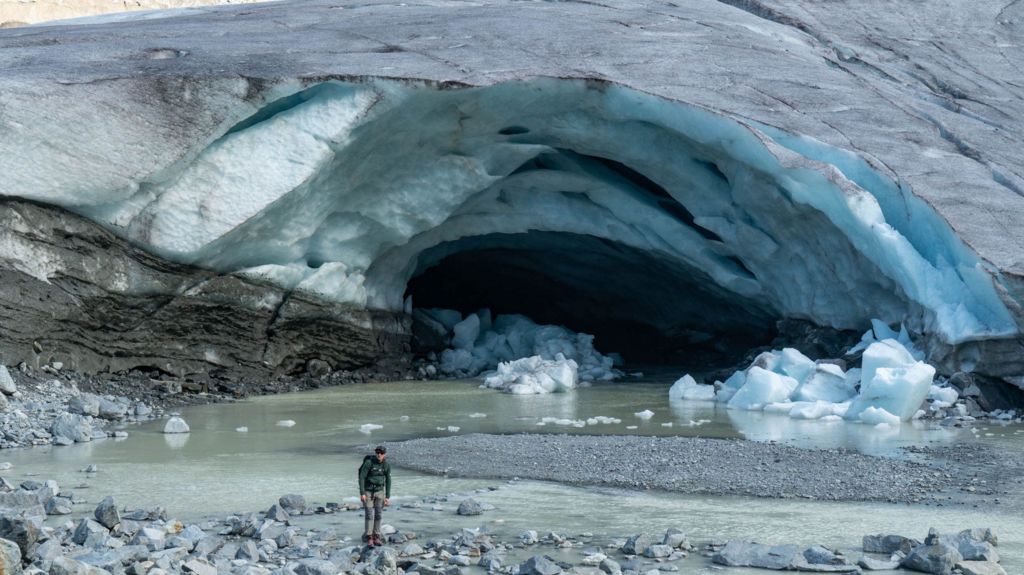
A newly released scientific report from Glacier Monitoring Switzerland has delivered a stark warning about the accelerating impacts of human-caused climate change, revealing that Swiss glaciers suffered one of the most severe annual ice losses on record in 2026, driven by a string of intense summer heatwaves across the European Alps.
Researchers estimate that approximately 5.5% of all remaining glacier ice across Switzerland has vanished over the past 12 months — a rate more than double the threshold glaciologists once considered “extreme” for a single year of melt. Dr. Matthias Huss, director of Glacier Monitoring Switzerland and lead author of the report, described the scale of loss as simply “disastrous.”
The rapid melt was fueled by a perfect storm of unfavorable conditions that left glaciers exposed to extreme solar heating. The region entered the summer season already vulnerable, after an unusually mild winter left far less snow cover than the historical average. When early, intense heatwaves hit in May and June, the sparse remaining snow melted away rapidly, uncovering the darker glacier ice beneath. Unlike bright, reflective fresh snow that bounces solar energy back into space, bare ice absorbs far more heat, creating a feedback loop that accelerates melting even as subsequent heatwaves move through the region.
Even more alarming is the observation of total snow loss at the highest-altitude measurement sites, some as elevated as 3,500 meters above sea level. Traditionally, these high elevations remain covered in year-round snow, which gradually compacts into new ice to replenish ice that melts at lower, warmer altitudes — a natural balancing process that sustains glaciers over time. This year, researchers recorded up to four meters of ice loss even at these highest points, with no surviving summer snow to build new glacial mass. “Snow is like glacier food,” Huss explained. Without annual snow accumulation, glaciers cannot replace lost ice, and will inevitably shrink to nothing over time.
Glaciologists have long expected Alpine glaciers to retreat amid global warming driven by fossil fuel emissions, but the unprecedented speed of the 2026 melt has shocked even seasoned researchers. “Ten years ago, I wouldn’t have thought that it’s possible to lose glaciers so quickly,” said Dr. Fabien Maussion, a glaciologist at the University of Bristol who was not involved in the new report. While he called the summer’s melt “extremely distressing,” Maussion added that the outcome aligns with longstanding climate model projections.
The rapid ice loss carries serious long-term risks for Swiss communities and infrastructure, beyond the loss of iconic alpine landscapes. Scientists warn that continued glacier retreat will eventually threaten reliable water supplies for agricultural irrigation, hydropower generation and inland water transport. Over the 2026 summer, between July and September, melting Swiss glaciers released an estimated 2.2 trillion liters of meltwater, which helped ease short-term water shortages across the region during the heatwave. But Huss emphasized that this abundant water is a finite resource drawn from ice that accumulated over centuries or decades. “Every drop of water that runs off during these heatwaves is kind of old water that’s been stocked in the glacier ice centuries or decades ago,” he said. “It’s helping us [now] but it’s unsustainable, so we won’t have it at [our] disposal in the next heatwave.”
Already, low water levels in the Rhine River this summer set new records, disrupting commercial shipping routes and driving up transport costs across the region. Glacier melt also increases geological risk: long-term thinning of glaciers and thawing of frozen alpine ground raises the likelihood of bedrock instability, which can trigger catastrophic landslides and flash flooding — a risk that was realized in a deadly event in Nepal this past August, when a combined collapse of glacial ice and bedrock caused widespread damage.
Multiple Alpine glaciers, including eastern Switzerland’s Plattalva, have already disappeared completely, and researchers confirm that current global temperatures are already too warm to save many smaller Alpine glaciers from vanishing in coming decades. However, the scientific team stressed that urgent, deep cuts to global carbon emissions can still preserve the majority of the world’s remaining glacier ice, particularly in the Himalayas and polar regions that hold most of the planet’s total ice volume. “There we still can make a big difference with protecting the climate,” Huss said. “If these ice masses can be saved or stabilised, we can limit the rise of global sea levels… which could affect billions of people living along the coast.”