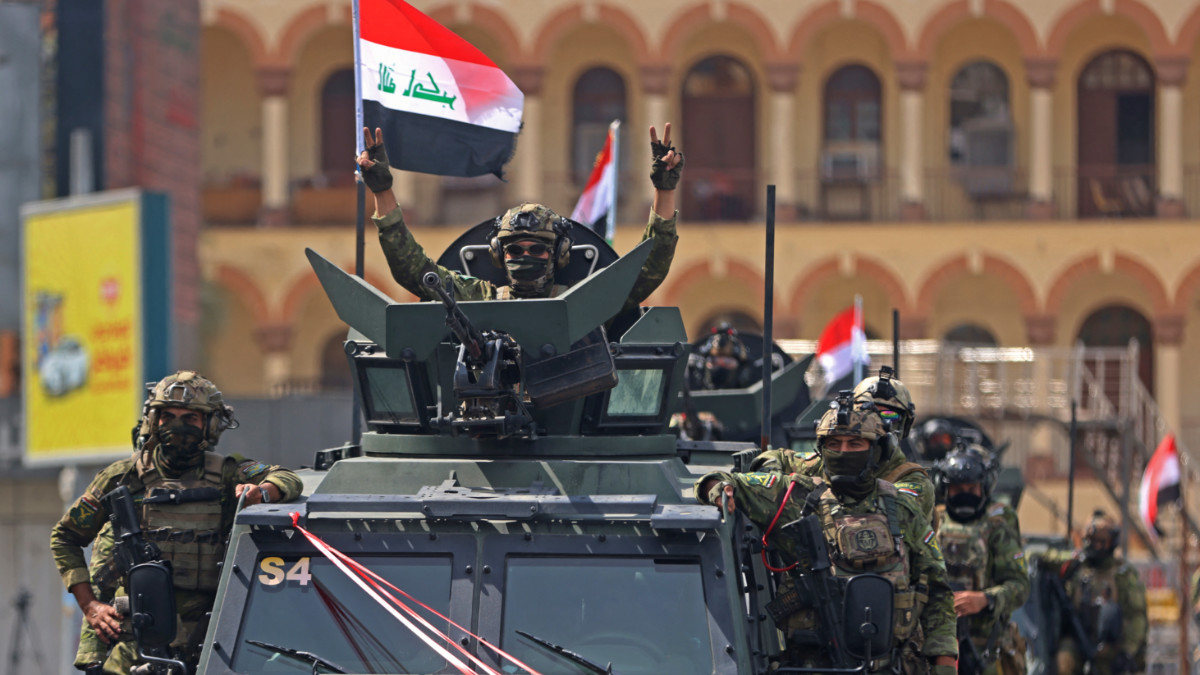
Twenty-two years after the United States launched a full-scale invasion of Iraq to overthrow then-president Saddam Hussein, Washington has finalized the withdrawal of its last remaining military forces from the country, closing out a two-decade-long intervention that has reshaped the Middle East at staggering human and financial cost. The exit brings an official end to America’s decades-long military combat mission in Iraq, a milestone that Baghdad has framed as a core step toward restoring full national sovereignty after years of foreign occupation.
In an official statement released Wednesday, the Pentagon confirmed that the United States and its coalition partners have formally concluded Operation Inherent Resolve in Iraq, aligning the withdrawal with the terms of a joint US-Iraq agreement reached in September 2024 and advancing core US national interests. The US military footprint in Iraq has shifted repeatedly over the past two decades: Washington first ousted Hussein and occupied the country in 2003, initially pulled all combat forces out in 2011, then redeployed troops three years later at the invitation of the Iraqi government to combat the rapid expansion of the Islamic State (IS) militant group, which had seized nearly a third of Iraqi territory at its peak.
The drawdown process began in 2025, with US forces relocating from key bases including Ain al-Asad in Anbar Province and the Victory Base Complex adjacent to Baghdad International Airport, before completing the full exit from all Iraqi territory including the semi-autonomous Kurdistan region in northern Iraq. Established as a semi-autonomous entity within Iraq under the country’s 2005 constitution, Iraqi Kurdistan operates its own independent governing institutions, including a local prime minister, president, and dedicated security force known as the Peshmerga.
Pentagon spokesman Sean Parnell emphasized that the full withdrawal marks a strategic transition, shifting from a US-led wartime coalition mission to an Iraqi-led security framework backed by a normalized bilateral security partnership between the two countries. For years, successive Iraqi governments have prioritized a full US troop withdrawal as a non-negotiable demand tied to national sovereignty, particularly as Baghdad works to cement post-IS recovery and rebuild state authority across the country.
Iraqi Prime Minister Ali al-Zaidi praised the conclusion of the US mission at a formal ceremony Wednesday, framing the withdrawal as the start of a new era for the country. “A new phase has begun, defined by Iraq’s sovereignty, the strength of its institutions, the readiness of its forces, unity of decision-making, and balanced partnerships with its friends,” Zaidi said. He also announced that October 1 will be designated as a new national holiday, “Sovereignty Day”, to mark the milestone. Earlier this week, leaders of Iraq’s executive, legislative, and judicial branches jointly described the occasion as a moment that “affirms the completion of Iraq’s path toward sovereignty and consolidates the presence of the state and its institutions.”
Beyond security, Zaidi has prioritized expanding economic cooperation with the United States. In July, during an official visit to Washington, the two governments formally announced a joint plan to revive a historic oil pipeline connecting Iraq to Syria, a project first reported exclusively by Middle East Eye.
The full withdrawal fulfills a longstanding campaign promise by former president and current US leader Donald Trump, who has made ending America’s so-called “forever wars” in the Middle East a central plank of his political agenda. Notably, however, Trump oversaw the largest Middle East conflict in decades earlier this year, launching joint military strikes against Iran alongside Israel in February that reshaped security dynamics across the Gulf region.
The strikes triggered retaliatory attacks from Iran that targeted US military bases across six Gulf nations and neighboring Jordan, raising new questions about the long-term future of America’s military footprint in the Gulf, where Washington has maintained decades-long security alliances with major oil-producing states including Saudi Arabia, the United Arab Emirates, Qatar, and Bahrain. Earlier this month, the US Department of Defense’s inspector general released a report confirming that Iranian attacks destroyed hundreds of structures at US bases across the region. The report noted that it remains unclear whether all damaged infrastructure will be rebuilt, or which party will cover the reconstruction costs, and estimated that the 2025 Iran conflict has cost US taxpayers a total of $33.4 billion to date.
As the US exits, Zaidi’s government is moving forward with a contentious domestic plan to disarm unregulated paramilitary militias that hold significant influence across Iraq. The initiative originally set a September 30, 2025 deadline for all non-state armed factions to hand over weapons, but the deadline was recently extended to June 30, 2027 amid ongoing negotiations to “regulate” weapons held outside of formal state control.
The Popular Mobilisation Forces, a coalition of paramilitary groups that originally formed a decade ago to fight the Islamic State, have since become deeply integrated into Iraq’s political system, drawing formal salaries from the Iraqi state budget. Most factions within the alliance are aligned with Iran’s “Axis of Resistance”, and US and regional officials have linked the groups to drone strikes carried out earlier this year during the height of US-Iran tensions. Kuwait blamed Iraqi militias for multiple drone attacks on its territory, while Saudi Arabia held the groups responsible for a strike that temporarily shut down its critical East-West oil pipeline.
This report is based on original independent coverage from Middle East Eye, a media outlet focused on unrivaled independent reporting and analysis of the Middle East, North Africa, and global affairs related to the region.