Against the backdrop of a rapidly aging population and a fast-growing domestic robotics industry, southern Beijing’s Beijing Economic-Technological Development Area – widely known as Beijing E-Town – has launched an ambitious pilot project to test how smart technology can transform eldercare services for local communities. The 1,100-square-meter smart eldercare hub, which opened its doors in March in the district’s Ronghua subdistrict, blends the functions of a community activity center, a cutting-edge robotics showroom and a prototype nursing facility, marking one of China’s first large-scale trials of integrated robotic care for older adults.
Ronghua subdistrict, like many urban areas across China, faces stark demographic shifts: official data shows more than 25 percent of its residents are aged 60 and above, with that share rising to 35 percent in some residential neighborhoods. To address growing demand for eldercare that goes beyond the basic assistance offered by traditional community care stations, local officials decided to leverage Beijing E-Town’s global reputation as a leading robotics manufacturing and innovation hub by integrating local tech firms’ products into daily elder services.
The facility operates through a unique three-party collaboration model designed to combine public oversight, private sector efficiency and industry innovation. The local subdistrict government provides core funding and regulatory oversight, while a private service operator manages day-to-day operations for visitors. A state-backed platform called the “Robot Mall” curates and supplies robotic systems from 24 different domestic robotics companies, creating a living testing ground for new eldercare-focused technologies.
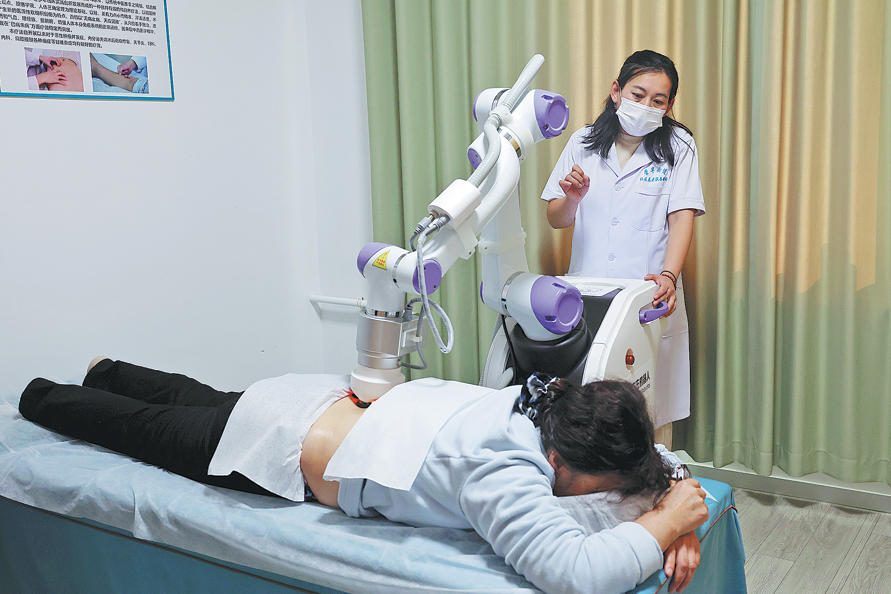
To date, 43 distinct robots have been rolled out across the hub’s four floors, serving a wide range of needs from dining to recreation to rehabilitation. At the ground-floor cafeteria, a stainless-steel robotic chef handles automated stir-frying with consistent mechanical precision, never requiring a day off, while an automated pancake-maker greets visitors near the entrance. On the third floor, AI-powered massage robots offer on-demand therapeutic care, and the fourth floor houses powered exoskeleton suits designed to support older adults with limited mobility. A robotic chess opponent in the recreation room provides interactive entertainment for visitors looking for leisure activity.
Unlike traditional eldercare facilities, this pilot hub is designed to iterate quickly based on user feedback. In the first month of operation alone, around 10 of the deployed robots were pulled from service for adjustments and modifications to better meet the needs of older visitors.
For many older visitors like 74-year-old Ren, who travels an hour by bus from her home to visit the hub for a second time, the facility already solves a common everyday challenge for aging adults: access to affordable, nutritious daily meals. “The cafeteria is very good, and the food is delicious,” Ren said. She initially came to the hub to address what she calls the “dining problem” that many older adults face when cooking for themselves becomes difficult. “When I can’t take care of myself anymore, then I’ll think about how to get through those days. For now, I just need good meals.” While Ren has not yet tried the facility’s high-tech rehabilitation and massage robots, she embodies the target user group that Beijing E-Town is aiming to serve with this smart eldercare model, which seeks to match the district’s robust robotics innovation capacity to the pressing national need for expanded, high-quality eldercare.
As China’s population continues to age, policymakers and industry leaders are increasingly turning to technological solutions to ease strain on traditional care systems, and the successful refinement of this model could see it rolled out to other communities across the country in coming years.