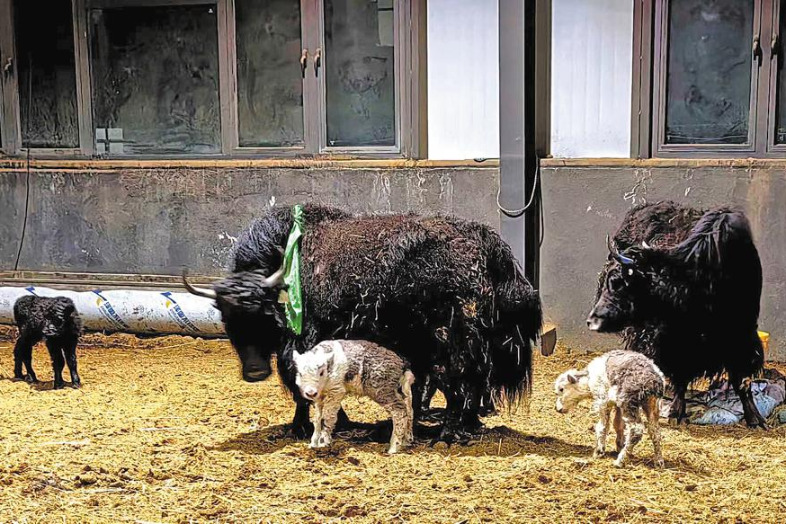
A groundbreaking advancement in large mammal cloning for high-altitude livestock has set China on a path to expand its population of elite cloned yaks to more than 100 by 2028, marking a key step toward the industrial application of the new breeding technology, according to lead researchers on the project.
The ambitious roadmap was unveiled by Fang Shengguo, a professor in the College of Life Sciences at Zhejiang University who heads the research initiative, coming shortly after China achieved its first successful batch cloning and natural delivery of 10 cloned yak calves in Damxung (Damshung) County, located in Lhasa, Tibet Autonomous Region. All 10 calves were carried to full term and born naturally between March 25 and April 15, a milestone that signals the technology has moved from isolated experimental success to small-scale, replicable commercial-ready production.
Fang explained that the project will progress from its current “1-to-10” experimental phase to the “10-to-100+” scaling phase by 2028. By the end of the target period, the team aims to establish a core population of more than 100 superior cloned yaks, selected through whole-genome sequencing analysis, develop the first stabilized improved yak strain optimized for high-altitude plateau conditions, and formalize standardized commercial cloning and breeding protocols for the industry.
This latest breakthrough builds on the 2025 birth of the world’s first cloned yak, named “Nam Co No 1”, which delivered the first proof that somatic cell cloning technology can be successfully applied to plateau-adapted livestock. “Nam Co No 1” has already demonstrated exceptional growth performance: it weighed 16.75 kilograms at birth, and reached 183.25 kilograms just nine months later, confirming the viability of the cloned breeding approach. To date, the research program has produced 11 healthy cloned yak calves and successfully established a stable somatic cell bank to support long-term breeding work.
The technology developed by the team integrates two cutting-edge genomic and reproductive techniques: whole genome selection and somatic cell cloning. To identify the most desirable starting genetics, researchers sequenced the genomes of nearly 9,000 yaks across Tibet to pinpoint top-tier “seed yaks” that carry highly desirable traits, including faster growth rates, stronger reproductive performance, natural disease resistance, and exceptional adaptation to the extreme low-oxygen high-altitude environment. These elite genetic profiles are then replicated exactly through cloning, allowing for precise and rapid propagation of superior livestock that cannot be achieved through conventional breeding.
Compared to traditional selective yak breeding, which typically takes 20 to 30 years to produce a stable improved strain, this new cloning-assisted method cuts the entire breeding cycle to just five years while enabling far faster expansion of high-quality breeding populations, Fang noted.
Local industry leaders say this technological breakthrough solves decades-long challenges that have held back Tibet’s yak industry. According to Hu Ke, head of Damxung County, unregulated cross-breeding and environmental shifts have led to gradual degradation of native yak genetic resources over the past 30 years, resulting in widespread declines in average body size, adult weight, fertility, and disease resistance across regional herds. At the same time, conventional selective breeding methods have proven too slow and inefficient to reverse these declines at a pace that matches industry needs.
“This breakthrough opens an entirely new technological pathway for rescuing and conserving native yak genetic resources, and for accelerating the expansion of improved breeds across the plateau,” Hu stated. He added that the achievement also fills a long-empty gap in cloning technology for large mammals at high altitudes, with broader implications beyond the yak industry: it supports plateau biodiversity conservation, creates new opportunities to boost the income of local herding communities, and aligns with regional ecological conservation goals for the Qinghai-Tibet Plateau.
To support the scaling of the technology, Fang’s team has laid out clear next steps: ramping up in vitro embryo production, expanding the pool of healthy surrogate cows, and developing customized forage systems tailored to the needs of the new improved yak strain. On April 27, a dedicated Yak Breeding and Germplasm Conservation Innovation Center was officially inaugurated at the project’s base in Damxung, which sits 4,300 meters above sea level and is currently home to all cloned yak calves.
Moving forward, Damxung County will deepen industry-academia-research collaboration to accelerate the development of large-scale high-quality yak breeding bases and build a national-level innovation hub for high-altitude livestock breeding, Hu confirmed.
As a species endemic exclusively to the Qinghai-Tibet Plateau, yaks are far more than livestock for the region: they are the primary source of livelihood for millions of local herding households, and play a critical role in maintaining the ecological balance of the plateau’s fragile high-altitude ecosystems.