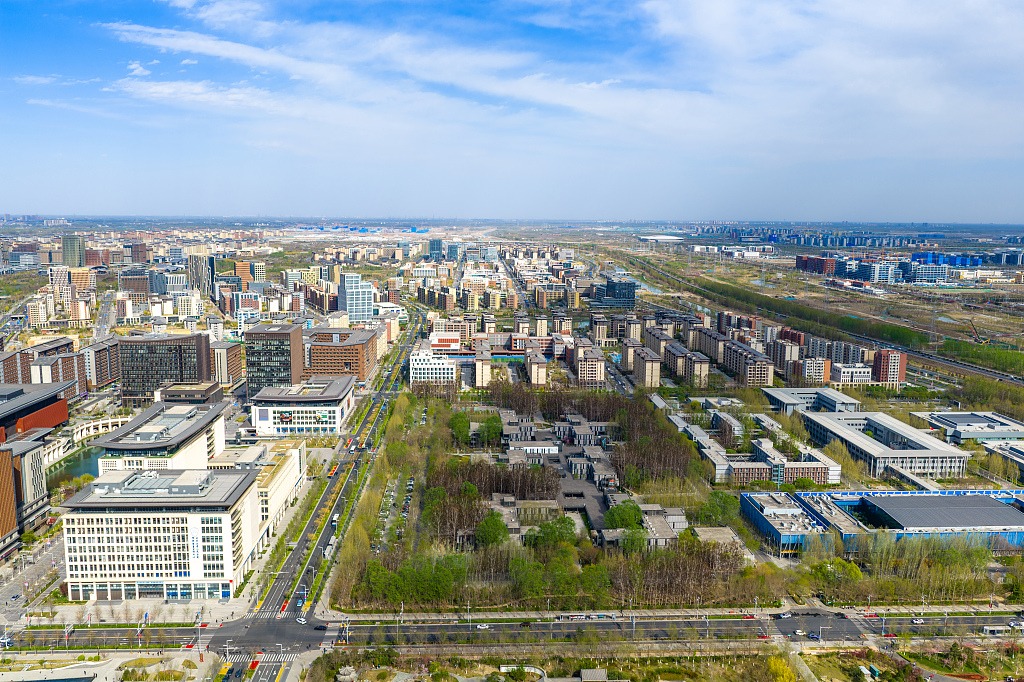
At a recent press conference held in Shijiazhuang, the capital of Hebei Province, provincial authorities unveiled their ambitious five-year development roadmap centered on advancing two key national strategies: the high-quality growth of the Xiong’an New Area and the deepening of coordinated development across the Beijing-Tianjin-Hebei region. Outlining priority work for the 15th Five-Year Plan period spanning 2026 to 2030, Hebei Governor Wang Zhengpu announced that the province will mobilize all necessary resources to transform Xiong’an into a leading national innovation hub and a benchmark example of high-quality development for the new era.
A core strategic mission of Xiong’an’s development remains serving as a designated承载 zone for Beijing’s non-capital functions that have been planned for relocation. Wang detailed that provincial authorities will revise and improve master planning frameworks and supporting service systems for organizations relocating to the new area, continue steady progress on construction and launch of the first and second batches of relocation projects, and roll out the third batch of projects to maintain orderly, continuous development momentum.
To make the new area attractive and welcoming for relocated teams and workers, Hebei will refine and optimize relocation support policies, and deepen integrated development with Beijing to ensure that relocated employees enjoy access to housing conditions and public services that match the high standards available in Beijing. “Our ultimate goal is to shift from the pattern of just individuals moving to the whole family relocating together, so that new residents can put down roots and truly make Xiong’an their home,” Wang explained.
Early signs of progress and tangible benefits are already emerging after years of targeted development. China Datang Group Technology Innovation Co., a subsidiary of state-owned power giant China Datang Co., completed its relocation from Beijing to Xiong’an in late 2023. Liu Haiyang, deputy director of the company’s hydrogen preparation research institute, shared that the firm currently employs 85 people, nearly 70 of whom are research staff holding master’s degrees or doctorates. Thanks to generous housing subsidies for relocated enterprises and highly streamlined administrative approval services in the new area, the company has been able to expand its research and development focus on cutting-edge future energy sectors including hydrogen energy and grid energy storage, Liu added.
Beyond the core Xiong’an New Area, other regions across Hebei are also actively taking on non-capital functions relocated from Beijing, advancing the coordinated development strategy across the entire region. For example, the Cangzhou Biomedical Industrial Park, located around 150 kilometers southeast of Xiong’an, has already attracted 49 biomedical enterprises relocated from Beijing and Tianjin, successfully realizing the development model of “R&D in Beijing and Tianjin, manufacturing in Cangzhou”, according to Hebei Executive Vice Governor Zhao Chenxin. Zhao added that Hebei is continuing to deepen this cross-regional collaboration model of “research and innovation in Beijing-Tianjin, industrial transformation in Hebei”. Data shows that in 2025, the total value of technology contracts signed between Hebei and its two neighboring municipalities exceeded 120 billion yuan (equivalent to approximately 17.6 billion U.S. dollars), representing a year-on-year increase of 16.4 percent.
A second innovative development model gaining significant traction across Hebei is the province’s “shared intelligent manufacturing” framework, which is driving upgrading of county-level industrial clusters across the province. Hebei Vice Governor Zhao Dachun explained that under this model, small and medium-sized enterprises (SMEs) share access to expensive production equipment, joint R&D platforms, and even national and global market distribution channels, transforming the historic pattern of cutthroat competition into mutually beneficial win-win cooperation.
This innovative model has already delivered striking operational results. In Qinghe County, a specialized production base for cashmere products, a central shared factory equipped with 4,500 automated knitting machines can now fulfill a custom order for 200 cashmere sweaters within a single working day, a level of efficiency that would be impossible for most small individual manufacturers. Hebei plans to scale this shared manufacturing model across a wider range of industries in the coming years. By 2030, the combined total revenue of the province’s 107 key county-level industrial clusters is projected to reach 5 trillion yuan, and Hebei aims to retain its position as one of the provinces with the largest number of national-level competitive industrial clusters in China. A core focus of this expansion will be smart upgrading, Zhao Dachun noted, with artificial intelligence and big data technologies deployed to build a digital “industrial brain” that streamlines and optimizes procurement, R&D, production, and corporate financing processes for all participating SMEs.