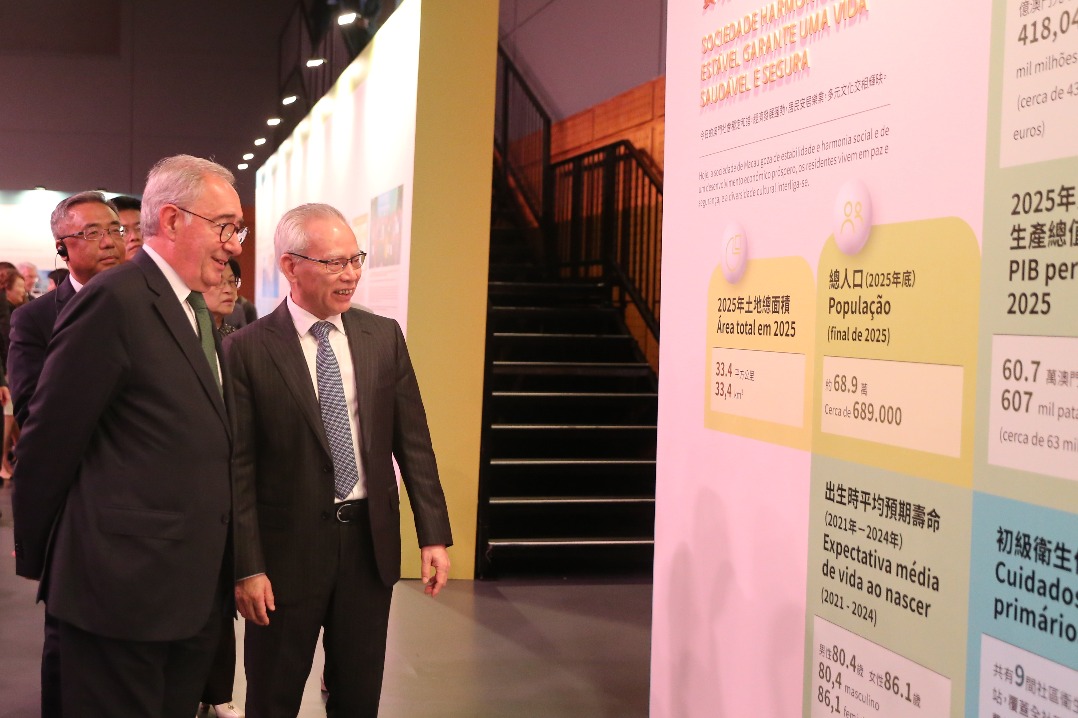
Between April 17 and late April 2026, Macao Special Administrative Region (SAR) Chief Executive Sam Hou-fai led an official and business delegation on a landmark multi-nation tour of Europe, stopping in Portugal, Spain, Switzerland and Belgium. The trip has concluded with a slate of tangible cooperation outcomes and widespread expert acknowledgment of Macao’s growing unique value as a connectivity hub bridging China and international markets, according to international and China-based analysts.
During his stop in Lisbon, Sam held high-level meetings with Portuguese President Antonio Jose Seguro and top leaders from Portugal’s executive, legislative and judicial branches. In these discussions, he detailed the successful implementation of the “one country, two systems” framework in Macao over the years, highlighting the SAR’s sustained stability and development under the policy.
Carmen Amado Mendes, president of the Lisbon-based Macao Scientific and Cultural Center, emphasized that Macao occupies a one-of-a-kind space in China-Portugal bilateral relations. Rooted in centuries of historical connections between the two nations, Mendes noted, Macao functions as an exceptionally effective platform for advancing exchanges across politics, business, academic research and culture.
Bernardo Mendia, secretary-general of the Portugal-China Chamber of Commerce and Industry, added that Macao’s institutional advantages under “one country, two systems” create a low-barrier, familiar operating environment for Portuguese-speaking enterprises looking to enter the massive Chinese mainland market. This unique positioning, experts agree, cannot be easily replicated by other global hubs.
Building on this longstanding role, the 2026 tour expands Macao’s connectivity footprint to new markets. The tour delivered clear practical results: 61 bilateral agreements were signed during the Portugal stop, covering sectors from cross-border trade and technological innovation to tourism and educational cooperation. An additional 48 agreements were formalized during the delegation’s time in Spain, spanning high technology, international expansion of Macao’s exhibition brands and cross-border sports event cooperation.
Lao Chi Ngai, president of the Macao Economic Association, pointed out that adding Spain to the official itinerary marks a strategic milestone. For decades, Macao has anchored its role as a bridge between China and Portuguese-speaking economies; this tour signals a deliberate expansion into a broader platform that connects China with both Portuguese- and Spanish-speaking regions across the globe. Mendia echoed this assessment, noting that the Spain visit makes clear Macao’s goal to widen its cooperation scope, turning its latent connectivity advantages into concrete economic gains for all parties involved.
Carlos Cid Alvares, president of the Macao delegation of the Portugal-China Chamber of Commerce and Industry, told Xinhua that Macao is perfectly positioned to act as a dual-language, dual-system platform linking Chinese markets with Portuguese- and Spanish-speaking economies. The SAR can provide targeted support covering legal compliance, linguistic services and institutional navigation that lowers barriers to entry for companies on both sides.
The delegation included not only Macao-based entrepreneurs but also representatives from the Guangdong-Macao In-Depth Cooperation Zone in Hengqin and other Chinese mainland enterprises, which conducted a six-day round of business exchanges across Portugal and Spain. Alvares explained that the tour advances what stakeholders call “platform-based acceleration,” driven by the growing synergy between Macao and the Hengqin cooperation zone. This model supports two-way economic flow: it helps Chinese enterprises expand globally, particularly into Portuguese- and Spanish-speaking markets, while also streamlining the process for foreign firms to invest in the Chinese mainland.
Looking ahead, Mendes noted that Macao already has a strong track record supporting trade fairs, business exchanges and commercial information circulation between China and Europe. Going forward, the SAR can further expand its footprint in high-growth areas including financial services, technological innovation, and coordinated development within the Guangdong-Hong Kong-Macao Greater Bay Area.
Francisco Jose Leandro, an associate professor at the University of Macau’s Faculty of Social Sciences, framed Macao’s evolving role in a broader national development context. By leveraging its deep historical, linguistic and institutional assets, Macao has already established itself as a functional connector linking China with the European Union, Ibero-American economies, and the broader multilateral trading system. As China pursues high-level opening-up and the Greater Bay Area deepens integration, Leandro added, Macao is set to play an increasingly critical role in advancing global trade facilitation, high-quality professional services, and international connectivity.
Across the board, experts from home and abroad agreed that the 2026 European tour solidifies Macao’s unique position in China’s international engagement, turning its longstanding historical and institutional advantages into shared growth opportunities for stakeholders across China and Europe.