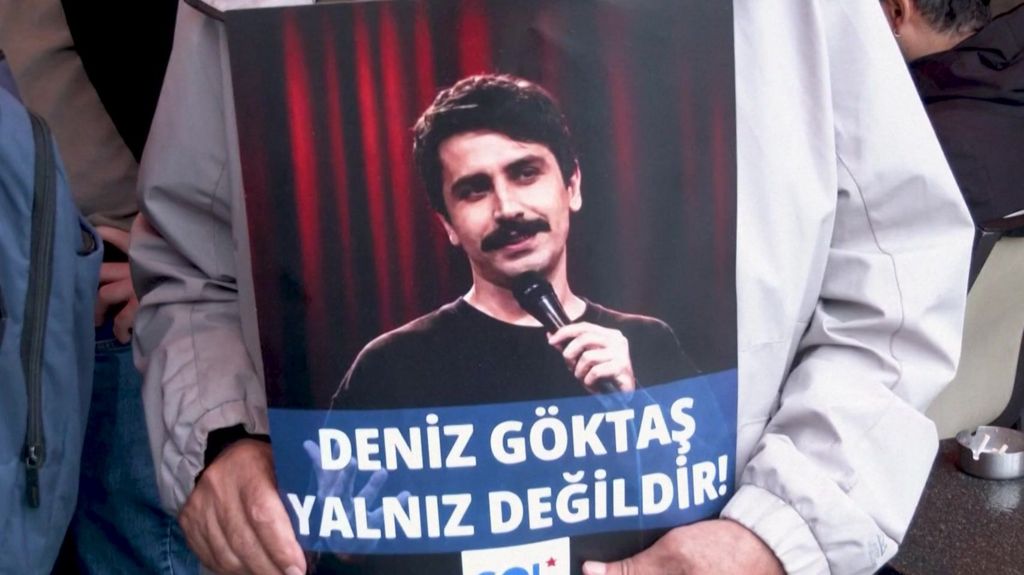
On Monday, supporters of Turkish comedian Deniz Göktaş assembled outside an Istanbul courthouse holding placards declaring “Deniz Göktaş not alone,” as a local court issued a highly anticipated verdict in a case that has drawn international attention to shrinking free speech protections in Turkey.
The court found Göktaş, one of Turkey’s most popular stand-up performers, guilty of insulting President Recep Tayyip Erdoğan, sentencing him to nearly 19 months in prison. However, the court ordered his immediate release from custody, accounting for the 88 days he has already spent behind bars. The ruling also imposed a permanent travel ban that bars Göktaş from leaving Turkey, and the case will now move to an appeals court for a final judicial decision.
Göktaş has consistently denied the charges against him. The case stems from a viral stand-up routine posted to YouTube that has racked up more than 15 million views. Prosecutors took issue with a single line from the set where Göktaş described Erdoğan as “a shy dictator.” During the proceedings, the comedian pushed back against the characterization of his comment as an insult, arguing that “dictator is not an insult, it is a political characterisation” and that there was “no criminal element” to his remarks.
Göktaş was first arrested in July at Istanbul airport as he returned from an overseas vacation, and he has been held in solitary confinement for nearly three months. Prosecutors had initially sought a sentence of up to 12 years in prison, making the Monday verdict a milder outcome than many observers expected. Remarkably, Göktaş retained his signature wit even after months in solitary. When addressing the court, he joked, “Three months have been taken away from my life. But I quit smoking, so I’ll add another three months to my life.” The quip drew laughter and loud applause from supporters packed inside the courtroom.
Outside the courthouse, Göktaş’s supporters expressed cautious relief at the outcome. Firat Aksal, a fellow comedian and friend of Göktaş, shared that the community had gone into the trial with little expectation of a fair ruling. “We hardly know what to do with our happiness,” Aksal said. “We are thrilled. To be honest we weren’t hopeful of getting a fair trial.” According to Aksal, Göktaş plans to take a short break to reunite with his family before returning to the stage, with his release expected within hours of the ruling.
Despite this partial win for Göktaş and his supporters, the broader crackdown on dissent in Turkey continues unabated. Human rights organizations have documented a sweeping wave of arrests targeting critics of the Erdoğan administration, and thousands of detainees remain behind bars. Those still in custody include dozens of journalists, human rights campaigners, student protesters, LGBTQ activists, and even Ekrem İmamoğlu, the popular elected mayor of Istanbul. Prisons across Turkey are currently operating over capacity as the government continues its campaign to suppress opposition voices.