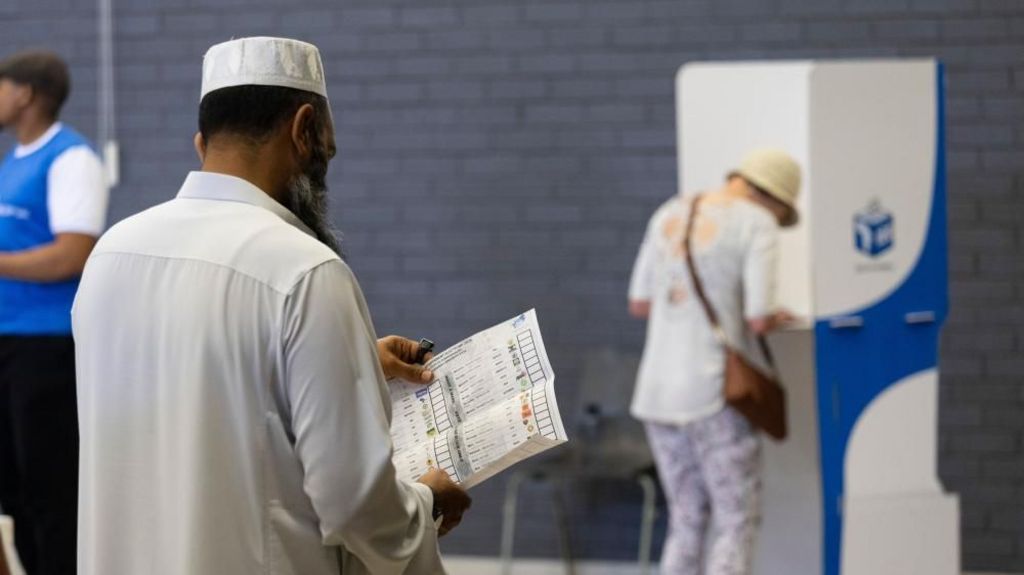
Voters across South Africa cast their ballots at polling stations, including sites in Johannesburg, for the latest round of local government elections, producing a landmark political shakeup that marks the worst electoral performance for the African National Congress (ANC) since the country transitioned to multiracial democracy under Nelson Mandela more than 30 years ago. The long-ruling liberation party, which claimed the largest overall vote share, secured just 30.76% of national support – a steep drop from the 46% it earned in the 2021 local elections, and a stark decline from the 64.82% share it commanded two decades prior.
Geographically, the ANC’s eroding support is even more pronounced: it holds a governing majority in only one of South Africa’s nine provinces, the northern Limpopo region, down from six provincial majorities won in 2021. Among the nation’s eight major metropolitan cities, the party finished as the top vote-getter in just two, compared to six in the last local electoral cycle. Opposition parties made notable inroads: the Democratic Alliance (DA) took second place with 24.64% of the national vote, retaining its majority control over Cape Town. The uMkhonto we Sizwe (MK) party, led by former president Jacob Zuma, claimed third place with 9.76% of votes, ousting the ANC as the leading party in the coastal economic hub of Durban. The Economic Freedom Fighters (EFF), once widely viewed as a formidable challenger to the ANC’s dominance, landed in fourth with 6.22% of the total tally.
ANC Secretary-General Fikile Mbalula openly described the outcome as “very catastrophic” in remarks delivered on Saturday, noting that party leadership had foreseen the impending electoral collapse, driven by soaring cost-of-living burdens that pushed large swathes of the South African middle class to abandon the party. President Cyril Ramaphosa, who also serves as ANC leader, addressed reporters at the vote count centre, stating, “We accept the will of the people however concerning it might be, we accept that this is how the people of South Africa in our towns, in our cities, in our metros have spoken – and this is their verdict, we accept it with humility. It is a decline that is concerning, that is how I characterise it.”
This latest poor showing extends a years-long downward trajectory for the ANC, which lost its unbroken national governing majority for the first time in its history during the 2024 general elections, forcing it to form a cross-party Government of National Unity (GNU) to hold power. For the DA, the incremental vote gain from its 21.83% 2021 share fell short of the 26.9% support it secured in 2016. Overall voter turnout reached 52.29%, a notable uptick from the 45.9% recorded during the 2021 elections, which were held amid ongoing Covid-19 public health restrictions.
Political analyst Susan Booysen emphasized that the election results deliver a “devastating message to the ANC”, highlighting sustained, widespread declines in the party’s support at municipal, metropolitan, provincial and national levels. Booysen attributed the collapse primarily to decades of unaddressed failures in public service delivery and crumbling national infrastructure, including persistent electricity blackouts, water shortages, and broken sanitation systems that have disrupted daily life for ordinary residents across both low-income townships and affluent suburban neighbourhoods.
Long-term projections for the ANC remain deeply uncertain. Ramaphosa is set to step down as ANC party leader next year when his term concludes, though he will remain national president until the 2029 general elections, and the party currently lacks a clear line of credible successors for either role. Analyst William Gumede framed the election results as a definitive turning point: “It is sort of the end of the liberation movement era in South Africa, and the dominance of the liberation movement since the end of apartheid. So the ANC is going to be a party that by 2029 could be the second biggest rather than the biggest party. It may actually spiral into a long period of just total infighting. This is a new era for South Africa’s politics and also the ANC.”
The elections also signal a historic shift in traditional voting demographics: the DA, long labelled the “white party” for its overwhelming support from white South African voters, made significant inroads with Black voters, leading Gumede to observe that the country is steadily moving toward a post-racial voting pattern. In the immediate aftermath of the vote, local political parties face a 14-day window to negotiate governing coalitions, with the three major metropolitan hubs in the economically critical Gauteng province – including Johannesburg and Pretoria – under intense public scrutiny, as the ANC could potentially be locked out of governing power in both cities. “We are now in a coalition country,” Gumede noted, adding that voters have clearly rejected decades of single-party dominance, demanding cross-party collaboration at all levels of government to address the nation’s long-unresolved social and economic challenges.