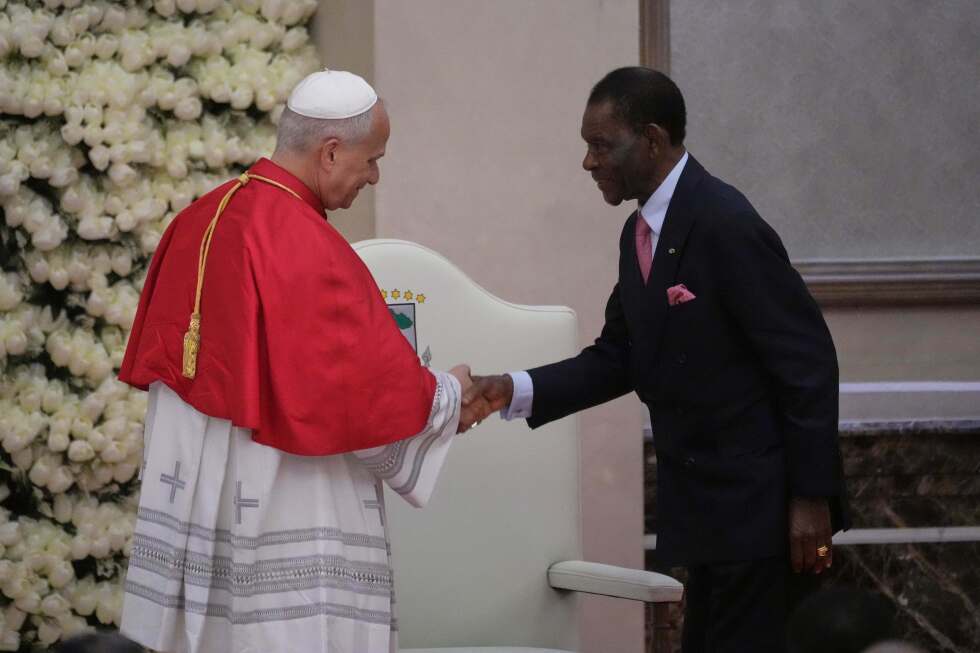
LAGOS, Nigeria — For exiled Equatorial Guineans who fled systemic political repression, Pope Leo XIV’s high-profile visit to their West-Central African homeland is not a cause for celebration — it is a public relations opportunity that longtime authoritarian ruler Teodoro Obiang Nguema Mbasogo will weaponize to whitewash his regime’s global image.
Guti Bae Tongala, a 59-year-old former cook from the remote Annobon Island who sought asylum in Spain in 2002 after escaping what he describes as targeted abuse of minority communities by the government, is among the critics speaking out against the trip. The visit marks the final stop on Pope Leo’s four-nation African tour, following stops in Algeria, Cameroon, and Angola. Vatican data shows Equatorial Guinea boasts one of the highest Catholic population shares on the continent, with roughly 75% of citizens identifying as Catholic, a legacy of decades of Spanish colonial rule.
During his time in the country, Pope Leo has publicly condemned the neocolonial extraction of Africa’s mineral resources, decried global political leaders’ “lust for power”, and publicly called on Equatorial Guinea’s government to advance greater justice and close the stark economic divide between the country’s tiny ruling elite and its majority disadvantaged population. But exiled dissidents and human rights activists argue these calls for reform will ultimately work to Obiang’s advantage.
Obiang, Africa’s longest-serving sitting head of state who has held uninterrupted power since seizing control in a 1979 coup, stands accused by global rights organizations of running one of the world’s most repressive regimes. For exiles like Tongala, the papal visit is a perfect gift for a leader eager to gain international legitimacy. “Obiang knows very well that the pope’s visit comes like a ring on his finger,” Tongala told the Associated Press in an interview from Spain. “Obiang will use the pope’s presence to clean up his image.”
Tutu Alicante, executive director of U.S.-based human rights organization EG Justice, notes that papal outreach is just the latest in Obiang’s long-running strategy to polish his global standing through high-profile international events. The Equatorial Guinean leader has already hosted two editions of the continent’s top football tournament, the Africa Cup of Nations, in 2012 and 2015, in a similar push to gain global acceptance.
Though Equatorial Guinea is legally a secular state, the Catholic Church remains deeply embedded in the nation’s political and social fabric, a holdover from Spanish colonial rule. Churches run much of the country’s educational and healthcare infrastructure for its population of nearly 1.9 million, and all major state events — from presidential inaugurations to Independence Day celebrations — open with a Catholic Mass. In 2011, Obiang was even inaugurated for another term at the sprawling neo-Gothic Basilica of Immaculate Conception in his hometown of Mongomo, a structure modeled after Vatican City’s St. Peter’s Basilica that ranks as the second-largest religious building in all of Africa, second only to the Basilica of Our Lady of Peace in Côte d’Ivoire.
Alicante argues that the relationship between church hierarchy and the Obiang regime is deeply intertwined. “The church leaders are very much interconnected intrinsically with the government,” he explained. “Part of it is the fear the government has instilled in everyone, including the church, and part of it is the monetary gains that the church derives from this government.” Neither local Catholic officials nor the Equatorial Guinean government responded to AP requests for comment on allegations of ongoing human rights abuses in the country.
Vatican representatives, however, defend the church’s approach to engaging with controversial political regimes. The Rev. Fortunatus Nwachukwu, second-in-command at the Vatican’s missionary evangelization office, told the AP that the church must navigate fraught civic spaces rather than withdraw or enter outright conflict. “Should the church go to war against the government? Surely no,” Nwachukwu said. “Should the church swallow everything as if it were normal? No. The church has to continue preaching justice, always in defense of life, human dignity and the common good.”
The Catholic Church’s relationship with political power in Equatorial Guinea has long been complicated. Former ruler Francisco Macias Nguema — Obiang’s uncle, whom he overthrew in 1979 — brutally persecuted Catholics, shuttered houses of worship, and banned the church entirely in 1978 in a push to sever remaining ties to former colonial power Spain. After seizing power, Obiang immediately reversed the ban, transitioned to civilian rule in 1982, and hosted Pope St. John Paul II on a visit the same year. He has remained in power ever since, winning six consecutive widely disputed elections marred by allegations of fraud and voter intimidation.
Global rights and economic data back up dissidents’ claims of systemic inequality and abuse. The World Bank estimates that more than half of Equatorial Guinea’s population lives in poverty, despite the country’s vast oil and mineral wealth, which rights groups say is almost exclusively siphoned off to enrich Obiang’s extended family. One of the president’s sons, current Vice President Teodoro Nguema Obiang Mangue, was convicted of money laundering and embezzlement by French courts and sanctioned by the United Kingdom for similar corrupt activities. A second son, Carmelo Ovono Obiang, was opened for investigation by Spain’s High Court in 2024 over allegations he ordered the kidnapping and torture of two opposition leaders holding Spanish citizenship. A 2024 Amnesty International report documented widespread, routine arbitrary arrests, torture, and other cruel treatment of political dissidents across the country.
In 2023, the AP confirmed that the Obiang government imposed a months-long total internet shutdown on Annobon Island to suppress protests against abusive practices by a state-linked construction company. The country has also been accused of accepting millions of dollars in under-the-table payments from the U.S. to accept deported migrants who are not citizens of Equatorial Guinea, in a controversial deal that has drawn widespread global criticism.
Many exiled Equatorial Guineans are calling on Pope Leo to use his global platform to explicitly condemn the Obiang regime’s ongoing human rights violations. “I would like the pope to speak out in defense of the Christians who live in Equatorial Guinea and who have to endure the abuses of human rights that occur day by day at the orders of Obiang Nguema,” said Jorge Awal, a 27-year-old exiled Equatorial Guinean now working in Spain’s private sector.
This reporting is part of the Associated Press’ ongoing religion coverage, supported through a collaboration with The Conversation US via funding from the Lilly Endowment Inc. The AP retains full editorial control over all content.