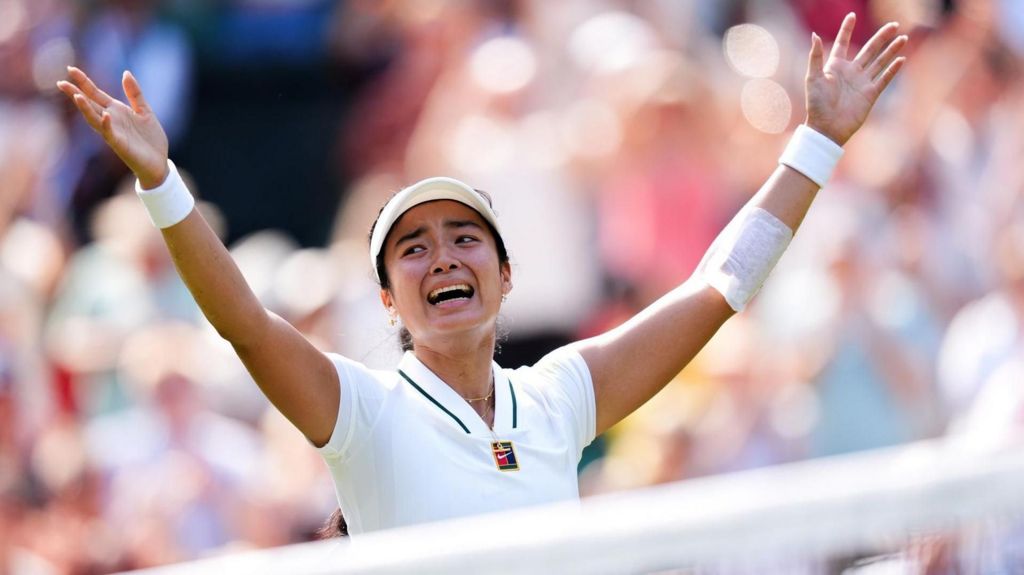
For decades, sports culture in the Philippines has revolved around three dominant pillars: basketball, boxing, and beauty pageants. Decades of American influence cemented basketball as the nation’s top pastime, with a court in virtually every rural village and urban neighborhood, while a deep cultural love for rags-to-riches underdog narratives turned boxing into a national obsession and kept beauty pageants at the center of public attention. Today, however, a new tennis star is shaking up this long-standing status quo, sparking a nationwide surge of interest in a sport that has long been limited to the country’s elite circles.
At 21 years old, Alexandra “Alex” Eala has made history as the first Filipina to reach the fourth round of a Grand Slam tournament, a milestone she achieved at this year’s Wimbledon. During her historic run, she pulled off a stunning upset by defeating defending champion Iga Swiatek of Poland, capturing the attention and admiration of the entire Filipino nation, which followed every match via social media and streaming platforms. This breakout success comes on the heels of her standout semi-final performance at the 2025 Miami Open, a run that first signaled her arrival on the global tennis stage.
When Eala returned to Manila after her Wimbledon campaign, she received a hero’s welcome fit for the country’s newest sports icon. Philippine President Ferdinand Marcos hosted an official reception in her honor at Malacañang Palace, where Eala expressed her gratitude for the overwhelming public support. “I’m so grateful that I am able to share my triumphs, most especially my recent run at Wimbledon, with the country,” she said at the event. “As we say, this is our victory. I cannot begin to describe how overjoyed I am to see how my progress has been received by the Filipino people. This recognition makes me feel very seen.”
For young aspiring tennis players across the country, Eala’s success has become a life-changing source of inspiration. One of these rising stars is 14-year-old Maristella Torrecampo, who traveled 13 hours by bus from her quiet hillside hometown in Iriga City to compete in a July tournament in Manila. With a limited crowdfunded budget that only covered two round-trip bus tickets and a few days of meals, Torrecampo could only bring her father along for the trip, leaving her mother and four siblings at home. Barely recovered from the exhausting cross-country journey, she defeated her Omani opponent in straight sets 6-1, 6-1 at Rizal Stadium, keeping her own dream of following in Eala’s footsteps alive. “Like Ate Alex, I want to win at Wimbledon, the WTA, and tournaments around the world,” Torrecampo said, using the Filipino term for elder sister to refer to her idol. “She inspired me so much. I’ve looked up to her since I was little. I love her attitude on and off the court—she’s so humble, and there are so many kids like me who see her as a role model.”
Eala’s rise has not been without criticism, however. Critics have pointed to her privileged background: she trained at the elite Rafael Nadal Academy in Spain, her mother is a former telecommunications executive, and her father is a businessman from a prominent Filipino family. Eala has brushed off these critiques, noting that many commentators overlook the years of relentless hard work she has put in to reach the top of the sport.
Beyond inspiring young athletes, Eala’s success has sparked a surge of interest in tennis among casual hobbyists across the Philippines. Celso Mugot, a 33-year-old accountant in Manila who has been training for three months to stay fit, said his determination to improve intensified after watching Eala’s run. “I was definitely inspired by Alex Eala. I saw her progress from a low-ranked player all the way to the top,” he told reporters. Rafael Santos, a 29-year-old IT professional who recently took up the sport, added that booking court time has become far harder since Eala’s breakout performance in Miami last year. “There are only a handful of courts in Manila, but hundreds of new people want to play and train,” Santos explained. “That’s been a bit of a letdown. We’ve also seen tennis shoes and apparel sell out across stores, and some retailers have hiked up racket prices dramatically.”
These growing pains highlight a long-standing barrier to tennis accessibility in the Philippines: the sport’s high cost and limited infrastructure. For decades, tennis courts have been concentrated exclusively in wealthy, gated enclaves, and court rentals in Manila cost around 2,000 Philippine pesos ($32) per hour—equivalent to half a day’s work for minimum wage earners, and enough to cover a month of groceries for an average household. Jovy Barce, a veteran Manila tennis coach who grew up in poverty on the capital’s outskirts, knows these barriers firsthand. He started out as a six-year-old ball boy, earning 100 pesos per day to help his family buy groceries, before picking up a discarded racket from a court trash bin at age eight to start teaching himself to play. Later, a regular player gave him an old racket, a gift he still remembers vividly. “Up until this day, I couldn’t explain how happy I was when I got it,” Barce said. “I used it over and over until I became confident. No one taught me; I never had a professional coach. It was all self-study.” Barce worked his way through college on a sports scholarship, taking jobs at a hotel and as a motorcycle delivery rider before launching his coaching career with just 40 used tennis balls. “I started from nothing, but I tried my best to learn everything because I really wanted to become a coach,” he said.
Urban planners note that limited available space is a core structural barrier to expanding tennis infrastructure across the country. Metro Manila, the national capital region, is home to nearly 16 million people and ranks among the most densely populated urban centers in the world. Renowned architect and urban planner Felino Palafox told reporters that expanding access will require rethinking how public space is allocated across the country’s 42,000 barangays, or villages. “Ideally, every barangay should have a tennis court, not just basketball courts,” Palafox said. “We are fighting for public space for new activities.”
Despite the challenges, Eala’s success has already had a transformative impact on the sport in the Philippines, drawing tens of thousands of new players and creating a pipeline of young talent that many hope will reshape the nation’s sports landscape long-term. Thousands of fans turned out for public fan events in Metro Manila after Eala’s return, with some traveling for hours from neighboring provinces just for a chance to see her and get an autograph. Eleven-year-old Luca Ong, a young tennis player who attended one of the events, said his goal is to one day follow in Eala’s footsteps and represent the Philippines on the global stage.
Now, Eala has left Manila to prepare for the US Open in August, where she will aim to build on her Wimbledon success and raise the Philippines’ profile in global tennis even further. In a social media post ahead of her departure, she wrote: “That’s a wrap on Manila. Thank you for welcoming me, my countrymen. Each and every one of your stories has touched me on a profound level. I leave with a refreshed memory of what I carry when I’m out there playing tennis. And wow, is it a privilege to be part of something bigger than myself. Never been prouder to represent home.”
For young players like Torrecampo, the journey to that same goal continues. Her father and coach, Delfin Torrecampo, says the family’s limited resources have not stopped them from chasing their dream, a message he wants to share with other aspiring athletes facing similar barriers. “To people who are in the same situation as us, know that poverty is not a hindrance for you and your family’s dreams,” he said. “The people who keep on fighting and persevering are the same people who have the chance to win. You may not win today or tomorrow, but your win will come one day as long as you keep on fighting.”