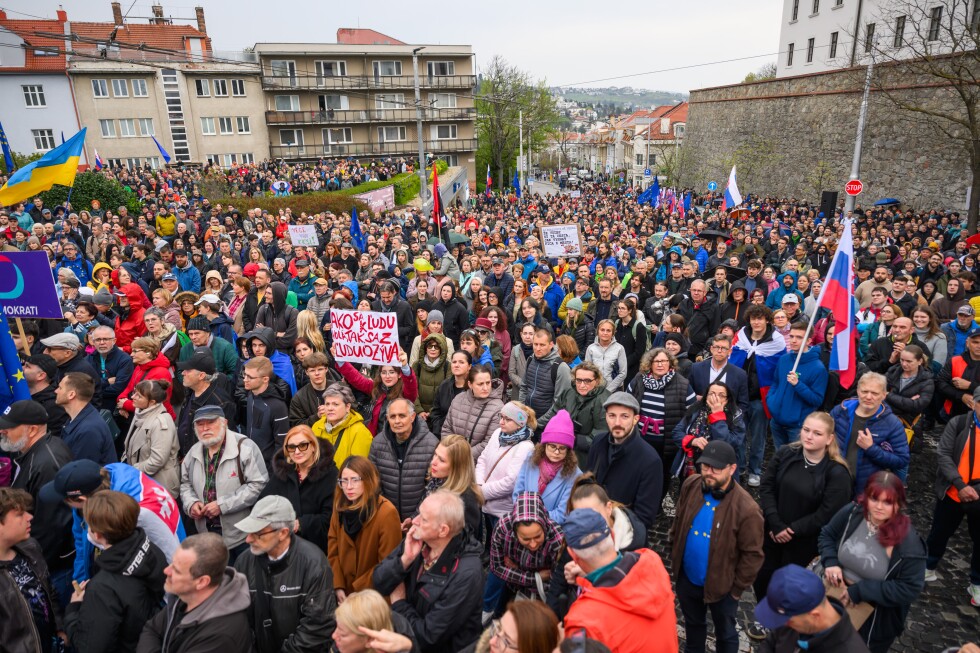
Tens of thousands of demonstrators gathered across Slovakia — and in major European cities outside the country — on Tuesday to push back against a contentious electoral proposal from populist Prime Minister Robert Fico that would eliminate postal voting for Slovak citizens residing abroad. The largest demonstration, held directly outside Slovakia’s parliament building in the capital Bratislava, opened with a warm round of applause for the shocking outcome of neighboring Hungary’s weekend general election, where long-time authoritarian populist Viktor Orbán was ousted from power by a pro-European opposition candidate.
Fico, who returned to the office of prime minister in 2023 following parliamentary elections, has emerged as a deeply polarizing figure both within Slovakia and across the European Union. His consistently pro-Russia policy stances and perceived authoritarian power grabs have already sparked waves of mass public demonstrations since his administration took office. Critics have repeatedly drawn parallels between Fico’s governing style and Orbán’s 12-year illiberal rule in Hungary, noting that Fico has openly drawn inspiration from Orbán’s approach to politics. Tuesday’s protests mark just the latest in a months-long string of public outcry against the Fico administration’s policy agenda.
The protest initiative was organized by a coalition of four opposition political groups: the Progressive Slovakia party, Freedom and Solidarity, the Christian Democrats, and the Democrats. Speaking to the assembled crowd in Bratislava, Progressive Slovakia leader Michal Šimečka framed the fight over overseas voting as an existential battle for Slovak democracy, echoing the stakes Hungarians faced just days earlier.
Šimečka argued that Fico’s proposed legislation would effectively disenfranchise tens of thousands of Slovak citizens who have settled outside the country’s borders. Under the new plan, the only option for overseas voters would be to cast ballots in person at Slovak embassies and consulates — a requirement that creates major logistical barriers for many citizens living far from diplomatic outposts. As he spoke, the crowd chanted repeatedly: “Shame, shame.”
“It is obvious the government is pushing this change because they are afraid,” Šimečka told demonstrators. “They are afraid of the people, they are afraid of free elections, they are afraid of losing power.” The draft legislation is scheduled to go under formal debate during the current sitting of the Slovak parliament, leaving the window open for urgent political pushback from opposition lawmakers.
Data from the 2023 Slovak parliamentary election underscores why Fico’s party has targeted overseas postal voting. In that election, nearly 59,000 Slovaks living abroad cast mail-in ballots. Fico’s Smer (Direction) party captured just 6.1 percent of that overseas vote, while the unified opposition won more than 80 percent of support from citizens voting from outside the country. Fico has defended the policy change by claiming it is necessary to “prevent electoral fraud and manipulations,” a framing opposition leaders dismiss as a baseless pretext to suppress anti-government votes.
Beyond the capital Bratislava, demonstrations were also held in major Slovak cities including Košice and Banská Bystrica. Solidarity rallies were also organized by Slovak expats outside the country, including in the EU capital Brussels and Prague, the capital of neighboring Czech Republic. Slovakia, a Central European nation with a total population of 5.4 million, is not scheduled to hold its next general election until 2027 — but the fight over electoral rules has already reignited a tense political standoff between Fico’s populist government and pro-Western, pro-European opposition forces.