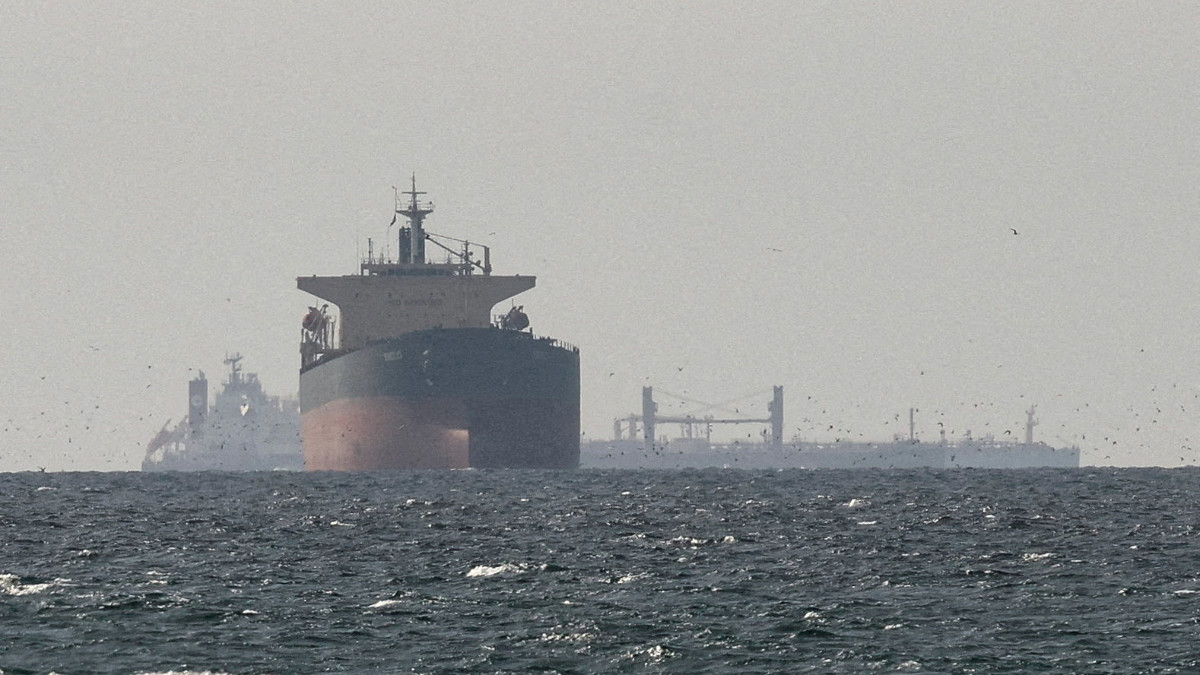
Washington’s maximum pressure campaign via a naval blockade of Iranian energy exports was designed as a short-term leverage tool to force Tehran into concessions at the negotiating table, but experts warn the gambit could backfire — with China positioned to quietly test the restrictions without triggering open military conflict, and energy markets already signaling growing confidence that a diplomatic breakthrough between the two rivals is within reach.
In theory, cutting off Iran’s 1.5 million barrels per day of crude exports, much of which flows through the strategically critical Strait of Hormuz, should send global energy prices soaring. Yet since the US blockade officially took effect this Monday, Brent crude, the global benchmark for oil, has defied expectations and fallen sharply, dropping 4.3% to trade at $95.08 per barrel as of mid-week.
Diplomats and industry analysts interviewed by Middle East Eye say the unexpected price dip stems from widespread optimism that both Washington and Tehran are committed to a two-week ceasefire and renewed negotiations, overshadowing immediate fears of disrupted energy supplies. US President Donald Trump announced Tuesday that talks between the two sides could resume as soon as within 48 hours in Islamabad, Pakistan, the site of earlier negotiations that ended without a final agreement.
Aaron David Miller, a former US Middle East peace negotiator now with the Carnegie Endowment for International Peace, told MEE that the coming days will be a critical test of the blockade’s durability. “The test right now is whether in the next several days we see a return to kinetic activity on the part of the Iranians to challenge the US blockade or US kinetic action against Iran,” Miller said.
The Trump administration has claimed the blockade is already successfully halting Iranian oil shipments, and initial analysis of global ship tracking data appears to back that assertion, according to maritime analysts. On Tuesday, two vessels linked to Iranian energy exports — the Panama-flagged *Elpis* and Chinese-owned *Rich Starry*, a regular carrier of Iranian methanol — drew international attention after crossing the Strait of Hormuz but idling in the Gulf of Oman rather than exiting toward global markets.
Matthew Wright, principal freight analyst at energy analytics firm Kpler, explained that the exit from the Gulf of Oman is the key metric for tracking compliance, since US naval forces are positioned outside the Strait of Hormuz. “We haven’t seen any Iranian-linked vessel transiting the Strait of Hormuz and exiting the Gulf of Oman. That is what we are waiting on,” Wright said. Experts add that US warships have deliberately stayed outside the narrow strait and away from the Iranian mainland, recognizing they remain vulnerable to Tehran’s fleet of drones and short-range anti-ship missiles.
As the largest buyer of Iranian oil, purchasing roughly 90% of Tehran’s total exports, China is the only global power with the capacity to undermine the US blockade. In the aftermath of the June 2025 US-Israeli war against Iran, Beijing has already supplied Tehran with air defense systems and drones, and The New York Times reported over the weekend that China may have also delivered shoulder-fired missiles to Iranian forces. Beijing has denied all reports of arming Iran, and issued a public statement Tuesday calling the US blockade “dangerous and irresponsible” while urging an immediate ceasefire and a return to normal shipping traffic through the Strait of Hormuz.
Yun Sun, director of the China Program at the Stimson Center, told MEE that Beijing will avoid direct military confrontation with Washington over the blockade, even as it pursues quiet efforts to prop up the Iranian government. “The Chinese will not pick a fight with the US over Iran. They might do things behind the scenes to rebuild and rearm Iran, but not directly confront the US militarily,” Sun said. “The Strait of Hormuz is so far from China, and the geographical distance is a key barrier to any Chinese plan for effective military intervention.”
Still, one senior Arab diplomat told MEE that the entire US blockade ultimately relies on China’s quiet willingness to comply, pointing to a recent precedent where Washington allowed a Russian oil tanker to reach Cuba despite long-standing US sanctions on the Caribbean nation. The diplomat added that Tehran is well-positioned to outlast the restrictions: Iran pre-positioned massive volumes of crude ahead of the blockade, boosting loadings at its key Kharg Island export terminal before the February 28 US-Israeli attack. Kpler data shows Iran currently holds roughly 38 million barrels of crude stored on tankers at sea, much of it already anchored near the Chinese coast, with enough storage capacity to continue production for weeks before being forced to shut down operations. Iran also has alternative trade routes, including access to the Caspian Sea and overland land borders that reduce its reliance on open sea lanes for imports, unlike Cuba, which the US has targeted with a similar energy blockade.
Many foreign policy experts argue the US has based its blockade strategy on flawed timelines and miscalculations. Alan Eyre, a former senior State Department Iran expert, told MEE that the slow-acting restrictions will fail to pressure Tehran into making concessions within the timeframe the Trump administration needs for a diplomatic win ahead of any planned political milestones. “For any sort of time frame the US cares about to inflict pain on Iran’s economy, the blockade is just too slow-acting,” Eyre said. “It’s a short-term tool that will fail to move the Iranians at the negotiating table.” Eyre added that Iran already holds hundreds of millions of dollars in recent oil export revenue, giving it ample financial breathing room to wait out the standoff.
Experts note that if Tehran chooses not to immediately challenge the blockade, it is likely because Iranian leadership believes a negotiated deal with Washington is achievable. Earlier talks in Islamabad broke up without an agreement after US Vice President JD Vance walked away over disputes about the future of Iran’s nuclear program, but multiple regional and US media outlets have reported that the two sides came surprisingly close to reaching a framework agreement. Eyre compared Vance’s walkout to traditional Middle Eastern bazaar haggling, noting that it is a common negotiating tactic rather than a sign that talks are dead. “Vance walking away is like negotiating for a rug at a market in the Middle East. You ask the price, say it’s too high and walk away. But then you come back the next day,” Eyre said.
A key breakthrough in the earlier talks was a US concession offering Iran a 20-year moratorium on uranium enrichment, a significant shift from earlier US demands that Iran end all enrichment activities permanently. Iran has long maintained its right to enrich uranium for peaceful civilian energy purposes, and its late supreme leader Ayatollah Ali Khamenei issued a binding religious decree against developing nuclear weapons back in 2003, a position Tehran has repeatedly reaffirmed.
Miller noted that the US shift to accepting a moratorium, or temporary pause, rather than a permanent end to enrichment is a major step forward that makes meaningful negotiation possible. “If the administration has conceded to using the word ‘moratorium’, which means ‘pause’ and not ‘permanent ending’ – that’s a significant concession, and you might actually have a negotiation,” Miller said.
Despite the progress, several major sticking points remain to be resolved. These include Iran’s demand to charge transit tolls for commercial vessels passing through the Strait of Hormuz, the status of Iran’s existing stockpiles of enriched uranium, and the maximum level of enrichment that Washington will agree to allow Tehran to maintain. Experts add that Trump faces political pressure to secure a high-profile foreign policy win, and opening the strait to shipping is not enough to meet that goal. “I don’t think the Iranians will agree to a 20-year moratorium, but if they agree to a pause in single digits, that could open things up,” Miller said.