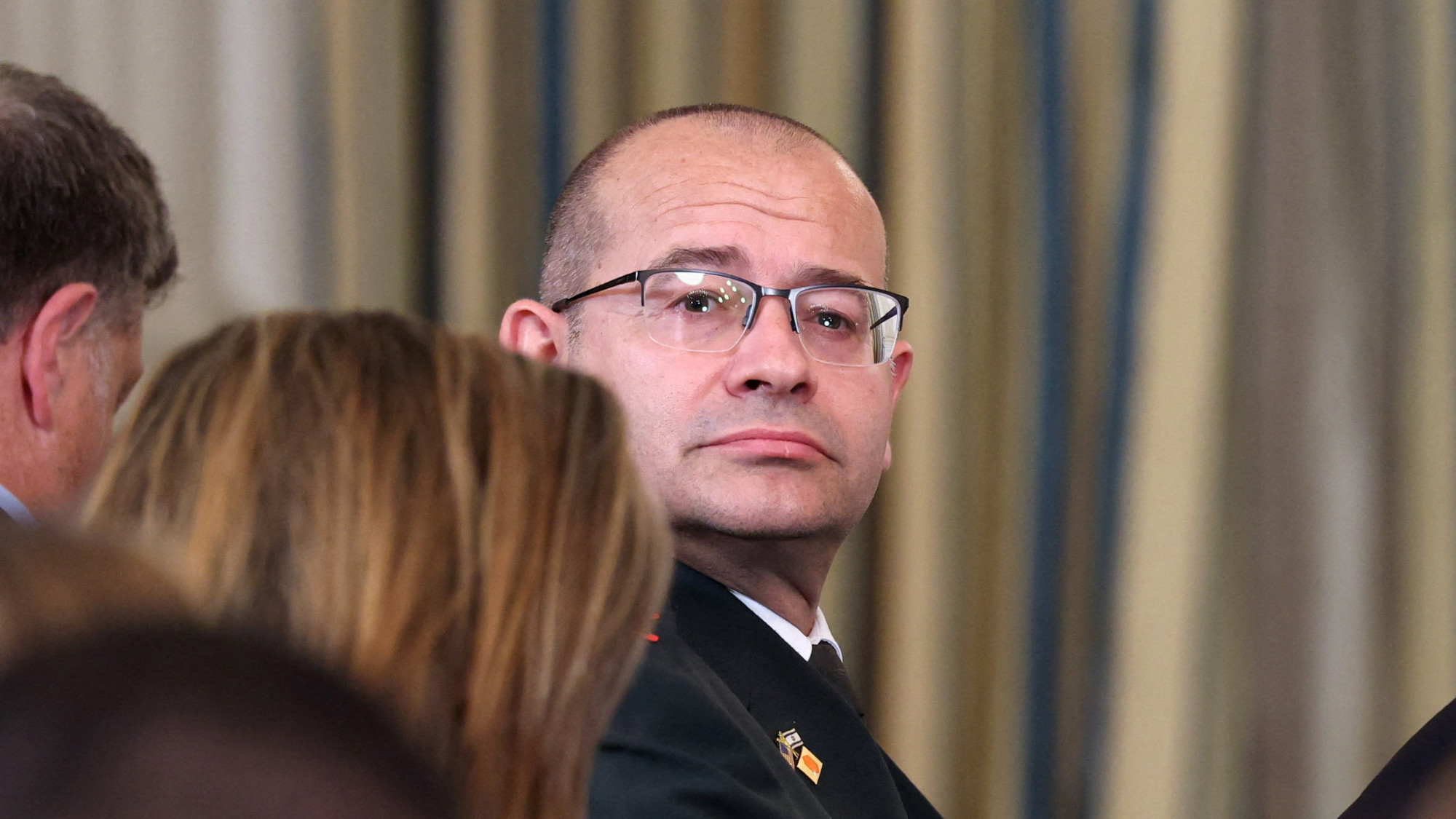
Israel’s advisory committee for senior public appointments has given the green light to Roman Gofman, a close ally of Prime Minister Benjamin Netanyahu, to take the helm of the country’s iconic intelligence agency Mossad, capping a rapid military rise that has been overshadowed by bitter controversy over his past conduct, hardline political views, and allegations of power abuse. Gofman, 49, will assume a five-year term starting in June, succeeding outgoing director David Barnea, who has publicly opposed his appointment.
Born in the Soviet Union’s Belarus, Gofman immigrated to Israel with his family in 1990 at age 14. Five years after arriving, he enlisted in the Israel Defense Forces’ armored corps, climbing steadily through the ranks to earn a promotion to major general in early 2024. His career has spanned combat deployments across southern Lebanon, the occupied West Bank, and the Gaza Strip, and he has long been associated with far-right ideological circles: as a young pre-military trainee, he studied at the Bnei David yeshiva in Eli, an illegal Israeli settlement in the occupied West Bank, an institution notorious for promoting extremist Jewish supremacist views. Gofman himself has publicly credited the yeshiva with shaping his core ideological beliefs about Israel.
Gofman’s most high-profile military experience came during the October 7, 2023, Hamas-led attack on southern Israel, when he was wounded in a firefight with Palestinian fighters near his home in Ashdod. Surveillance footage captured him exchanging fire before sustaining a leg injury and pulling back, but he returned to duty shortly after recovering. Reflecting on the surprise attack, he argued that even the most formidable military forces face unexpected breaches, and that proactive initiative is the only way to prevent future surprises.
As the Israeli military campaign in Gaza unfolded after October 7, Gofman emerged as one of the most outspoken hardliners in Israeli security circles. He drafted an official plan calling for the full reoccupation of the entire Gaza Strip, and has argued that Israel should maintain permanent control over the enclave at the end of the current conflict. He has previously criticized the Israeli military for what he frames as excessive caution in deploying ground forces across multiple fronts, from Gaza to Lebanon to Syria, and has publicly praised Orde Wingate, a British Mandate-era officer famous for developing brutal counterinsurgency tactics against Palestinian groups alongside early Zionist militias, framing decisive, reality-altering military action as the core of Israeli strategy. In a 2019 academic proposal, he even controversially suggested that Israel should sell nuclear warheads to Egypt, Saudi Arabia and Turkey to counter Iran’s nuclear program, a view far outside mainstream Israeli security policy.
Netanyahu tapped Gofman to serve as his personal military secretary in April 2024, marking his entry into the prime minister’s inner circle. But his nomination to lead Mossad has sparked fierce opposition from across Israel’s political and security establishment, centered on two core sets of concerns: his lack of prior intelligence experience, and multiple allegations of professional and ethical misconduct during his military career.
The most explosive controversy surrounds a 2022 intelligence operation, when Gofman commanded the 210th Bashan Regional Division on the Golan Heights. According to investigative reports, Gofman instructed military intelligence personnel to provide 17-year-old Israeli civilian Ori Elmakayes with classified information to publish on social media as part of a covert influence campaign targeting Iran, Hezbollah, and Hamas. After Elmakayes published the material, Israeli police arrested him on charges of leaking state secrets, and he spent 18 months in pre-trial detention.
Gofman initially denied to military investigators that he knew of Elmakayes’ involvement, but the case against the teenager collapsed when evidence confirmed he had been acting on direct military orders approved by Gofman. Gofman has since denied authorizing the release of truly sensitive material and claims he did not know Elmakayes was a minor. Elmakayes, however, has slammed Gofman for throwing him aside to protect his own career.
“Roman Gofman used me illegally and immediately afterwards disowned me, abandoned me and did not put an end to the ongoing nightmare I went through,” Elmakayes wrote on the social platform X following Sunday’s approval vote. “Someone who abandoned a 17-year-old boy will also abandon Mossad agents.”
Committee chair Asher Grunis, a former president of Israel’s Supreme Court, was the most prominent official to oppose Gofman’s approval, issuing a scathing rebuke of his conduct in the Elmakayes case. “The use of a minor Israeli civilian constitutes an extremely serious flaw and raises a moral-ethical concern. It amounts to a breach of integrity,” Grunis argued, though he was outvoted by the committee’s three other pro-appointment members. Outgoing Mossad chief Barnea has also joined the opposition, labeling Gofman’s actions in the case as an abuse of power.
Additional allegations of misconduct date back to Gofman’s tenure as a West Bank regional commander between 2015 and 2017, when he reportedly ordered the recruitment of Palestinian informants near Beit Ummar without following mandatory legal authorization processes; his directive was later overturned by military leadership.
Beyond the personal misconduct claims, many current and former Israeli security and political figures argue Gofman’s appointment is part of a deliberate effort by Netanyahu to politicize Israel’s independent intelligence and security establishment by installing loyalists to top posts. Gofman has become a trusted confidant of Netanyahu over the past two years of repeated Israeli military campaigns across the region, and Israeli media reports confirm the prime minister has full confidence in him, even assigning him sensitive behind-the-scenes diplomatic missions, including unannounced visits to Russia to maintain ties with President Vladimir Putin. He also played a central role in secret Israeli-Syrian talks in January 2025.
“Prime Minister Benjamin Netanyahu’s decision to appoint his military secretary, Major General Roman Gofman, as head of the Mossad is a continuation of his politicization and takeover of the intelligence community and the security establishment,” veteran military commentator Yossi Melman warned in December, noting that the appointment would mark another key institution brought under Netanyahu’s direct political control. Former Israeli army chief and opposition MP Gadi Eisenkot has echoed these criticisms, arguing top security posts are now being handed out as rewards for loyalty to the prime minister’s political agenda, rather than on the basis of professional merit. Former senior Mossad official Rami Eigra called the nomination politically motivated, warning it will likely erode the agency’s operational effectiveness and increase the risk of major failures.
The battle over Gofman’s appointment is far from over. Elmakayes and multiple Israeli human rights and pro-democracy NGOs are preparing to petition the Supreme Court to block the nomination, according to reports from Haaretz. Some Israeli defense establishment insiders told Ma’ariv they believe the court could strike down the appointment, which would force Netanyahu to ask Barnea to extend his term for several weeks or months while a new candidate is selected.