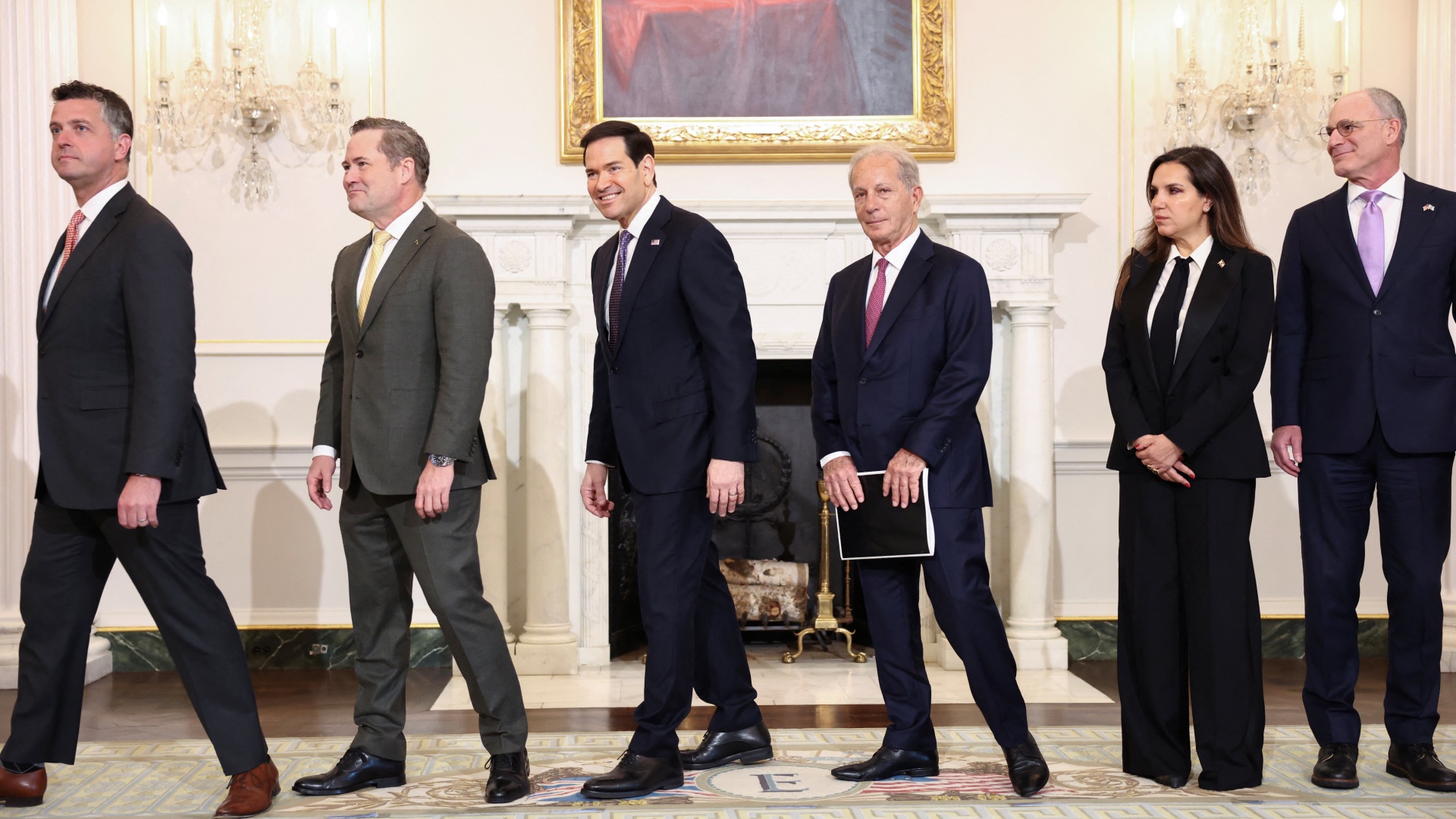
In a groundbreaking step that marks the first formal direct diplomatic engagement between Israel and Lebanon in over 30 years, the second Trump administration hosted top diplomatic representatives from both nations at a Washington meeting on Tuesday. But despite the historic opening of dialogue, the summit was hobbled by glaring limitations from its outset: a formal ceasefire to end weeks of deadly Israeli strikes on Lebanese soil was excluded from the official agenda, and the influential group Hezbollah, a core point of contention for both sides, had no seat at the negotiating table, leaving Lebanese delegates with drastically limited negotiating power.
U.S. Secretary of State Marco Rubio framed the talks to reporters after the opening session, pushing back on questions about the absence of ceasefire discussions. “This is a lot more than just about that,” Rubio said. “This is about bringing a permanent end to 20 or 30 years of Hezbollah’s influence in this part of the world – not just the damage that it’s inflicted on Israel, but the damage that it’s inflicted on the Lebanese people.” The U.S. first formally designated Hezbollah as a foreign terrorist organization in 1997; despite this designation, the group, founded in 1982 to oppose Israeli occupation of Lebanese territory, remains the most powerful military actor in Lebanon and holds elected seats in the country’s parliament.
Rubio acknowledged that the decades-long complexities of the conflict could not be untangled in a single session, but said the meeting laid critical groundwork for future progress. “All of the complexities of this matter are not going to be resolved in the next six hours. But we can begin to move forward to create the framework where something can happen – something very positive, something very permanent,” he remarked. In the end, the closed-door talks wrapped up after just two hours, far shorter than the projected timeline Rubio referenced earlier.
The delegation roster reflected the low-key, exploratory nature of the summit: Lebanon sent its Washington ambassador Nada Hamadeh Moawad, while Israel was represented by its own U.S. ambassador Yechiel Leiter. Senior U.S. officials including U.S. Ambassador to Lebanon Michel Issa, U.S. Ambassador to the UN Mike Waltz, and State Department Counsellor Michael Needham, Rubio’s top aide, also joined the talks.
In post-meeting comments to reporters, Leiter struck an optimistic tone, framing the gathering as a unifying step for both nations. “We discovered today that we’re on the same side of the equation,” he said. “That’s the most positive thing we could have come away with. We are both united in liberating Lebanon from an occupation power dominated by Iran called Hezbollah.”
A later official statement from State Department Deputy Spokesperson Tommy Pigott offered a more measured framing of the day’s outcomes. Washington reaffirmed its longstanding position that Israel holds the right to defend itself, while Israel reiterated its demand for the complete disarmament of all non-state armed groups and the dismantling of all militant infrastructure across Lebanon. For its part, Lebanon’s delegation called on all parties to uphold the November 2024 ceasefire agreement brokered by the prior Biden administration – a deal that Israel has violated thousands of times, according to Lebanese accounts. The 2024 framework already lists Hezbollah’s disarmament as a core future step in the process.
Hezbollah has repeatedly rejected any disarmament talks as long as Israel maintains what it calls a direct threat to Lebanese sovereignty, amid growing rhetoric from Israeli officials about expanding Israel’s northern border into Lebanese territory. Over the past six weeks alone, Israeli military operations in Lebanon have killed more than 2,000 Lebanese people, according to on-the-ground reports. The Lebanese national army, which the 2024 agreement tasks with disarming Hezbollah, lacks the advanced training and military equipment required to confront the Iran-backed group, which has decades of built-up military capacity.
Even before the talks kicked off, Hezbollah’s leadership pushed for the summit to be scrapped entirely. “We reject negotiations with the usurping Israeli entity,” Hezbollah Secretary General Naim Qassem said in a statement on Monday. “These negotiations are futile and require a full Lebanese agreement and national consensus that does not exist right now.”
In his official statement, Pigott outlined the U.S.’s broader strategic goals for the process: Washington aims to go beyond the parameters of the 2024 Biden-era ceasefire deal, and insists that any final hostilities agreement must be negotiated directly between the Lebanese and Israeli governments, with U.S. mediation, ruling out any separate negotiation tracks involving non-state actors. Notably, the word “ceasefire” did not appear anywhere in the U.S.’s official policy statement – it was only referenced by Lebanon’s ambassador, who called for an immediate end to fighting and urgent measures to address the severe humanitarian crisis unfolding across southern Lebanon. Analysts note that the U.S.’s refusal to endorse the term implies that Washington will continue to allow Israel to conduct military strikes in Lebanon it classifies as self-defense, even if informal hostilities pause.
To incentivize continued negotiations, the U.S. held out the promise of major post-conflict support: Pigott said future negotiations “have the potential to unlock significant reconstruction assistance and economic recovery for Lebanon and expand investment opportunities for both countries.” He confirmed that all three sides reached agreement to launch a broader formal direct negotiation process at a time and location to be mutually agreed by all parties.
Outside experts who spoke to Middle East Eye expressed widespread skepticism about the talks’ ability to shift the current trajectory of violence. Jeffrey Feltman, former U.S. Ambassador to Lebanon and a current fellow at the Brookings Institution, noted that neither side was willing to reject the U.S.-led process publicly, even as core demands remain irreconcilable. “Neither side wanted to be seen by the Americans as refusing to talk, even if the conditions felt wholly unrealistic,” Feltman explained. “One side can’t do what the Israelis want. The other side will refuse to do what the Lebanese want. The Israelis are not going to stop hitting Lebanon right now, whether these talks go on or not, and I don’t believe that President Trump will restrain Netanyahu in Lebanon any more than President Biden restrained Netanyahu in Gaza.”
For Lebanon, participation in the talks carries a specific symbolic purpose: it allows the Lebanese government to assert its sovereign authority over the country’s foreign policy, even though it cannot represent the large segment of the Lebanese population that supports Hezbollah, particularly in southern Lebanon. Iran, which holds major influence over Hezbollah, is currently pushing to fold the Lebanese conflict into broader regional ceasefire talks with the U.S. and Israel, but the Lebanese government has pushed back against being framed as a mere proxy for Iranian interests.
Steven Simon, a former National Security Council official in the Clinton administration and current fellow at the Quincy Institute for Responsible Statecraft, described Lebanon’s position as fraught. “They’re the meat in the sandwich, really, and they’re not captains of their own fate,” Simon said. He added that Iran is willing to prioritize its broader regional strategic goals over Hezbollah’s position if necessary: “Iran has a strong interest in folding the Lebanese conflict into the broader conflict… and if it’s necessary for Iran to shove Hezbollah under the bus, I think they’ll do that. It would just be a strategic necessity.”
Simon also pointed out a fundamental contradiction in the U.S. and Israeli framework: continued Israeli military operations on Lebanese soil are actively eroding the legitimacy and credibility of the Lebanese government that both countries insist must disarm Hezbollah. “As long as Israeli combat operations are taking place on Lebanese soil, particularly given their intensity, the Israelis are weakening the credibility or the legitimacy of the Lebanese government on which they’re depending to disarm Hezbollah,” Simon said. “It’s counterproductive. It’s self-jamming.”
Feltman added that while the talks broke a decades-long political taboo in Lebanon against direct official engagement with Israel, Lebanon’s top civilian leaders remain unable to enforce any deal that contradicts Hezbollah’s position. “When Hezbollah refuses to go along with that, there’s not much that [Prime Minister Nawaf Salam and President Joseph Aoun] have been able to do to force Hezbollah to comply,” he noted.