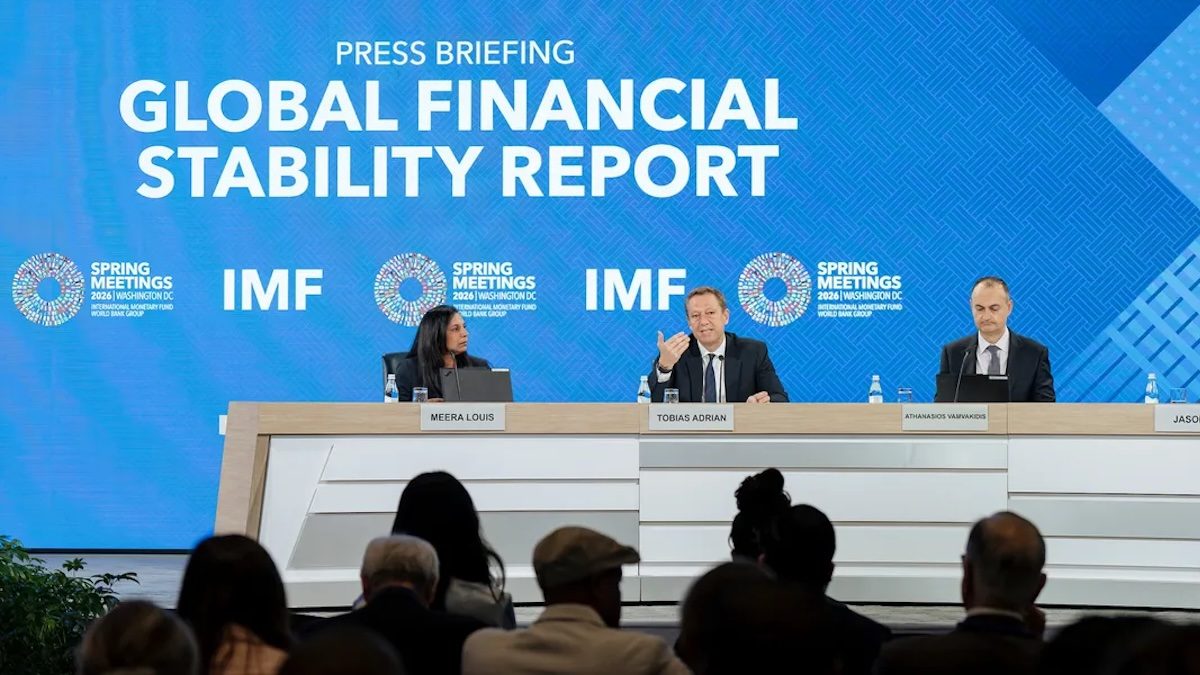
As international financial leaders gather in Washington D.C. for the International Monetary Fund’s annual Spring Meetings, the institution has issued a stark warning: the ongoing US-Israeli military conflict in Iran threatens to derail global economic momentum, trigger a new energy crisis, and push vulnerable economies into deep recession. The grim update, included in the IMF’s latest *World Economic Outlook*, comes as independent analysts and policy experts warn the long-term financial cost of the conflict to US taxpayers alone could top $1 trillion, with disproportionate harm falling on low-income and vulnerable communities worldwide.
Prior to the outbreak of hostilities, the IMF had upgraded its 2026 global growth forecast to 3.4%, buoyed by private sector adaptation to ongoing trade shifts, lower-than-expected US tariffs, targeted fiscal support, favorable financing conditions, and a productivity boom driven by emerging artificial intelligence technologies. That positive momentum has now come to a sudden halt, according to Pierre-Olivier Gourinchas, the IMF’s director of research. The conflict has already closed the Strait of Hormuz, a critical chokepoint through which roughly 20% of the world’s daily oil supplies pass, and damaged key energy infrastructure across the hydrocarbon-rich Middle East. If hostilities continue, the region’s central role in global energy markets makes a full-blown energy crisis increasingly likely.
Even in the best-case scenario of a quick end to fighting, the IMF projects lasting damage to the global economy. Under a limited conflict framework, global growth is forecast to hit just 3.1% in 2026 and 3.2% in 2027, figures that fall below recent growth outcomes and sit well below pre-pandemic averages. Global inflation, which had been on a downward trajectory, is projected to tick back upward in 2026 before resuming its decline in 2027. The brunt of the impact will fall on emerging market and developing economies, particularly commodity-importing nations that already faced preexisting financial vulnerabilities. Downside risks dominate the forecast: a prolonged conflict, deepening geopolitical fragmentation, underperformance of AI-driven productivity gains, or renewed trade tensions could further weaken growth and roil global financial markets. High public debt levels and eroded policy space leave many nations with little buffer to absorb new shocks. The IMF urges policymakers to prioritize economic adaptability, policy credibility, and strengthened international cooperation to mitigate harm.
The severity of the ultimate economic shock will depend on how long the conflict lasts and its geographic scale, as well as how quickly global energy production and shipping normalize once hostilities cease, the IMF notes. Impacts will vary sharply across regions: net energy-importing nations face the highest exposure, while low-income countries will see reduced tourism, slowing business activity, and falling remittances from migrant workers employed in the conflict region. Eric LeCompte, executive director of Jubilee USA Network and a United Nations finance expert, called the IMF’s new forecast deeply alarming, noting that the world’s poorest and most vulnerable populations will bear the worst of the crisis. “World leaders coming to Washington are receiving a very dark picture of the global economy,” LeCompte said. “The war is causing greater poverty and increases in our fuel and food costs.”
Beyond macroeconomic disruptions, a leading Harvard public policy expert who specializes in calculating the true long-term costs of US military conflicts says the total price tag for American taxpayers will almost certainly reach at least $1 trillion once all indirect and long-term expenses are accounted for. Linda Bilmes, the Daniel Patrick Moynihan senior lecturer at Harvard Kennedy School who co-authored *The Three Trillion Dollar War: The True Cost of the Iraq Conflict* with Nobel Prize-winning economist Joseph Stiglitz, estimates that just the first several days of the US-Israeli assault cost US taxpayers a minimum of $16 billion, nearly $5 billion higher than the Pentagon’s official $11.3 billion estimate.
Bilmes explains that the Pentagon understates short-term costs by valuing used munitions and equipment at their historical book value, rather than the much higher current cost to replace depleted stockpiles. She also points to multi-year, multibillion-dollar contracts the Trump administration has already signed with major defense contractors including Lockheed Martin that will add to long-term costs. Most significantly, the long-term costs of veterans’ care will create a decades-long financial burden. Roughly 55,000 deployed US troops have been exposed to toxins, burning fuel residues, and other environmental hazards linked to chronic long-term illness. Even if only one-third of these troops file for disability and medical benefits, Bilmes projects those costs alone will reach tens to hundreds of billions of dollars. “We are borrowing to finance this war at higher interest rates, on top of a much larger national debt base,” Bilmes explained. “The result is that the interest costs alone will add billions of dollars to the total cost of this war. And unlike the upfront costs, these are costs we are explicitly passing on to the next generation.” She added that she would not be surprised if the total cost has already surpassed the $1 trillion mark.
The Washington Post reports the Trump administration is expected to request between $80 billion and $100 billion in emergency war funding from Congress, as part of a broader fiscal 2027 budget proposal that calls for $1.5 trillion in annual military spending. If the request is fully approved, Bilmes notes, total US military spending will rise to levels roughly 20% higher than the peak spending of World War II. Even if Congress rejects the full increase, she projects the conflict will lock in a permanent $100 billion annual increase to the baseline defense budget – a change that compounds to $1 trillion in additional spending over the next decade.
Other independent economic analysts share the IMF’s warnings of severe global harm. A recent report from Oxford Economics analysts Ben May, Bridget Payne, and Paul Moroz found that an extended conflict in Iran could push the entire global economy into recession. In that scenario, Gulf economies would contract by more than 8% in 2026 before a gradual recovery, while advanced Asian economies heavily dependent on Gulf oil would face steep cost increases from more expensive energy imports and widespread supply chain disruptions. Europe would face a painful squeeze on natural gas and electricity prices, while the US – though buffered by its own domestic energy production – would still see a nearly 20% drop in equity markets that would weigh heavily on consumer spending.
Domestically, US policy experts have highlighted the conflict’s toll on American household finances and social spending. Dean Baker, senior fellow at the Center for Economic Policy Research, emphasized that the massive military spending required by the conflict comes at the expense of critical domestic social programs. “To be clear, the main reason to oppose this pointless war is its impact on the people of Iran and elsewhere in the region. But it also has a huge economic cost that is seriously underappreciated,” Baker said. Trump’s proposal to spend 5% of US GDP – or $1.5 trillion annually – on the military works out to $12,000 per household annually, he noted. To offset this record military spending, the Trump administration has proposed $73 billion in cuts to non-defense domestic spending, on top of historic cuts to Medicaid and the Supplemental Nutrition Assistance Program that already serve tens of millions of low-income Americans. “It is striking to see that Congress might be willing to quickly cough up this money for military funding when it has refused far smaller sums that could have made a huge difference in the lives of tens of millions of people,” Baker added.