Thirty years after their last full bilateral tour, two of rugby union’s most iconic and successful nations, South Africa and New Zealand, are set to kick off a historic four-test series this Saturday at Johannesburg’s Ellis Park, a venue widely revered as one of the sport’s most imposing home fortresses. The long-anticipated showdown arrives with just minor late injury concerns for a handful of players on both sides, as the two global powerhouses finalize their starting lineups for the opening match.
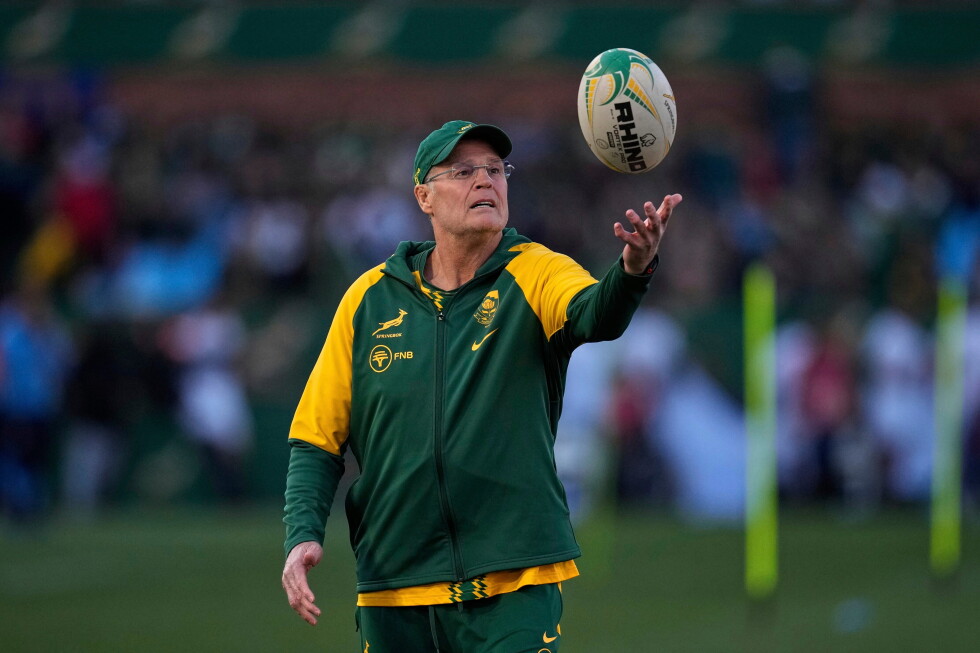
Bookmakers and analysts broadly favor the two-time defending World Cup champion Springboks, who enter the first four-test series between the sides since 1976 as the top-ranked side in the world, opposite New Zealand’s second-ranked All Blacks. At the helm of South Africa is Rassie Erasmus, who has spent eight years as the Springboks’ head coach and director of rugby, building an impressive 8-6-1 head-to-head record against the All Blacks that buck decades of historical trend. The All Blacks hold an overall all-time lead in the matchup, largely buoyed by the Springboks’ historic struggles to secure wins on New Zealand soil, but Erasmus has completely reshaped the South African program since he took over following a humiliating 57-0 loss to the All Blacks in 2017. Under his leadership, the Springboks have claimed the last two consecutive World Cup titles, including a narrow 12-11 victory over New Zealand in the 2023 World Cup final.
Widely known for his unconventional approach to selection, Erasmus regularly prioritizes developing young, uncapped talent over fielding his most experienced starting XV every match. But his innovative tactical approach — which introduced the famous “Bomb Squad”, a reserve bench stacked entirely with powerful impact forwards, and popularized the use of hybrid utility players — has earned unwavering trust across the entire Springboks squad. Proving their resilience, South Africa overcame early red cards to secure wins over France and Italy twice during the 2023 World Cup run, and Erasmus currently has at least 15 double World Cup winners in his squad, all of whom are already targeting a third consecutive title at the 2027 World Cup in Australia.
Erasmus shares a long-standing coaching relationship with his All Blacks counterpart Dave Rennie, whose appointment as New Zealand head coach came only this June, following a successful title run in Japan’s domestic rugby league. The two first crossed paths a decade ago, when Erasmus led Ireland’s Munster against Rennie’s Glasgow Warriors, and met again during Rennie’s tenure as head coach of Australia from 2020 to 2022. Erasmus has praised Rennie’s ability to instill intensity and competitive fire in his squads, noting that “he makes it physical”.
Despite limited preparation time to build cohesive starting combinations, Rennie has already successfully lifted team morale across the All Blacks camp, leading the side to wins over France, Italy and Ireland in the July Nations Championship. To help his squad get up to match speed ahead of the series, Rennie arranged for his players to gain competitive minutes with South African domestic clubs the Stormers, Sharks and Bulls earlier this month. While Rennie is still working to identify which fringe players can step up into key backup roles, Erasmus faces the far more favorable challenge of cutting established talent from his matchday squad, thanks to the Springboks’ unprecedented depth that is the envy of every other top rugby nation.
Erasmus has approached the 2024 international window as a sort of pre-World Cup pool stage, making as many as 10 changes to his starting lineup between matches even as the Springboks continued to dominate top competition. Even with disrupted team cohesion from frequent lineup changes, South Africa put up more than 40 points against England, Scotland and Wales in the Nations Championship, and navigated their only tough test of the window with a 17-10 win in Buenos Aires. For Erasmus, this series against the All Blacks is the logical next step: the playoffs for the 2027 World Cup cycle.
The grueling series structure — four tests on four consecutive Saturdays, split across two countries, with the final test hosted in Baltimore, USA — means injuries are all but guaranteed for both squads. Rennie has warned that the series is likely to see more than 30 players from his 44-man touring squad pick up knocks, and he has already been forced to replace four players, two of whom were capped test starters.
Erasmus, however, enters the opener brimming with confidence, rooted in the Springboks’ last dominant showing against the All Blacks in Wellington last September. After a narrow loss at New Zealand’s unbeatable Eden Park fortress earlier in the tour, Erasmus made seven changes to his starting XV, was forced to substitute four players due to injury in the first half, and still watched his relatively young side secure a historic 43-10 victory over the All Blacks. That win launched the Springboks into an uninterrupted 12-test winning streak, their longest run of victories in 18 years.
In a notable tactical shift for 2024, South Africa has evolved its traditional playing style, long defined by a physically punishing forward pack and kick-first halfback play, to adopt a more dynamic attacking strategy. This shift has been driven by the hiring of former All Black Tony Brown as attack coach, who has helped the Springboks increase their counterattacking frequency and score tries from fewer phases. Brown’s work has been so impressive that the All Blacks have already signed him to join their coaching staff starting in 2028.
For their part, the All Blacks have historically offset their smaller average player size compared to the Springboks with faster play and sharper tactical decision-making. Former All Black captain and current assistant coach Tana Umaga described facing the Springboks as “a relentless wave of a big bang coming at you”.
The history of the All Blacks’ success in South Africa has always been built on forward play: New Zealand’s only ever series win on South African soil, achieved in 1996, came behind one of the greatest forward packs in rugby history, led by icons Sean Fitzpatrick, Olo Brown, Michael Jones and Zinzan Brooke. Former South African head coach Heyneke argues that the current All Blacks’ scrum and set-piece play does not reach that standard, and predicts that this weakness will be their downfall in the series.
“If you don’t have a good set-piece you’re in trouble. And we’ve got an unbelievable set-piece,” Meyer told the *Behind the Ruck* podcast. “So, it will be close, but at home you have to back the Springboks.”