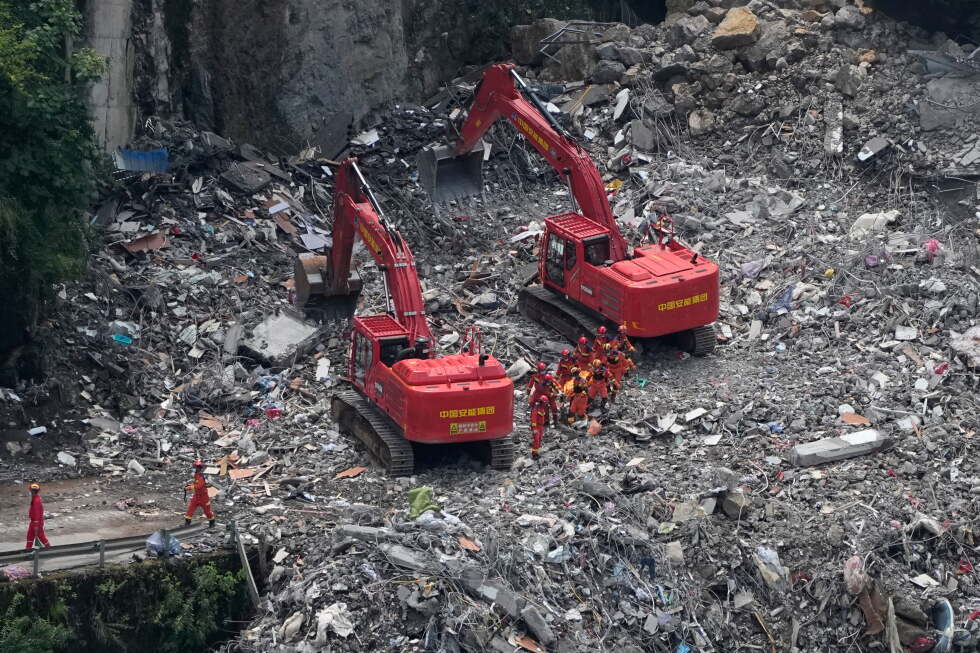
On a rainy Friday morning in Pengshui County, a mountainous suburban district of southwest China’s Chongqing municipality, a catastrophic natural disaster unfolded: a massive landslide, carrying roughly 18,000 cubic meters of rock, soil and debris including a single 3,000-cubic-meter boulder, surged down a steep slope along the Wujiang River, completely burying more than 10 residential structures. As of Sunday, the disaster has been confirmed to have claimed at least eight lives, left 34 people unaccounted for, and left local emergency response teams working around the clock to locate any remaining survivors trapped under the rubble.
By Sunday, heavy machinery including excavators had been brought in to systematically clear debris at the disaster site, with search and rescue teams methodically combing through broken concrete and shifted earth. Witnesses at the scene observed a team of nine rescuers carrying a sealed orange body bag away from the active search zone, though official confirmation of the bag’s contents had not been released as of Sunday afternoon.
In a statement released via Chinese social platform WeChat on Sunday, Chongqing municipal authorities outlined proactive safety measures taken after the landslide. All residents from 21 at-risk buildings within a 1-kilometer radius of the disaster site, including structures on unstable adjacent slopes and low-lying flood and landslide-prone areas, have been successfully evacuated, relocating more than 1,100 local residents to safer temporary accommodation to protect them from potential secondary disasters.
Ten people have already been pulled alive from the rubble since the disaster struck. Officials confirmed that one of those rescued has already been discharged from medical care, while the remaining nine survivors remain in stable condition as they receive treatment for their injuries.
Just a day prior on Saturday, search teams working with trained sniffer dogs and specialized life detection equipment picked up clear signs of life under the debris, confirming at least one person was still alive and trapped in the rubble. Rescue commanders noted that work had to proceed with extreme caution, as hasty or reckless excavation could dislodge the massive boulders scattered across the site and trigger a secondary landslide that would put both trapped survivors and rescue personnel at greater risk.
More than 120 technical experts have been deployed to the disaster zone to support rescue efforts, providing geological assessment, search planning and engineering guidance to emergency response teams. The landslide was confirmed to have been triggered by sustained rainfall, striking a river-adjacent stretch of karst mountain terrain crisscrossed by small rural towns and agricultural terraces, in Pengshui County which borders China’s Hubei and Guizhou provinces. Reporting for this story was contributed by Leung from Hong Kong, with additional support from Associated Press video producer Wu Jia.