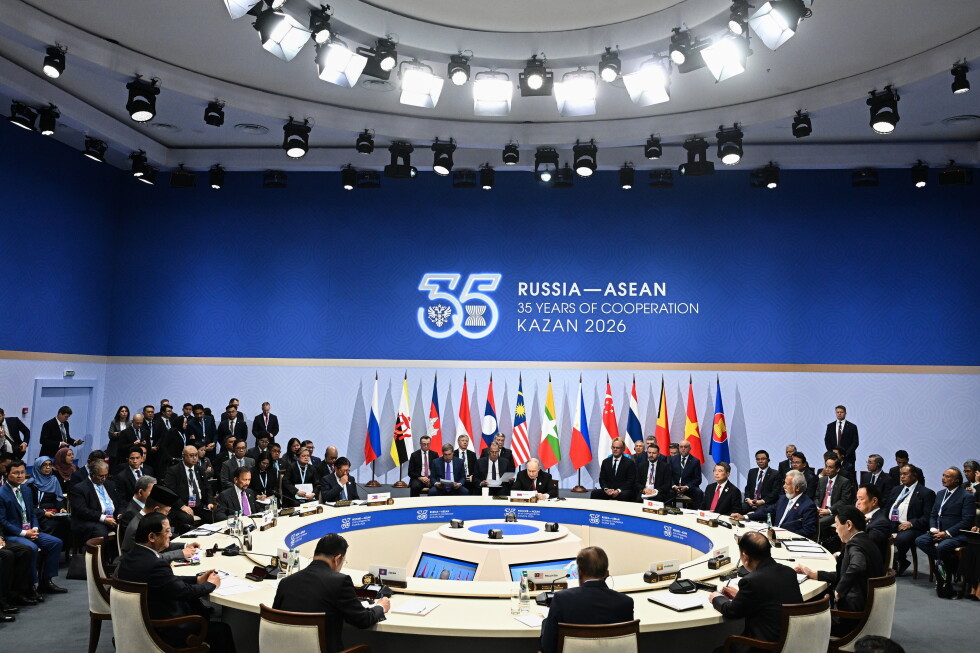
On Thursday, Russian President Vladimir Putin opened a landmark Russia-Association of Southeast Asian Nations (ASEAN) summit in the Russian city of Kazan, using the occasion to celebrate three and a half decades of diplomatic and economic cooperation and push for deeper ties between Moscow and the 11-nation Indo-Pacific bloc. The gathering, which brought together leaders from across ASEAN’s member states — Brunei, Cambodia, Indonesia, Laos, Malaysia, Myanmar, the Philippines, Singapore, Thailand, East Timor and Vietnam — concluded with a formal agreement to expand the bilateral “strategic partnership” that has defined relations between the two sides for decades.
In his opening address to the assembly, Putin emphasized that this partnership has emerged as a critical stabilizing force for the entire Asia-Pacific region, at a time when global geopolitical tensions are creating widespread uncertainty. “It is a strategic partnership that serves as an essential stabilizing factor in the Asia-Pacific amidst geopolitical turbulence, contributing to the formation of a balanced security architecture and equitable mutually beneficial cooperation,” Putin told attendees.
The summit’s working agenda centered on three core priorities: an open exchange of perspectives on pressing global and regional security issues, a comprehensive review of ongoing cooperation initiatives between Russia and ASEAN, and the mapping out of priority areas for joint work in the coming years. Putin highlighted that collaboration between the two sides has already expanded across a broad range of sectors, spanning counterterrorism and responses to emerging transnational security threats, trade and foreign direct investment, energy, agriculture, digital transformation, scientific research and technological development, tourism, and people-to-people cultural exchanges.
In a joint declaration signed by all participating delegations at the close of the summit, leaders reaffirmed their shared commitment to building a “just multipolar world” governed by international law and the core principles laid out in the United Nations Charter, with a focus on advancing mutually beneficial cooperation and equal respect for the sovereignty of all nations. The document labeled the Kazan summit a transformative milestone in Russia-ASEAN relations, and participants pledged to maintain regular high-level diplomatic engagement to continue advancing their shared strategic goals.
Beyond the plenary summit sessions, Putin held a series of closed-door bilateral meetings with individual ASEAN leaders. The event was co-chaired by Philippine President Ferdinand Marcos Jr., as the Philippines currently holds ASEAN’s rotating rotating bloc presidency.
ASEAN’s 11 member states maintain widely varying foreign policy alignments: some members, including the Philippines, have long-standing security alliances and alignment with the United States, while others maintain deep trade and security ties with both China and Russia. In recent years, following sharp spikes in global energy prices triggered by widespread geopolitical disruptions, multiple ASEAN capitals — including the Philippines, Indonesia, Thailand, and Vietnam — have either increased imports of discounted Russian crude oil or publicly expressed interest in expanding energy purchases from Moscow.