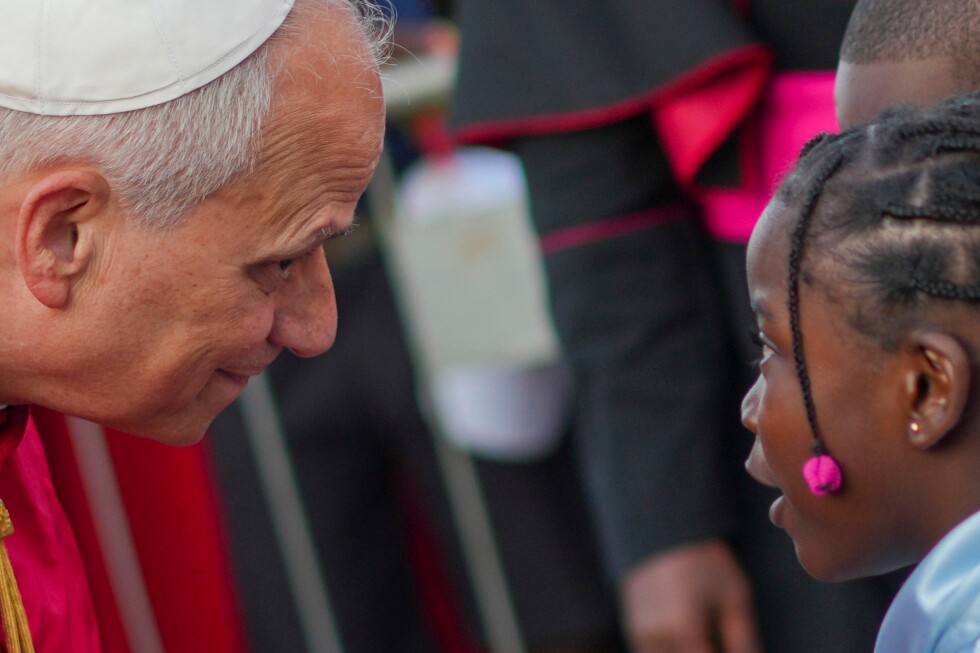
After wrapping up earlier stops across four African nations, Pope Leo XIV touched down in Equatorial Guinea on Tuesday for the closing leg of his first papal visit to the continent — a stop widely framed as the most diplomatically sensitive challenge of his early tenure leading the global Catholic Church.
Nestled on Central Africa’s west coast, this former Spanish colony has been under the uninterrupted rule of 83-year-old President Teodoro Obiang Nguema Mbasogo since he seized power in a 1979 coup. Today, Obiang stands as Africa’s longest-serving incumbent head of state, and his administration has faced decades of global scrutiny over systemic authoritarian rule and widespread graft.
Equatorial Guinea’s economic trajectory shifted dramatically in the mid-1990s, when large offshore oil reserves were discovered. Data from the African Development Bank shows oil now makes up nearly half the country’s total gross domestic product and accounts for more than 90% of its export revenue. Despite this resource wealth, however, more than half of Equatorial Guinea’s 1.9 million residents live below the poverty line. Human rights organizations including Human Rights Watch, as well as ongoing court proceedings in France and Spain, have documented how the vast majority of oil revenues have been siphoned off to enrich Obiang’s ruling family rather than lifting living standards for the general population.
From the start of his maiden African pilgrimage, Pope Leo has made clear he has no intention of softening his rhetoric on global inequality and graft. His earlier stop in Cameroon offered a clear preview of what observers can expect during his time in Equatorial Guinea. Last week in Cameroon’s capital Yaounde, the pope met with 93-year-old President Paul Biya — the world’s oldest sitting head of state, who has held power since 1982 and faces identical accusations of authoritarianism. Standing beside Biya in the presidential palace during his arrival address, Leo did not hold back.
“In order for peace and justice to prevail, the chains of corruption — which disfigure authority and strip it of its credibility — must be broken,” the pope stated. “Hearts must be set free from an idolatrous thirst for profit.”
While Equatorial Guinea is officially designated a secular state, it is one of the most overwhelmingly Catholic nations in Africa, with roughly 75% of its population identifying as Catholic, and the Church holds a central role in the country’s political and social fabric. Tutu Alicante, a U.S.-based human rights activist who leads the advocacy group EG Justice, explains that Church leadership is deeply intertwined with Obiang’s government. “Part of it is the fear the government has instilled in everyone, including the church, and part of it is the monetary gains that the church derives from this government,” Alicante noted.
The Vatican’s approach to engaging with the regime is nuanced, explained the Rev. Fortunatus Nwachukwu, the second-highest ranking official in the Holy See’s missionary evangelization department. “Should the church go to war against the government? Surely no. Should the church swallow everything as if it were normal? No. The church has to continue preaching justice, always in defense of life, human dignity and the common good,” he said.
Beyond systemic corruption, Equatorial Guinea’s government regularly faces allegations of routine harassment, arbitrary arrest and intimidation targeting political opposition figures, dissident critics and independent journalists. On Transparency International’s annual Corruption Perceptions Index, the country has consistently ranked among the bottom 10 out of all nations surveyed. Samuel Kaninda, Transparency International’s regional advisor for Africa, acknowledged that the Obiang administration has taken tentative steps in recent years to address public anger over graft, including passing a national anti-corruption law and moving to establish a dedicated anti-corruption commission. However, Kaninda stressed that these reforms will only deliver tangible change if the commission is granted full independence to investigate corrupt officials and the national judiciary operates free from political interference.
Kaninda said he holds cautious optimism about the papal visit, noting that even when authoritarian leaders attempt to frame papal trips as an endorsement of their rule, history shows these visits ultimately benefit ordinary citizens. “The risk is there, but at the same time, we see more of the opportunity to shed more light on a lot more that is happening there,” he said, adding that the high-profile visit could lift hopes among Equatorial Guinea’s population and draw global attention to the country’s unaddressed human rights and governance failures.
For many local residents, the visit has already delivered tangible, small-scale benefits: Equatorial Guinean seamstress Tumi Carine says she has seen a surge in orders for garments printed with Pope Leo’s image. “The coming of the pope brought us many customers,” Carine said. “We are really grateful for the coming of the pope, so, we are really happy.”
This is the first papal visit to Equatorial Guinea since Pope St. John Paul II traveled to the country in 1982. Pope Leo faces a packed schedule during his two-day trip: after arriving and holding an initial meeting with Obiang, he will deliver addresses to government leaders and diplomatic representatives, followed by a speech at the country’s national university. He will also celebrate multiple public Masses, visit a psychiatric hospital and a local prison, and meet with young people and their families. Before departing on Thursday, he will travel to the city of Bata to lay prayers at a memorial for the more than 100 people killed in a 2021 explosion at a nearby military barracks, which investigators blamed on grossly negligent handling of dynamite stored in a facility located close to residential neighborhoods.