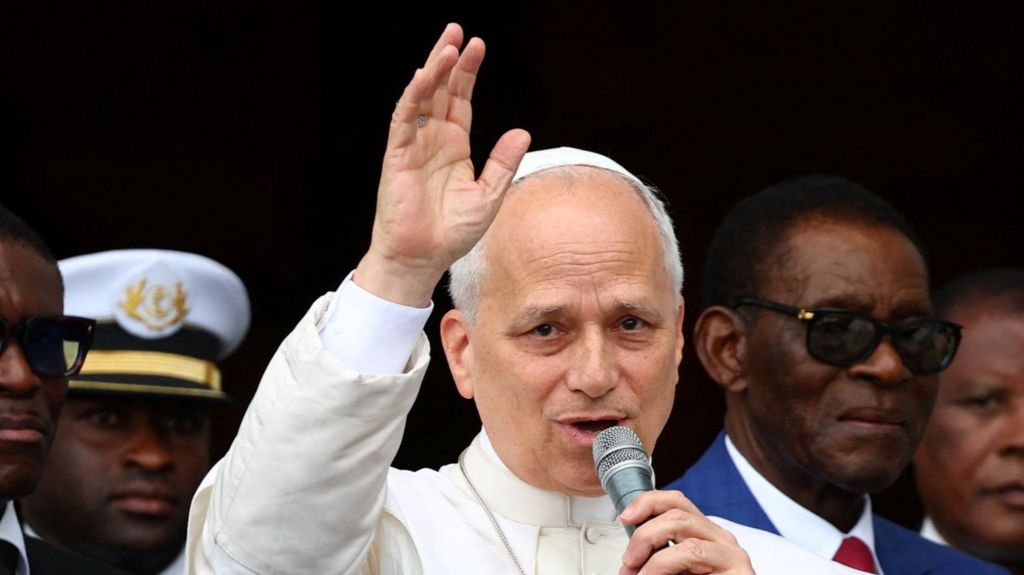
On the final leg of his four-nation African pilgrimage, Pope Francis (correction: Pope Leo as referenced) has delivered a pointed rebuke of systemic injustice in Equatorial Guinea, calling out inhumane prison conditions, endemic corruption, and extreme wealth gaps that have left millions in poverty despite the small nation’s vast oil reserves.
The Pope’s public address came during a heavily attended open-air Mass in the city of Mongomo on Wednesday, where an estimated crowd of 100,000 gathered to greet him — including long-ruling President Teodoro Obiang Nguema Mbasogo, who seized power in a 1979 coup and currently holds the title of the world’s longest-serving incumbent head of state.
Opening his remarks with a call for compassion for marginalized groups, Pope Leo drew direct attention to the grim reality of incarceration in the country, ahead of a scheduled visit to Bata Prison, the notoriously overcrowded and abusive correctional facility in Equatorial Guinea’s economic capital. “My thoughts go to the poorest, to families experiencing difficulty and to prisoners who are often forced to live in troubling hygienic and sanitary conditions,” he told the gathered crowd.
Human rights watchdog Amnesty International has documented widespread abuse inside Bata Prison for years, reporting that inmates are subjected to routine brutal beatings as disciplinary punishment, and that dozens of detainees have been held incommunicado, leaving their families with no information about whether their loved ones are alive or dead.
Beyond prison conditions, the Pope used the high-profile visit to challenge deep-rooted inequality in the oil-rich nation, where decades of rule under Obiang have been marred by accusations of systemic corruption, widespread human rights abuses, and the diversion of national resource wealth to a tiny ruling elite. He urged Equatoguinean leaders and citizens alike to prioritize collective prosperity over private gain, saying: “The Creator has endowed you with great natural wealth. I urge you to work together so that it may be a blessing for all.”
Pope Leo specifically called for the country’s massive oil revenues to be invested in lifting up the broader population, rather than enriching a small circle of connected elites — a direct reference to longstanding accusations that Obiang’s government has siphoned off public funds for the personal gain of ruling family members. In 2020, Obiang’s son, current Vice President Teodoro Nguema Obiang Mangue, was convicted by a French court of embezzling hundreds of millions of dollars in public funds to fund a lavish lifestyle in Paris, resulting in fines and the seizure of his French assets. Obiang’s government has repeatedly denied all allegations of corruption.
Global corruption watchdog Transparency International currently ranks Equatorial Guinea among the most corrupt countries in the world, while World Bank data confirms that despite the country’s high per-capita GDP driven by oil exports, more than half of its population lives in extreme poverty. Political opposition is effectively banned, independent journalism is nonexistent, as all domestic broadcast media is controlled directly by the state or allies of the ruling regime. In a clear call for greater political openness, Pope Leo added: “May there be greater room for freedom and may the dignity of the human person always be safeguarded.”
The Mass came one day after Pope Leo held a closed-door private meeting with President Obiang, ahead of his scheduled visit to Bata Prison on Wednesday evening, the final full day of his 4-country tour that also included stops in Algeria, Cameroon, and Angola. Throughout the tour, the Pope has spoken bluntly about historical and ongoing exploitation of the African continent, condemning neocolonial extraction of African mineral resources and blasting authoritarian leaders who divert billions of public funds into war instead of supporting vulnerable populations.
This outspoken tone has already drawn international pushback: shortly before departing for the African trip, Pope Leo criticized former U.S. President Donald Trump over aggressive rhetoric threatening military action against Iran, prompting Trump to respond that the pontiff was “bad for foreign policy.”