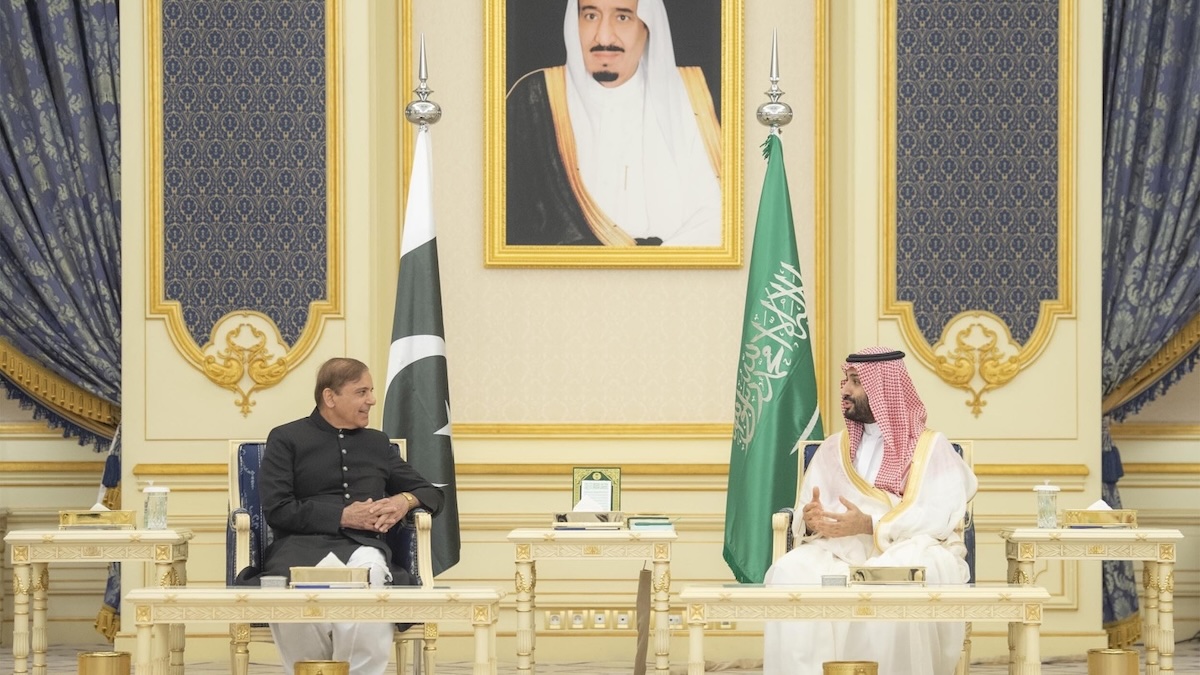
In what geopolitical analysts are calling one of the most underreported yet consequential shifts in Middle Eastern security in recent years, unconfirmed reports of a major Pakistani military deployment to Saudi Arabia under a secret bilateral defense pact have reshaped understandings of evolving regional power arrangements. Citing anonymous security and government sources, Reuters first broke the story that Islamabad has deployed roughly 8,000 troops, a full squadron of JF-17 fighter jets, drone combat units, and a Chinese-built HQ-9 advanced air defense system to the kingdom, all under the terms of the 2025 mutual defense agreement signed by the two nations. Neither Pakistani nor Saudi officials have issued an official confirmation or denial of the deployment details, but the reported scope of the force makes clear this is far more than a limited symbolic advisory mission.
The 2025 Saudi-Pakistan Mutual Defense Agreement was signed in Riyadh on September 17 by Saudi Crown Prince Mohammed bin Salman and Pakistani Prime Minister Shehbaz Sharif, finalized against a backdrop of rapidly escalating regional volatility. The pact’s announcement came just days after an Israeli airstrike targeting a Hamas leadership delegation in Doha, Qatar — an operation that sent shockwaves through Gulf capitals far beyond Qatar’s borders. For decades, Gulf monarchies operated under the core strategic assumption that close alignment with Washington would deter unilateral Israeli military actions on Gulf territory. The Doha strike shattered that long-held confidence, exposing deep growing uncertainty around the reliability of existing regional deterrence frameworks and Western security guarantees. It is this uncertainty, rather than an attempt to displace long-standing American military leadership in the region, that the reported Pakistani military buildup reflects.
The deployment, if confirmed, underscores an emerging new reality: Gulf states are actively pursuing additional layers of strategic protection as doubts grow about the stability and predictability of the regional security environment. Riyadh’s move to deepen security ties with Islamabad sends a clear but understated message to Washington: if existing security guarantees grow less reliable during periods of regional escalation, Gulf nations will diversify their strategic partnership networks. Crucially, this does not mean Saudi Arabia seeks to replace the United States with Pakistan as its primary security guarantor. That misinterpretation ignores both the deep-rooted structure of Gulf security and the scale of long-standing American military entrenchment across the region. The U.S. maintains an extensive, institutionally embedded military presence throughout the Gulf: the U.S. Fifth Fleet is headquartered in Bahrain, Qatar hosts the largest American air base in the Middle East, thousands of U.S. troops remain stationed in Kuwait, and Washington holds formal strategic access agreements with Oman and the United Arab Emirates. Saudi Arabia itself still relies heavily on American military hardware, intelligence sharing, and overarching regional deterrence architecture — a role Pakistan simply cannot fill.
Instead, Riyadh and other Gulf states are increasingly focused on supplementing existing security arrangements, rather than relying entirely on a single external power for protection. It is important to note that deep military cooperation between Saudi Arabia and Pakistan is not a new development. Since the 1970s, Pakistani troops have periodically deployed to Saudi Arabia to support training, border security, and advisory missions. Pakistani military institutions have long-standing, close ties with Gulf defense establishments, and Saudi Arabia has repeatedly stepped in to provide critical economic support to Islamabad during periods of severe financial crisis. The bilateral relationship has also extended beyond conventional defense cooperation to include unspoken broader strategic understandings. For decades, analysts have speculated that decades of Saudi financial support for Pakistan’s nuclear program created an informal expectation that Islamabad’s strategic deterrent capabilities could be called on to support Gulf security if the regional balance of power deteriorated dramatically. Public remarks from former Pakistani Defense Minister Khawaja Asif, which implied Saudi Arabia falls under Pakistan’s “nuclear umbrella”, have only reinforced these assumptions, even though no formal nuclear security arrangement has ever been publicly acknowledged.
While Saudi Arabia has long-standing concerns about Iran’s regional expansion and nuclear ambitions, framing the new agreement solely as a counter to Iran oversimplifies the complex regional context. By the time the pact was signed in September 2025, Iran’s nuclear infrastructure had already sustained major damage during the June 2025 Israel-Iran conflict and subsequent American strikes on Iranian nuclear facilities. Instead, the timing of the agreement reflects broader anxiety across the Gulf about growing regional unpredictability, rather than just an immediate fear of Iranian expansion. The Doha Israeli strike made clear that Gulf territory itself is no longer insulated from spillover escalation from broader regional conflicts, a realization that has accelerated Gulf efforts to diversify security partnerships, build redundant deterrence capabilities, and reduce overreliance on any single security framework.
For Pakistan, the new arrangement requires navigating an extremely delicate geopolitical balancing act. Islamabad holds two unique roles in the region: it is a formal military partner to Saudi Arabia, while also serving as a rare diplomatic intermediary between Washington and Tehran. In recent weeks, Pakistan has reportedly played a central role in brokering and maintaining the current ceasefire between the U.S. and Iran, and even hosted the only direct round of negotiations between the two parties. Few regional actors maintain open, working diplomatic channels with Riyadh, Tehran, Beijing, and Washington simultaneously. Iranian Foreign Ministry spokesperson Esmaeil Baghaei recently confirmed that indirect diplomatic engagement with the U.S. over the Iranian nuclear file remains ongoing rather than intermittent, and noted that Tehran reviewed proposed U.S. amendments to a draft agreement conveyed via Pakistani intermediaries before submitting its formal counterproposal — further underscoring Islamabad’s growing role as a critical communication bridge between adversarial powers.
This diplomatic flexibility has emerged as one of Pakistan’s most valuable geopolitical assets in the current regional order, but balancing between rival regional and global camps carries clear risks. Iran has historically tolerated Pakistan’s defense relationship with Saudi Arabia because the relationship was limited to defensive and advisory roles. A visibly expanded Pakistani military deployment directly tied to regional confrontation could eventually undermine Islamabad’s credibility as a neutral intermediary, complicating its diplomatic work. This strategic tradeoff helps explain why Pakistani officials have remained deliberately vague and cautious in public responses to the Reuters report, as strategic ambiguity continues to serve Islamabad’s core interests.
Beyond its geopolitical implications, the reported deployment also carries technological significance that points to shifting defense markets in the Gulf. The inclusion of Chinese-origin defense systems — the JF-17, which is co-produced with China, and the HQ-9 air defense system — highlights Beijing’s growing indirect footprint in Gulf defense ecosystems. While China remains far from replacing the United States as the dominant military power in the Middle East, and lacks Washington’s extensive alliance network, regional basing infrastructure, and expeditionary military capabilities, Chinese defense technologies are increasingly being integrated into Gulf national procurement plans. This trend is fostering a more diversified, multipolar regional defense environment.
The development is also being closely watched in New Delhi, as Chinese-built defense systems from Pakistan are now entering Gulf security calculations. While the deployment does not fundamentally reshape the regional balance of power, it does reflect the growing strategic interconnectedness between South Asian and Middle Eastern security theaters, a shift that will have ripple effects across the Indo-Pacific.
Ultimately, regional states are not abandoning the United States as a core security partner. Instead, they are taking deliberate steps to reduce their strategic vulnerability by expanding partnership networks and building overlapping security relationships that can adapt to an era of growing geopolitical uncertainty. In this sense, the significance of the Saudi-Pakistan defense arrangement is far more political than it is military. The pact signals the emergence of a new Gulf security order that is more flexible, layered, and strategically diversified than the post-Cold War framework that dominated the region for decades. The United States remains the central external security actor in the Middle East, but Gulf states are increasingly unwilling to rely exclusively on any single power amid intensifying regional fragmentation and shifting global great power priorities. For Pakistan, the greatest challenge will not be deploying military assets to the Gulf, but preserving its valuable strategic flexibility without being pulled irreversibly into competing regional confrontations.
This analysis is contributed by Saima Afzal, a research scholar at Justus Liebig University in Germany, whose work focuses on South Asian security, counterterrorism, and cross-regional geopolitics across the Middle East, Afghanistan, and the Indo-Pacific.