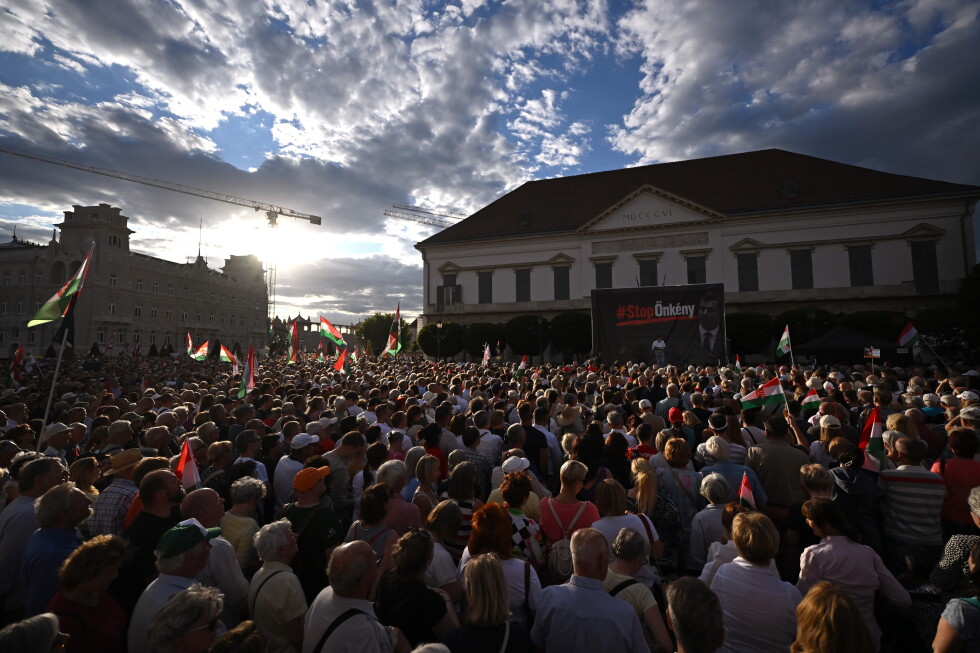
BUDAPEST, Hungary — Thousands of demonstrators converged outside Sándor Palace, the official seat of Hungary’s presidency in Budapest’s historic Castle District, on Thursday for a protest organized by former long-serving prime minister Viktor Orbán’s far-right Fidesz party to oppose the new government’s push to oust sitting President Tamás Sulyok. The demonstration comes amid a bitter political power struggle just months after pro-European center-right Prime Minister Péter Magyar ended Orbán’s 16-year autocratic rule in a landslide April election, and has cast a sharp spotlight on competing claims of what constitutes democratic governance in Hungary.
Magyar’s administration has made dismantling what it calls Orbán’s “mafia-style” autocratic regime a top policy priority, moving quickly to remove dozens of political appointees and institutional leaders installed by the former government who were accused of enabling its anti-democratic agenda. The centerpiece of this current push is a constitutional amendment scheduled for a parliamentary vote next week that would cut Sulyok’s term short, alongside sweeping reforms including new term limits for members of parliament, overhauls to the national judiciary, and the creation of a new anti-corruption body empowered to investigate allegations of widespread financial misconduct during Orbán’s tenure.
Orbán, whose government spent 16 years systematically dismantling independent democratic institutions in Hungary, has now framed the effort to remove Sulyok as an attack on the rule of law and a dangerous first step toward authoritarian rule. He spent weeks promoting the “Stop Tyranny” protest across his social media channels, though he did not appear at the event itself, which comes as Fidesz continues to grapple with its identity after its catastrophic election defeat in April. For many protesters, the demonstration was not a defense of Sulyok personally, but of the integrity of the presidential office. “The point is not whether Tamás Sulyok is popular or not, but that this is simply unacceptable in a democracy,” protester Krisztina Nemerkényi told reporters on Thursday.
Fidesz lawmaker János Pócs defended his party’s record of constitutional changes during its time in power, noting that Fidesz unilaterally rewrote Hungary’s constitution in 2011 and has since amended it 15 times. “We have always done so in the interest of the country, in order to protect the country, but not for the sake of dictatorship,” Pócs told the Associated Press at the protest.
Magyar, for his part, has stood firmly by his pledge to remove Sulyok, arguing that the president failed to uphold his constitutional duties by standing aside as Orbán’s government rolled back democratic checks and balances. The prime minister campaigned explicitly on ousting Sulyok ahead of April’s election, and points to his party’s two-thirds parliamentary majority as a clear voter mandate to follow through on the promise. While Hungary’s presidency is largely a ceremonial role, it holds key powers: the office must sign all legislation into law and can send parliamentary bills to the Constitutional Court for judicial review. Magyar’s allies warn that Sulyok, as an Orbán appointee, could use these powers to block the new government’s planned democratic and anti-corruption reforms.
Since taking office in May, Magyar’s administration has moved rapidly to deliver on other key campaign promises. It immediately suspended operations at the public television and radio news service, which Magyar accuses of operating as a state propaganda mouthpiece for Fidesz during Orbán’s tenure. The government has also implemented an eight-year term limit for future prime ministers, removed the heads of national security and intelligence agencies appointed under Orbán, and enacted rapid democratic reforms that unlocked 16.4 billion euros ($19 billion) in frozen European Union cohesion funds that had been withheld over the democratic backsliding of Orbán’s era.