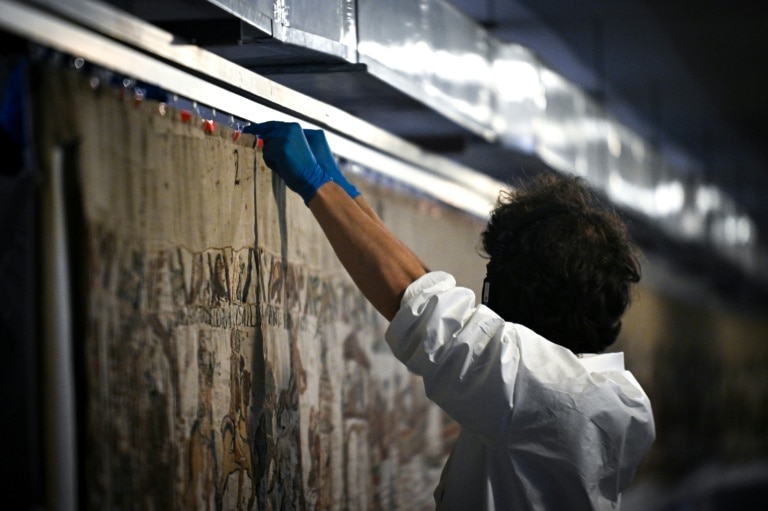
After more than 900 years rooted in its permanent French home, the iconic 11th-century Bayeux Tapestry began its unprecedented journey to London’s British Museum on Thursday, in what ranks as one of the most complex cultural logistics operations in modern history. The fragile 68-meter embroidered masterpiece, which has called the northern French town of Bayeux home for centuries, departed its home institution inside a custom-built high-tech container engineered to absorb vibrations and lock in a consistent temperature and humidity level, according to sources close to the operation. The artwork will travel through the Channel Tunnel aboard a climate-controlled truck, accompanied by a full police security escort to ensure its safe passage across the Channel. This landmark loan is billed as a deliberate diplomatic gesture designed to strengthen long-standing Franco-British friendship, marking the first time the tapestry has left French territory in more than nine centuries. The tapestry chronicles the 1066 Norman invasion of England led by William the Conqueror, who crossed the Channel to defeat King Harold at the Battle of Hastings — an event that permanently reshaped the trajectory of English and European history. Starting September 10, the UNESCO-listed artwork will be open to public viewing at the British Museum in a special exhibition running through July 2027. The historic move has not been without controversy, however. A cohort of conservation experts has raised repeated alarms that the cross-channel transport could cause irreversible harm to the already fragile artwork, which currently bears 30 distinct tears and nearly 10,000 small holes. A 2021 analysis by restoration specialists warned that any journey longer than two hours would carry unavoidable “additional risks” for the delicate piece. These warnings were set aside when French President Emmanuel Macron first announced the approved loan exactly one year ago, framing the move as a celebration of Franco-British ties a decade after the divisive Brexit referendum that strained bilateral relations. In the years since the announcement, cultural and technical teams have completed extensive preparatory work to mitigate transport risks, including multiple detailed technical studies and two full test runs using a full-size reproduction of the tapestry to refine logistics protocols. Last September, conservators completed a delicate, months-long operation to carefully remove the tapestry from its permanent display at the Bayeux Museum, where it had not been moved since 1983, and transfer it to a secured, undisclosed storage location to await transport. This is not the first time plans have been floated to bring the tapestry to the UK: two prior proposals, one for Queen Elizabeth II’s 1953 coronation and a second for the 900th anniversary of the Battle of Hastings in 1966, were ultimately scrapped over conservation and logistics concerns. Public demand for the upcoming exhibition has already broken records, with the British Museum selling 100,000 tickets on the first day of sales earlier this month. Adult tickets are priced between £25 and £33, and after the first batch sold out in record time, museum officials have announced that a second allocation of tickets will be released to the public later this year. Once on display, the tapestry will be laid flat for unobstructed viewing inside a purpose-built elevated glass display case designed to protect the artwork while giving visitors a full view of its intricate embroidery. The UK government has covered the full cost of the transport operation, though the exact total expenditure has not been disclosed to the public.