A fresh sovereignty row over the North African enclave of Ceuta has sent diplomatic tensions between Morocco and Spain soaring, after a senior Moroccan cabinet minister publicly questioned Madrid’s rule over the territory during an official state ceremony.
Ahmed Toufiq, Morocco’s Minister of Habous and Islamic Affairs, made the contested remarks at an event marking the birth of the Prophet Muhammad, held at Rabat’s Royal Palace and hosted by King Mohammed VI. During his speech highlighting centuries of Islamic scholarly work on the life and teachings of the Prophet, Toufiq named three influential texts written by Islamic intellectuals hailing from Ceuta: Al-Shifa by Qadi Iyad, Al-Durr al-Manzum by Al-Azafi, and the well-known collection of prayers Dala’il al-Khayrat by Imam Al-Jazuli.
Toufiq went on to frame Dala’il al-Khayrat as a historic symbol of Moroccan collective mobilization to free what he called “occupied cities” along Morocco’s Atlantic coast during the early modern era. The reference was a clear nod to 15th and 16th century Moroccan resistance movements that pushed back against Portuguese and Spanish territorial expansion along both the Atlantic and Mediterranean coasts of the region.
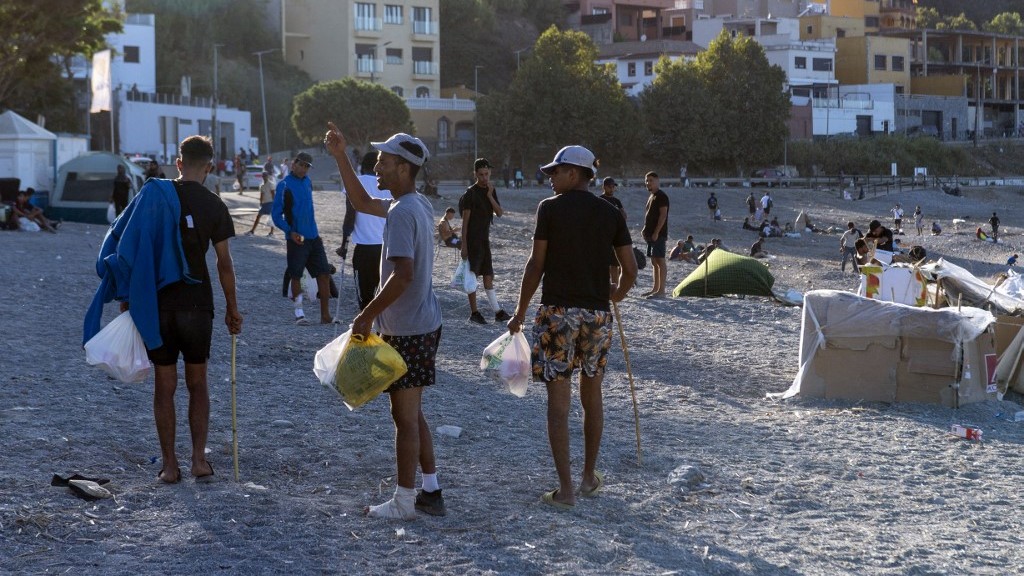
The comments sparked immediate outrage in Spain, which is already grappling with persistent diplomatic friction and migration pressures linked to a massive border crisis at Ceuta that unfolded in late July. During that crisis, more than 72,000 people crossed from Morocco into Ceuta, including roughly 7,000 unaccompanied minors, according to official Spanish data. Viral footage captured thousands of migrants swimming around the border barrier to reach the enclave, many relying on basic flotation devices to make the dangerous crossing. While most migrants returned to Morocco within hours, several thousand remained in Ceuta, overwhelming local reception facilities. Madrid ultimately rolled out an emergency plan to relocate 500 of the most vulnerable minors to the Spanish mainland to ease overcrowding.
At least 141 people were killed during the July 30 crossing incident, an event that already drove a sharp wedge between the two neighboring countries. Many Spanish political figures have openly accused Moroccan authorities of deliberately enabling the mass migration surge to pressure Madrid over longstanding territorial disputes.
Toufiq’s sovereignty claim is not an isolated incident: he is the second senior Moroccan government official to publicly stake a claim to Ceuta and the neighboring adjacent enclave of Melilla in the months following the July crisis. Just one week prior, Moroccan Justice Minister Abdellatif Ouahbi publicly referenced Morocco’s “historical and geographical right” to both territories, and proposed establishing a bilateral commission to negotiate their “return to the homeland.”
Spanish officials have moved swiftly to reject the new claims. On Tuesday, Spanish Migration Minister Elma Saiz issued a firm rebuke of Toufiq’s comments during a public press briefing. “Ceuta and Melilla are Spanish,” she stated. “They are our southern borders, as well as the borders of Europe. There is nothing more to add.” Madrid has previously “categorically” rejected any challenge to its sovereignty over the two territories.
Ceuta and Melilla are both Spanish autonomous cities located entirely within Moroccan territory along the country’s northern Mediterranean coast. They host the only shared land border between the European Union and the African continent, making their status a critical point of both diplomatic and policy contention for the EU as well. The Moroccan government has never formally recognized Spanish sovereignty over either enclave, leaving the issue as one of the longest-running unresolved disputes in North African-European relations.