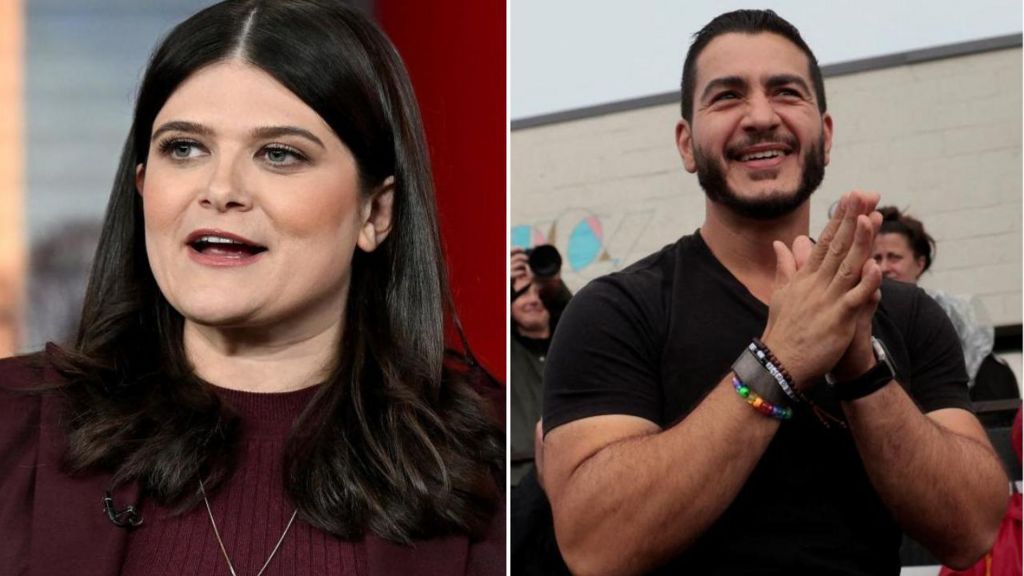
As voters head to the polls on Tuesday in Michigan, one of the most closely watched and fractious Democratic Senate primaries in recent memory will finally deliver a verdict on a battle that lays bare the deep ideological rift splitting the Democratic Party ahead of November’s critical midterm elections. The fight for the open, retiring Democrat-held Senate seat pits establishment-backed four-term moderate congresswoman Haley Stevens against progressive former public health official Abdul El-Sayed, a left-leaning challenger who has channeled widespread grassroots anger at the status quo in Washington.
This race carries national stakes far beyond Michigan’s borders: as a pivotal Midwestern swing state that backed Joe Biden in 2020 before flipping to Donald Trump in 2024, holding the open seat is non-negotiable for Democrats if they hope to retain Senate control, build legislative gains, and block Trump’s policy agenda. The winner of Tuesday’s primary will face off against former Trump ally Mike Rogers in the general election on November 3, with polling locations opening at 7 a.m. EDT and closing at 8 p.m. EDT.
For more than a year, the two candidates have campaigned on sharply contrasting visions for the state and the nation. El-Sayed, 41, the son of Egyptian immigrants, would make history as the first Muslim U.S. senator if he claims the seat. Endorsed by high-profile progressive leaders including Vermont Senator Bernie Sanders and New York Representative Alexandria Ocasio-Cortez, El-Sayed has centered his platform on progressive priorities: Medicare for All, a wealth tax on billionaires, and the elimination of U.S. Immigration and Customs Enforcement. He has rejected the socialist label, despite aligning with many left-wing policy goals, and drawn strategic inspiration from New York Mayor Zohran Mamdani’s successful 2025 campaign, which leveraged social media and a laser focus on cost-of-living issues to win over voters.
For working-class voters like longstanding Democrat Les Lukacs, who remains uninsured amid soaring prices for groceries, gas and housing, El-Sayed’s focus on household affordability is the reason for his support. Lukacs has even said he will sit out the general election if El-Sayed loses the primary, arguing that the Democratic Party has failed to prioritize the needs of everyday Americans, a sentiment El-Sayed echoes on the campaign trail.
The race has also become a flashpoint for national tensions over U.S. foreign policy in the Middle East. Michigan is home to the second-largest Arab-American population in the U.S., and growing voter frustration with U.S. support for Israel in the Gaza conflict has boosted El-Sayed, who has called Israel’s military actions in Gaza a genocide – a claim Israel denies – and called for an end to unconditional U.S. military aid to Israel. He has repeatedly highlighted Stevens’ ties to the American Israel Public Affairs Committee (AIPAC), which has spent nearly $30 million to support his opponent. Stevens, a moderate who identifies as staunchly pro-Israel but has publicly criticized Israeli Prime Minister Benjamin Netanyahu, drawing a rebuke from him in a CNN interview, has stood by her support for continued U.S. aid to Israel. The split over the issue has put Michigan Democrats in a classic bind: the party has historically relied on support from both Jewish and Arab-American voters to win elections, according to University of Virginia Center for Politics director Larry Sabato, who notes that “both sides are trying to make it as painful as possible” for the party to choose a stance.
For Stevens, the 43-year-old incumbent congresswoman has positioned herself as the pragmatic, electable alternative to El-Sayed’s far-left platform. Endorsed by popular Michigan Governor Gretchen Whitmer and outgoing Senator Gary Peters, Stevens has centered her campaign on protecting Michigan’s core manufacturing jobs and argued that El-Sayed’s progressive stances will make him too weak a candidate to beat Mike Rogers in the general election. Her campaign says Stevens will “fight for all Michiganders from every zip code to lower costs, protect manufacturing jobs, and take on Donald Trump’s corruption and abuses of power.” She has also turned viral online mockery of her distinct Midwestern accent into a campaign talking point, dismissing commentators who dissect her voice as “coastal elites” who look down on Michigan voters. For undecided and centrist voters like 74-year-old Ferndale resident Colleen Houlihan, who plans to vote for Stevens, the priority in a volatile election year is putting forward a candidate who can win, even if it means putting off more radical change: “I want radical change in the country, but we’ve got to start with this administration and it’s got to be an electable candidate to get power back in sane hands.”
While progressive candidates have notched a wave of primary victories across the country this summer, including in Colorado, it remains an open question whether the left wing of the party can successfully win back disillusioned working-class voters who shifted to Trump in the 2024 election. Tuesday’s result will send a clear signal about which direction the Democratic Party will lean ahead of November, with consequences that will reverberate through U.S. politics for years to come.