For millions of years, Earth’s only natural satellite has endured a constant barrage of interstellar impacts. Asteroids and meteors have carved its iconic pockmarked landscape, leaving a sprawling network of craters that tell the story of our solar system’s violent history. In modern decades, human space exploration has added a new type of impact to the Moon’s surface, from intentional probe crashes to accidental collisions from discarded launch hardware. On August 5, the Moon is set to receive yet another human-made visitor: an abandoned upper stage of a SpaceX Falcon 9 rocket, drifting through space at 2.43 kilometers per second (roughly 5,400 miles per hour), is on track to collide with the lunar surface.
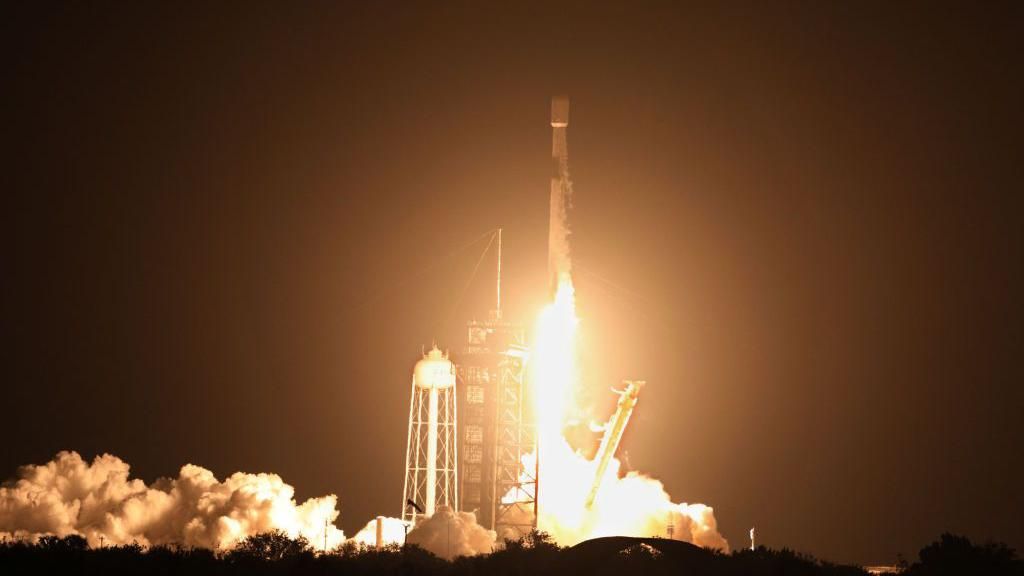
The prediction of this upcoming crash comes from NASA’s Center for Near-Earth Object Studies (CNEOS), which confirmed the trajectory after independent astronomers used public launch data to identify the rogue rocket component. The discarded stage was left in orbit following a January 2025 joint U.S.-Japanese lunar mission, which carried two lunar landers and a suite of scientific instruments to lunar orbit. While SpaceX designs most Falcon 9 components to be reusable and return to Earth for future flights, upper stages are often jettisoned in space after completing their boost mission, left to drift in orbit until gravitational forces pull them toward a collision with a celestial body.
Weighing in at no less than 4,000 kilograms (8,800 pounds) on Earth and roughly the size of a five-story building, this piece of space hardware is set to impact near the historic Einstein Crater, a location on the Moon’s Earth-facing side that will be bathed in daylight at the time of collision. Astronomer Bill Gray, the researcher who first identified the object’s collision trajectory, estimates the impact will carve a new crater more than 17 meters (56 feet) in diameter into the lunar surface. The collision is scheduled to occur at approximately 02:35 EDT (06:35 GMT) on August 5.
NASA has stressed that the incoming rocket stage poses zero risk to populations or infrastructure on Earth. In a statement, agency spokesperson Jimi Russell noted that NASA will continue tracking the booster as a training exercise for near-Earth object monitoring, and will later study the fresh impact site to advance lunar science.
The unplanned collision has drawn excitement from both amateur and professional astronomers around the world, who see it as a rare, free research opportunity that would be impossible to arrange intentionally. Dr. Matt Bothwell, public astronomer at the University of Cambridge, explained that the event will be far more dramatic than any similar impact on Earth, thanks to the Moon’s lack of atmosphere and much weaker gravitational pull. With no atmospheric drag to slow the incoming rocket, the entire 4,000-kilogram mass will hit the surface at full speed, throwing up an enormous plume of lunar dust that could reach 50 kilometers or higher into space, before spreading across the surrounding terrain. An estimated one million kilograms of rock and dust debris will be launched into space following the impact, a spectacle that cannot be replicated in controlled experiments on Earth.
While the impact flash will not be visible to the naked eye from Earth, observers with access to high-powered professional or advanced amateur telescopes may be able to spot a brief flash of light on the lunar surface immediately after collision. A broad international collaborative effort is already in place to capture as much data as possible from the event: large ground-based telescopes across the Americas will monitor the impact, NASA’s Lunar Reconnaissance Orbiter and South Korea’s Danuri lunar probe will capture close-up observations of the flash, dust plume and newly formed crater, and a citizen science project is recruiting amateur astronomy enthusiasts to record the event as well.
By observing the plume in real time and mapping the new crater after impact, researchers hope to turn this accidental collision into a groundbreaking scientific experiment. Tracking the volume of ejected material, the height of the plume, and how dust falls back to the surface will allow scientists to refine existing models of lunar impact processes. The crash will also expose fresh, unaltered subsurface material at the impact site, giving researchers a rare unplanned look at the composition of lunar rock just below the surface that has never been exposed to space weathering.
Beyond the scientific gains, astronomers say the event also serves as a stark reminder of the growing problem of human-made space debris. “I think more people should be more worried about space debris,” Bothwell noted. “Every single year we put more stuff in orbit. Sometimes the satellites just collide, and they shatter into more pieces. I think there’s a worry about a runaway cascade, if we put so much stuff in orbit.” Data from the European Space Agency (ESA) underscores this concern: there are currently more than 54,000 human-made objects larger than 10 centimeters drifting in Earth and lunar orbit, and humans have launched a total of roughly 17,000 tonnes of hardware into space since the start of the Space Age in 1957.
This is not the first time discarded human rocket hardware has impacted the Moon. The most recent prior incident occurred in 2022, when an upper stage of China’s Long March 3C rocket, left over from the 2014 Chang’e 5-T1 mission, crashed into the Moon’s far side, which is permanently turned away from Earth. Decades ago, NASA intentionally crashed multiple objects into the lunar surface to collect test data ahead of the historic Apollo crewed missions, demonstrating that even unplanned or intentional impacts can advance our understanding of Earth’s closest celestial neighbor.