On the tarmac of Tjilik Riwit Airport in Palangka Raya, Central Kalimantan, technicians from Indonesia’s National Disaster Management Agency carefully load canisters of sodium chloride into a waiting aircraft. This routine pre-flight preparation is part of a high-stakes gambit: the Southeast Asian nation is turning to cloud seeding to curb an unprecedented wildfire crisis amplified by one of the strongest El Niño events in recent decades.
Indonesia’s biodiverse Borneo island, a region home to old-growth pristine rainforest and globally protected endangered species, is ablaze this dry season. Official government data confirms more than 100,000 hectares of land have already burned in the first six months of 2024. But independent analysis from deforestation monitoring project Nusantara Atlas paints a far grimmer picture, putting the total burned area through July at over 285,000 hectares—an expanse more than four times the geographic size of Indonesia’s capital Jakarta.
Cloud seeding, a weather modification technique that disperses silver iodide, salt particles and other nucleating agents into existing clouds to stimulate rain formation, is not a common tool for wildfire suppression across the globe. But for Indonesia, the strategy carries urgent weight: the country is still recovering from the devastating 2015 wildfire season, which was also driven by a strong El Niño, burned millions of hectares of forest and peatland, and sparked a transboundary toxic haze crisis that disrupted daily life across Malaysia, Singapore and southern Thailand.
Unlike popular misconception, cloud seeding does not create new clouds, explained meteorologist Safillah Anggie Wahyuni, who has accumulated more than 300 flight hours on cloud seeding missions since she carried out her first operation three years ago. Instead, the technique works by maximizing the rainfall potential of existing cloud formations. “Weather modification will only be effective if the conditions are right,” Safillah told AFP during an overflight of fire-stricken Central Kalimantan.
Data from Indonesia’s national meteorological agency BMKG shows the country has dramatically scaled up cloud seeding operations in recent years: between 2021 and August 2024, crews carried out 252 missions, compared to just 85 operations across the entire preceding decade. While many of these missions have targeted flood reduction by drawing rain away from vulnerable populated areas, a growing share is now focused on dousing active wildfire hotspots and wetting down parched, highly flammable peatland ecosystems. Currently, dozens of helicopters and fixed-wing aircraft are on standby across the country to deploy cloud seeding at short notice, with security officials maintaining round-the-clock monitoring for any formation of rain-bearing clouds.
Still, the technique remains controversial, and the vast majority of Indonesia’s firefighting work still happens on the ground, where nearly 50,000 frontline firefighters are currently deployed across fire-prone regions. Critics point out that during the peak dry season, when wildfires are most intense and El Niño brings prolonged drought, clouds are often too scarce for cloud seeding to deliver meaningful results.
“Its effectiveness will be very low because of the lack of clouds,” said I Putu Santikayasa, a hydroclimatology lecturer at IPB University, located south of Jakarta. Beyond the issue of limited cloud cover, researchers have also noted that measuring the actual efficacy of cloud seeding remains methodologically challenging, while concerns have been raised about potential environmental harm from widespread silver iodide use and the high cost of sustained operations.
BMKG’s weather modification director Budi Harsoyo acknowledged that cloud seeding is only a temporary mitigation measure, not a long-term solution to Indonesia’s wildfire crisis. He also pushed back on safety concerns, noting there is no peer-reviewed evidence of harm from the levels of silver iodide used in current operations. A 2023 study authored by Harsoyo found that a 12-day cloud seeding operation in Central Kalimantan doubled expected rainfall and eliminated all mapped active fire hotspots during the operation period.
Environmental activists go further, arguing that technical fixes like cloud seeding distract from the root causes of Indonesia’s recurring wildfire crises. A large share of the country’s fire-prone land is made up of tropical peatlands: carbon-dense ecosystems that are highly water-retentive and fire-resistant when intact, but turn extremely flammable when drained for agricultural development, with underground fires that can smolder for months and reignite suddenly when conditions are dry.
Uli Arta Siagian, campaign coordinator for local environmental advocacy group WALHI, argues the core solution is protecting these vulnerable ecosystems from unsustainable development, rather than relying on emergency interventions after fires break out. “The responsibility for protection lies with the state by not issuing permits in areas that are vulnerable to fire,” she told AFP.
The 2024 wildfire season has already renewed regional concerns about transboundary haze, a recurring diplomatic and public health issue for Indonesia’s neighbors Malaysia and Singapore. In recent weeks, elevated haze from Borneo fires has pushed air pollution levels far past safe limits in the Malaysian portion of the island, forcing authorities to close hundreds of schools to protect children’s health.
Beyond cloud seeding, the Indonesian government has deployed a suite of additional response measures: ongoing peatland rewetting projects to restore water levels in drained ecosystems, satellite and ground-based monitoring of fire hotspots, and new enforcement directives for local governments. Large-scale plantation operators are banned from using fire to clear land, though the exemption for small-scale smallholders means the practice remains widespread, and is blamed for igniting the majority of annual wildfires. The country’s environment minister has now ordered local authorities to strengthen preventive patrols and pursue full legal penalties, including fines and criminal prosecution, for anyone caught carrying out illegal burning.
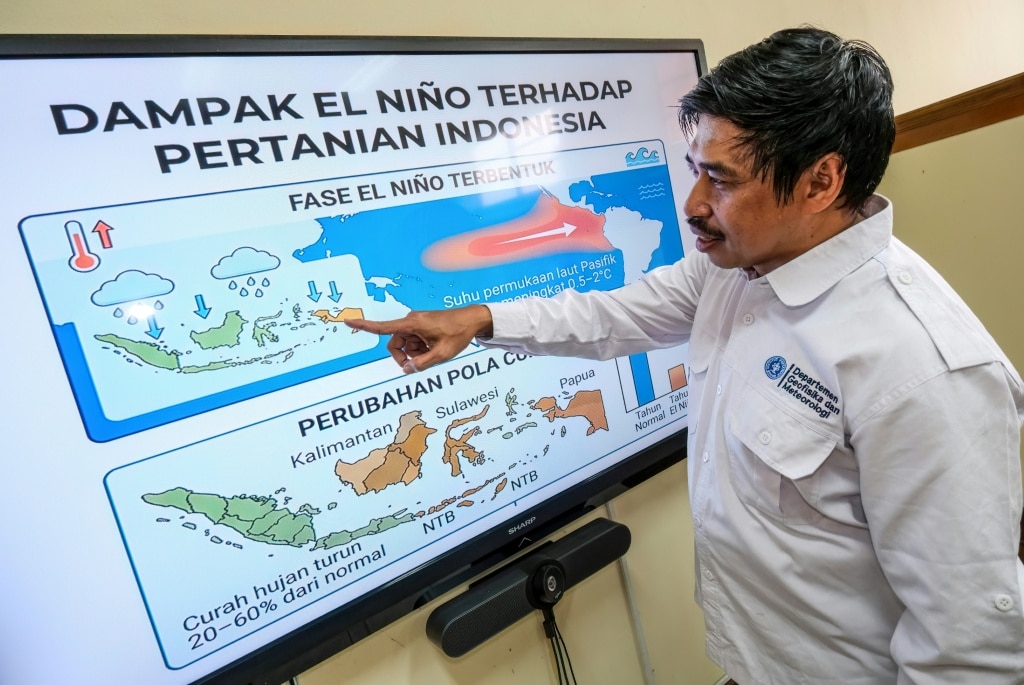
Climate scientists warn that this year’s extreme fire activity has been supercharged by the powerful El Niño event, a naturally occurring climate pattern that alters global wind, pressure and rainfall patterns, typically bringing severe drought to Indonesia. Already, the total burned area in just the first half of 2024 exceeds the total burned across the whole of 2023, the last year El Niño formed. Climate campaign group 350.org warned this week that human-caused climate change is amplifying the risk of extreme El Niño-driven fire seasons, noting that current El Niño conditions are occurring on top of already elevated global average temperatures that make extreme drought and fire far more likely.