Amid rising transatlantic friction, French President Emmanuel Macron has pushed back against former U.S. President Donald Trump’s latest plan to hike tariffs on European-made passenger vehicles and trucks, arguing that the world’s two closest democratic allies have far more pressing priorities than escalating trade conflict.
Trump first announced the measure last Friday, confirming he would raise import duties on EU-origin vehicles to 25% as early as this week. The planned tariff increase arrives at an already fragile moment for the global economy, which is still grappling with widespread market disruption stemming from the ongoing war in the Middle East.
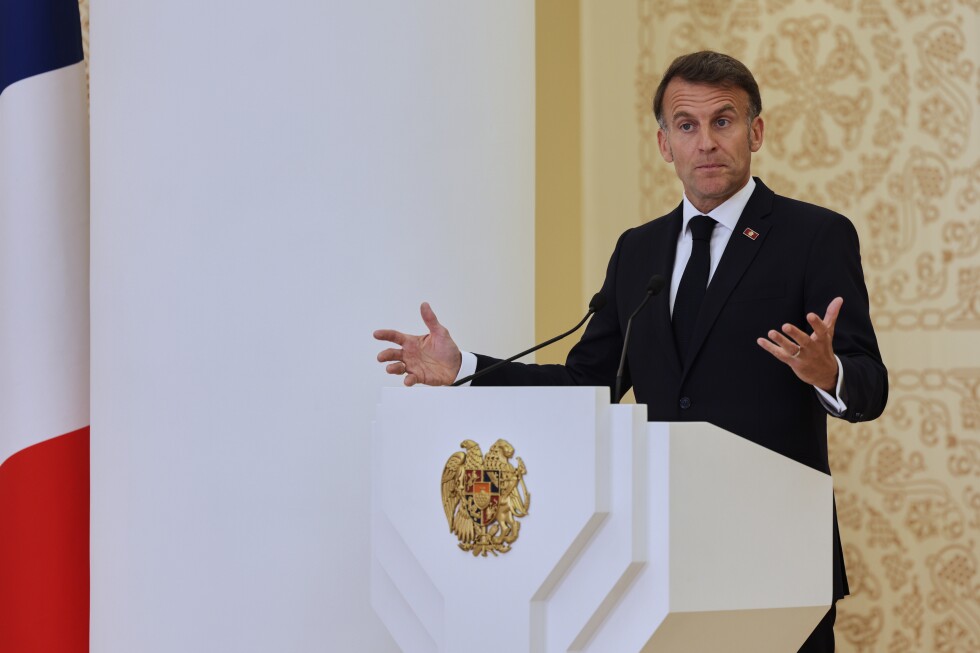
Speaking to reporters Tuesday on the sidelines of an EU-Armenia summit in Yerevan, Macron emphasized that the current tense geopolitical climate demands cooperation rather than confrontation between the U.S. and the European Union. “Especially in the geopolitical period we are experiencing, allies like the United States of America and the European Union have much better things to do than to stir up threats of destabilization,” Macron said. He added that for European businesses, households and general public, leaders should prioritize delivering a clear message of economic stability and market confidence, and expressed his hope that “reason will prevail soon.”
The tariff dispute stems from a landmark trade agreement reached by Trump and European Commission President Ursula von der Leyen back in July 2025, which established a 15% tariff ceiling for most traded goods between the two blocs. However, the legal foundation of that deal was undermined earlier this year when the U.S. Supreme Court ruled against the executive authority Trump had relied on to impose the agreed tariff levels. Trump has claimed the EU is failing to uphold the terms of the original agreement, though he has not offered further details to support his accusation.
Higher tariffs would hit Germany’s iconic automotive sector particularly hard, as the country is the EU’s largest vehicle exporter to the U.S. The new trade friction also follows heated rhetoric between Trump and new German Chancellor Friedrich Merz: Merz recently stated that the U.S. had suffered a diplomatic humiliation at the hands of Iran during negotiations to end the Middle East war, a comment that prompted Trump to threaten withdrawing thousands of U.S. military personnel stationed in Germany.
Senior trade officials from the EU and U.S. were scheduled to convene in Paris Tuesday to negotiate a path forward on the tariff dispute. Von der Leyen reaffirmed the EU’s commitment to upholding the existing 2025 trade deal during her remarks at the Yerevan summit, noting that “A deal is a deal, and we have a deal. And the essence of this deal is prosperity, common rules and reliability.”
As the EU’s executive body, the European Commission holds exclusive authority to negotiate trade agreements on behalf of the bloc’s 27 member states. Von der Leyen made clear the bloc has already prepared for all possible outcomes if talks break down, saying “we are prepared for every scenario” if the U.S. follows through on the tariff hike. Macron echoed that position, stressing that existing international trade agreements must be respected. He warned that reopening the terms of the 2025 deal would upend the entire framework of transatlantic trade relations, adding that “the European Union has instruments that would then need to be activated” in response to any unilateral U.S. action.
Reporting for this article included contributions from Masha Macpherson in Paris.