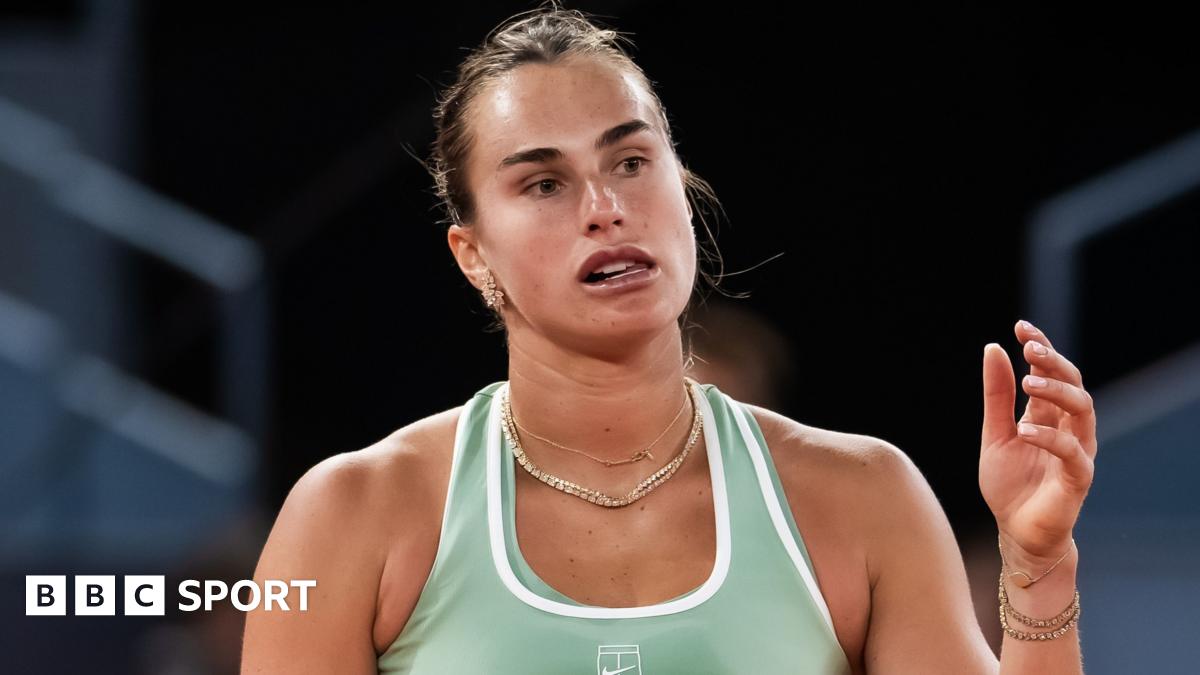
As the world’s top female tennis players gather in Rome for the Italian Open, a simmering dispute over Grand Slam prize money and player representation has broken into the open, with world No. 1 Aryna Sabalenka becoming the first high-profile player to openly predict a player boycott of one of the sport’s most prestigious events in the near future.
For weeks, top-10 ranked players from both the men’s and women’s tours have united behind a set of core demands: a larger share of the billions in revenue generated annually by the four Grand Slam tournaments, enhanced benefit contributions for lower-ranked players, and more input into key decisions like tournament scheduling. Until Sabalenka’s press conference in Rome, however, players had avoided publicly discussing strike action as a potential bargaining tool.
“I think at some point we will boycott it. I feel like that’s going to be the only way to kind of fight for our rights,” the four-time Grand Slam singles champion, from Belarus, told reporters. “I feel like the show is on us. I feel like without us there wouldn’t be a tournament and there wouldn’t be that entertainment.”
Her comments have exposed deep divisions within the women’s game over how far to push the sport’s governing bodies. World No. 4 Coco Gauff, the reigning French Open champion, quickly backed Sabalenka’s position, saying she could “100%” see herself joining a collective boycott if all players coordinate their action. Gauff added that progress on player demands has historically required collective organizing, noting that across other professional sports, meaningful change often only comes when players unionize to push for their shared interests.
“If we all collectively agree, then yes. I wouldn’t want to be the only one, but we definitely can move more as a collective,” Gauff said. “From the things I’ve seen with other sports, usually to make massive progress and things like this, it takes a union. We have to become unionised in some way.”
World No. 2 Elena Rybakina, champion of the 2022 Wimbledon, also signaled she would align with the majority of players if a boycott is called, saying she had no issue joining the action if most of the tour supported it. But other top players have pushed back on the idea of a tournament boycott, arguing that direct negotiation is a more effective and less extreme path forward.
World No. 3 Iga Swiatek, a four-time Grand Slam winner, said she fully supports calls for increased prize money but views a boycott as an overstep that risks breaking down productive dialogue between players and tournament organizers. “I think the most important thing is to have proper communication and discussions with the governing bodies so we have some space to talk and maybe negotiate,” Swiatek said, adding she hopes productive talks can be held ahead of the upcoming French Open at Roland Garros. “But boycotting the tournament, it’s a bit extreme… So it’s really hard for me to say how it would work, if it’s even there on the picture. For now, I haven’t heard anything.”
Former US Open champion Emma Raducanu went even further, saying she would refuse to participate in any boycott. Raducanu, who withdrew from the Italian Open 12 hours before Sabalenka’s comments due to lingering post-viral symptoms, said Grand Slams hold irreplaceable value for her that extends far beyond prize money. “It gives you something that money can’t and that is what is the most important to me, and what I value the most,” Raducanu told BBC Sport. “I wouldn’t be a part of [a boycott] but each to their own.”
The current dispute was reignited earlier this month when organizers of the 2025 French Open announced a 9.5% increase in total prize money, a raise that players dismissed as far insufficient to meet their demands. Players are currently calling for 22% of Grand Slam tournament revenue to be allocated to player prize money, a significant increase from the current share. In recent months, other major have already announced higher prize pool increases: the 2025 Australian Open raised its total fund by nearly 16% year-over-year, while the 2024 US Open increased its pot by 20%. Wimbledon is set to announce its 2025 prize money allocations next month.
Not all leading advocates of the prize money campaign back boycott threats. World No. 5 Jessica Pegula, one of the most vocal spokespeople for the players’ movement, told BBC Sport in March that she does not expect any player to actually strike against a Grand Slam, given how much players value competing at the sport’s biggest events. “We love playing the Slams – I don’t think anyone’s going to strike against the Slams,” Pegula said. “I just think it’s us asking for what we think we deserve, but I do think that if the men and the women can come together – which we have on that front – and keep pushing, there’s nothing wrong with us just asking for what we think is right.”
Sabalenka, for her part, said she is optimistic the two sides can reach a resolution that works for all parties, but added that women players are ready to organize to push for fair treatment. “I just really hope that we at some point are going to get to the right decision, to the conclusion that everyone will be happy with,” the 28-year-old said. “I feel like nowadays, we girls can easily get together and go for this because some of the things I feel like it’s really unfair to the players.”