For Brian Dubiski, bringing top-tier NCAA college football to London is not just a business venture—it is a full-circle moment that traces back to a legendary 1988 matchup in Tokyo. Three and a half decades ago, Dubiski was a defensive back for Texas Tech, set to face off against a freshly-minted Heisman Trophy winner Barry Sanders and his powerhouse Oklahoma State team. Just hours after claiming college football’s most prestigious individual award, Sanders delivered a historic performance, rushing for 330+ yards and four touchdowns to secure a 45-42 win for the Cowboys. Now, decades later, Dubiski is returning to the international college football stage in an entirely new role: chief executive of the first-ever Union Jack Classic, a landmark Big 12 Conference matchup between Arizona State and Kansas scheduled to kick off at London’s iconic Wembley Stadium next month.
International college football is not a new concept—teams have competed outside the United States for more than 100 years, with early matchups mostly held in neighboring countries like Canada and Cuba. The first post-season game outside the Americas was held in 1976, according to the NCAA, but in recent years, organizers have shifted scheduling to early-season matchups rather than holiday-style postseason games that functioned more as extended team vacations.
Dubiski and his team are betting that Europe is ready to embrace the full college football experience, pointing to the NFL’s decades-long presence in the region as proof that fan appetite already exists. “The NFL’s been there for two or three decades now,” Dubiski notes. “The appetite is there.” But breaking into a new market comes with steep hurdles: organizers must educate local fans on the unique traditions that define college football—from the passionate school spirit to the iconic marching band performances—and convince them to purchase tickets.
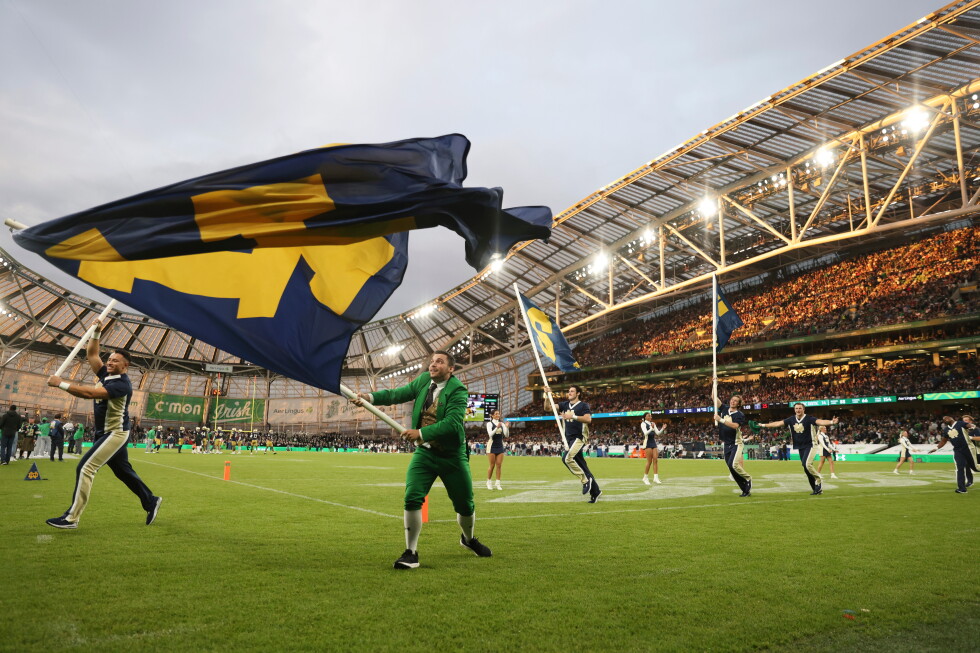
So far, Dublin has emerged as the most successful blueprint for international college football. What started as a one-off experiment has grown into a staple of Week Zero of the college football season, with the Aer Lingus College Football Classic drawing thousands of American travelers each year to the welcoming Irish capital. This weekend, TCU and North Carolina will face off at Dublin’s Aviva Stadium, marking the latest edition of the annual series. It has already delivered iconic moments, including Georgia Tech’s stunning upset of No. 10 Florida State just two years ago.
For participating programs, the Dublin game offers far more than just a unique on-field experience. “There is cachet in playing in Ireland, having an international game,” UNC athletic director Steve Newmark told the Associated Press. “It just draws intrigue, kind of curious onlookers to see Carolina blue and TCU purple playing in Dublin, and everything that goes with it.” TCU head coach Sonny Dykes, however, has echoed a common concern among coaches: the disruptive impact of international travel on a team’s season. He pointed to last year’s matchup between Iowa State and Kansas State, noting that the travel took a visible physical and mental toll on both programs early in the season, even as both recovered to play strong football down the stretch. For Dykes and TCU, a scheduled bye week immediately following the Dublin game has been a critical compromise to offset that disruption.
Despite growing enthusiasm for expanding college football to new global markets—with destinations like Germany, Brazil, and Saudi Arabia all touted as potential future hosts—many planned international matchups have fallen through in recent years. Michigan ultimately moved a planned matchup against Western Michigan from Frankfurt back to Ann Arbor, while Virginia relocated a scheduled game against ACC rival NC State from Rio de Janeiro back to its home campus in Charlottesville. ACC Commissioner Jim Phillips says the missing piece for most failed international games is local support and sponsorship. “You need to have a sponsor,” Phillips explained. “There has to be some support in another country to be able to pull this game together.” Still, Phillips remains bullish on the long-term future of international college football, adding that “the international piece is big. We’ve gone to Ireland several times. We want to go to a couple other places. We talked to the Holiday Bowl about maybe going to Saudi Arabia. To sprinkle the college game out internationally is great.” The 2027 Dublin matchup is already locked in, pitting Pittsburgh against Wisconsin.
Back in London, Dubiski and his team have already secured a multi-year agreement with Wembley Stadium, which can hold more than 86,000 fans, and Fox Sports’ popular “Big Noon Kickoff” program will travel across the Atlantic to broadcast the September 19 game. Dubiski has set a realistic inaugural target of 60,000 fans, with an estimated 15,000 supporters traveling from the U.S. to attend. Organizers have also introduced discounted group ticket packages to boost local sales. While Dubiski says the Union Jack Classic is in ongoing talks with airline and hospitality partners, a title sponsor will likely not be secured until 2025 at the earliest. “Year one is always a heavy lift, and so from the aspect of selling tickets to bringing in good partners and doing that sort of thing, it’s been a lot of hard work,” Dubiski said. “Everyone likes to be safe from that aspect and (say) ‘let’s see how this really goes down.’”
To avoid operational missteps in this first year, organizers have intentionally overinvested in logistics for the teams. “We’ve rented out full properties for the teams. We could have just put them in a hotel like normal,” Dubiski said. “We’ve rented two triple-seven jumbo jets for each team.” Dubiski’s team brings deep existing experience in American sports promotion in Europe: chief operating officer Thomas Hensey previously worked on marketing the World League of American Football, which later evolved into NFL Europe. Longer term, the organization has ambitions beyond a single annual game in London, with plans to expand to other European markets and even add other collegiate sports, starting with college basketball.
The growing push for international expansion aligns with shifting priorities across major college football conferences, with many seeing global games as a key to growing media rights revenue, expanding brand reach, and capitalizing on the rising importance of Name, Image, and Likeness (NIL) revenue for programs. “With the rising importance of NIL revenue for collegiate programs, international games are viewed as a critical area of growth with tremendous upside,” said John Anthony, co-founder of the Aer Lingus College Football Classic and executive vice president of hospitality provider On Location.
Pac-12 Commissioner Teresa Gould, whose conference sent Stanford to Australia for a 2017 matchup against Rice, says international games align with the conference’s long-term strategic goals. “The motivation for it and the reason it’s such an attractive option is international distribution in terms of television and media rights, brand reach and just really providing global exposure for our institutions,” Gould explained. Big 12 Commissioner Brett Yormark echoed that sentiment, noting that his conference already has deep experience with the Dublin model and has clear global ambitions. “We have global ambitions as a conference,” Yormark said. “I do like the NFL model and where they’re going. I like the NBA and where they’re going. There’s a lot of interest in Europe for what we do here at the Big 12.”
Beyond revenue and branding, participating programs also emphasize the non-athletic benefits of global exposure. Arizona State head coach Kenny Dillingham noted that the experience creates lifelong memories for the 18-to-22-year-old student-athletes who participate, while UNC has built a full itinerary of off-field engagement around its Dublin matchup, including a joint medical summit with Irish healthcare leaders. “It’s an opportunity to showcase Carolina on a global stage,” Rick Wernoski, UNC’s associate vice chancellor for operational excellence, told the AP. “It truly is much more than a game for us.”