For the first time in nearly 16 years, a sitting Lebanese president is set to step into the Oval Office for a high-stakes meeting with a U.S. head of state, marking a historic turning point for Lebanese-U.S. relations and the implementation of a new ceasefire deal between Lebanon and Israel. Joseph Aoun, a former commander of the Lebanese Armed Forces (LAF), will meet U.S. President Donald Trump on Tuesday, just one month after Washington mediated a trilateral framework agreement between Israel, Lebanon, and the United States aimed at ending a months-long conflict that has claimed more than 4,000 Lebanese lives.
The first phase of the agreement officially launched on Monday, with the Trump administration confirming that so-called “pilot zone operations” have commenced in the southern Lebanese villages of Froun, Srifa, and Zawtar Al-Gharbiya. These operations are being overseen by the newly established U.S.-led Military Coordination Group for Lebanon. Under the terms of the framework, Lebanese armed forces will deploy to southern areas to take over security control as Israeli forces withdraw, with the core mission of disarming the Iran-aligned militant group Hezbollah. The conflict erupted in March, when Hezbollah launched rocket attacks into northern Israel in support of its ally Iran, prompting a large-scale Israeli incursion that has left roughly one-fifth of Lebanese territory under Israeli occupation to date.
Key questions remain about the feasibility of the LAF’s assigned mission. The Lebanese military is already under-equipped compared to Hezbollah, which retains superior military capabilities across Lebanon and has not agreed to disarm itself. Washington has moved to shore up the LAF with a new $30 million funding boost last month, on top of a previously announced $100 million package of humanitarian aid for conflict-affected communities in the region, but analysts warn structural challenges could derail implementation.
At a Monday media briefing hosted by the Tahrir Institute for Middle East Policy, Sami Halabi, policy director and co-founder of regional consultancy Triangle, outlined the conflicting incentives facing Hezbollah. “If the framework fails, Hezbollah gains politically, because continued Israeli occupation proves its argument that diplomacy cannot deliver for Lebanon and that its armed arsenal is necessary for national defense,” Halabi explained. “At the same time, the group and its political allies want Israeli forces to withdraw, particularly from territories that are home to their core electoral and community constituencies.”
Halabi also pointed to a critical structural flaw in the deal’s security annex: the agreement frames Israeli movement as conditional redeployment rather than full withdrawal, with no binding timeline for completion and no automatic consequences for Israeli delays. “This creates a fundamental asymmetry between Lebanon and Israel,” he noted. Despite these concerns, U.S. officials have framed the framework as a landmark diplomatic breakthrough. U.S. State Department spokesperson Tommy Pigott called the deal a “milestone” in a Monday statement, adding that it grew directly out of recent Israel-Lebanon talks in Rome and that Washington would remain actively engaged to see the agreement through to full implementation. The Israeli military confirmed the process is underway in a post on X, warning it would “respond forcefully to any violation of the agreement.”
Aoun’s Washington visit, which began Saturday when he arrived in the U.S. capital with his wife, marks the first time a Lebanese president has visited the White House since Michel Sleiman met then-President Barack Obama in 2009. Aoun has not previously held one-on-one talks with Trump, and has little of the close rapport other regional leaders like Syria’s Ahmed al-Sharaa have built with the U.S. president. Still, like all Arab leaders, Aoun shares the widespread assessment that only Trump can exert meaningful pressure to rein in Israeli expansion.
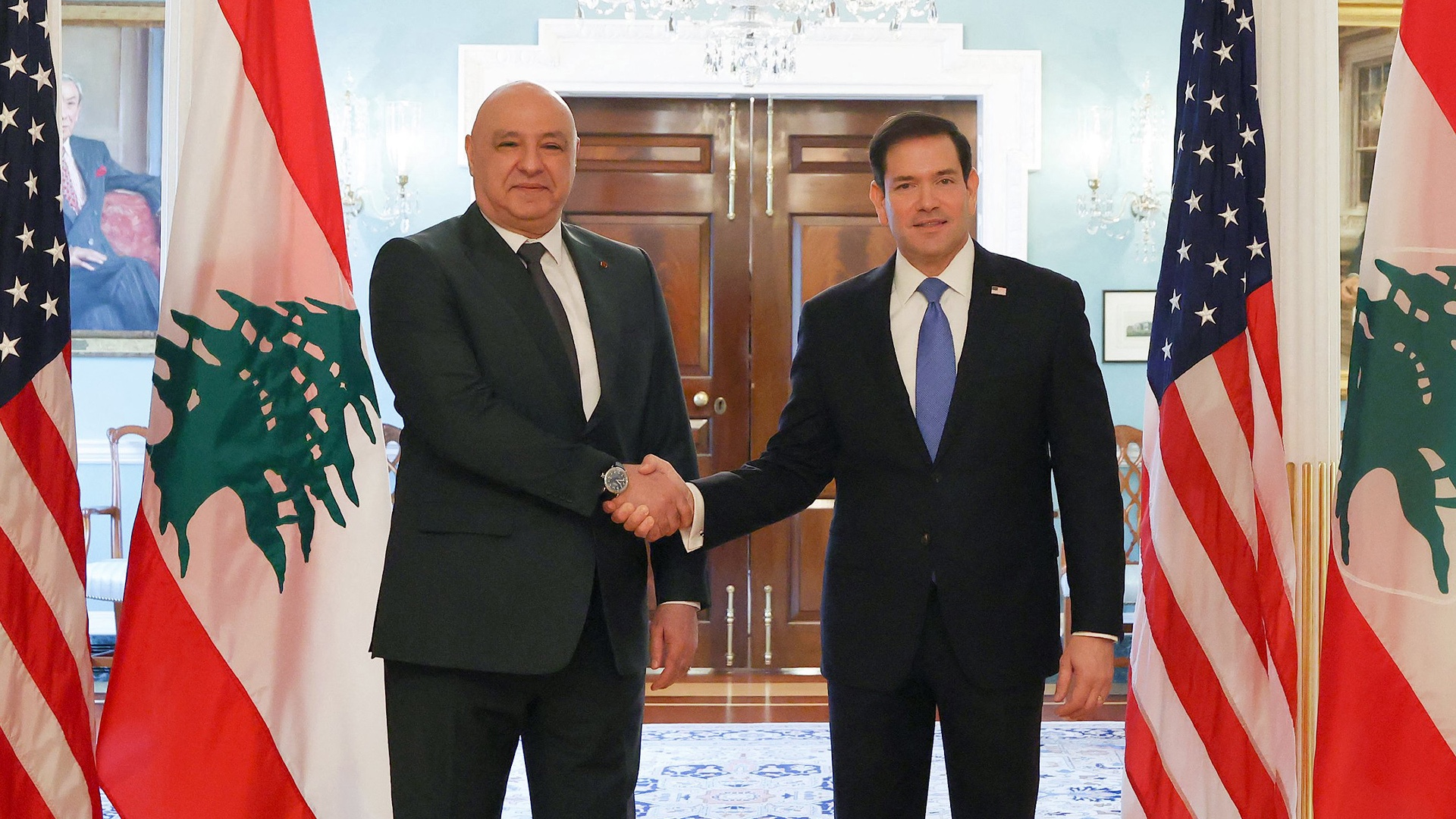
In a break from standard diplomatic protocol, Aoun held a separate meeting with U.S. Secretary of State Marco Rubio at the State Department on Sunday ahead of his White House audience. The move, which notably saw Lebanon’s foreign minister Youssef Rajji skip the trip entirely, sparked public outrage across segments of Lebanese society, with many critics framing the snub of their top diplomat as a national humiliation. Rubio characterized the discussions as “very positive” following the meeting, telling reporters that “President Aoun will be able to return to Lebanon and say to the people of Lebanon that he is the one getting positive results” for the country. He also emphasized that Washington recognizes Aoun’s government as the sole legitimate authority in Lebanon, “not Iran, not Hezbollah.”
The trilateral framework was finalized last month after five rounds of U.S.-hosted talks, with Rubio calling it “the beginning of the beginning” ahead of the official signing. Beyond the $30 million in support for the LAF and $100 million in United Nations-coordinated humanitarian aid, Rubio said the deal creates a clear, structured pathway to restore Lebanese sovereignty over its southern territory, disarm Hezbollah, dismantle the group’s military infrastructure, and allow Israel to secure its northern border once security threats are eliminated. “For Lebanon, this Framework provides a genuine pathway out of a long crisis. For Israel, it creates a verifiable path to removing the persistent threat on its northern border,” he said.
Lebanese Ambassador to the U.S. Nada Hamadeh Moawad described the ongoing Washington negotiations as “long and difficult.” In a post on X, Lebanese Prime Minister Nawaf Salam welcomed the framework as a step toward “restoration of the state’s sovereignty” but emphasized that Lebanon will not take on any new obligations beyond those already outlined in UN Security Council Resolution 1701 and the 2024 ceasefire agreement. Salam also reaffirmed that “Only the legitimate forces are authorized to bear arms in Lebanon.”
While Hezbollah refused to join direct negotiations with Israel, reports indicate the group maintained backchannel communications with the Trump administration throughout the mediation process. The militant group remains the most powerful military actor in Lebanon, with firepower that far outpaces that of the official Lebanese armed forces, leaving lingering uncertainty about whether the disarmament mandate at the core of the U.S.-brokered deal will ever be fully implemented.