For Rahela Begum, survival has become a chain of unthinkable hardships. After fleeing ethnic violence in Myanmar’s Rakhine State and spending eight years confined to the overcrowded Cox’s Bazar refugee camp in Bangladesh, the 25-year-old Rohingya refugee gambled everything on a dangerous sea crossing to Malaysia — and barely lived to tell the tale. In April, she joined 279 other refugees packed onto an overloaded wooden trawler, setting out from the southern Bangladeshi coastal town of Teknaf. Four days into the voyage, the overburdened vessel sank in the Andaman Sea, leaving Begum adrift with nothing but a discarded wooden plank to cling to for 48 hours.
“I was floating like a dead body, and after great difficulty managed to raise my head slightly,” Begum recalled, describing her ordeal before a passing rescue vessel spotted her and pulled her from the water. She is one of the lucky ones: new data from the United Nations High Commissioner for Refugees (UNHCR) confirms 2025 was the deadliest year on record for Rohingya attempting these perilous voyages, with nearly 900 refugees counted dead or missing at sea. So far in 2026, the death toll has continued to climb at an alarming rate.
More than one million Rohingya displaced from Myanmar currently reside in Cox’s Bazar, the world’s largest refugee settlement, where conditions have deteriorated sharply in recent years. Bangladesh’s national restrictions bar most refugees from leaving the camp, working formal jobs, or accessing stable economic opportunity, leaving the displaced population trapped in what many describe as an “open-air prison” with insufficient food, shelter, and basic services. With daily rations amounting to just 16 taka ($0.13) per person and most families only able to afford two meals a day, desperation has driven a surge in refugees turning to human trafficking networks to reach neighboring Southeast Asian countries including Malaysia, Indonesia, and Thailand.
Trafficking has grown into a highly lucrative criminal enterprise for transnational networks that span Bangladesh, Myanmar, Thailand, and Malaysia, with recruiters operating openly within the Cox’s Bazar camps and along the border. A trafficker who spoke to AFP on condition of anonymity explained the operation: refugees are first gathered in Teknaf, packed onto small local trawlers, then transferred to larger sea-going vessels once they reach international waters. Recruiters can earn up to 250,000 taka ($2,000) per person they smuggle, and many do not view their exploitation of desperate refugees as a crime, instead framing it as fulfilling a demand for escape.
UN data shows more than 6,500 Rohingya attempted sea crossings in 2025, meaning roughly one in every seven refugees who set out died or went missing at sea. The pace of departures has only accelerated in 2026: between January and May, UNHCR recorded 2,300 attempted departures from Cox’s Bazar, more than double the 1,180 recorded during the same period in 2025.
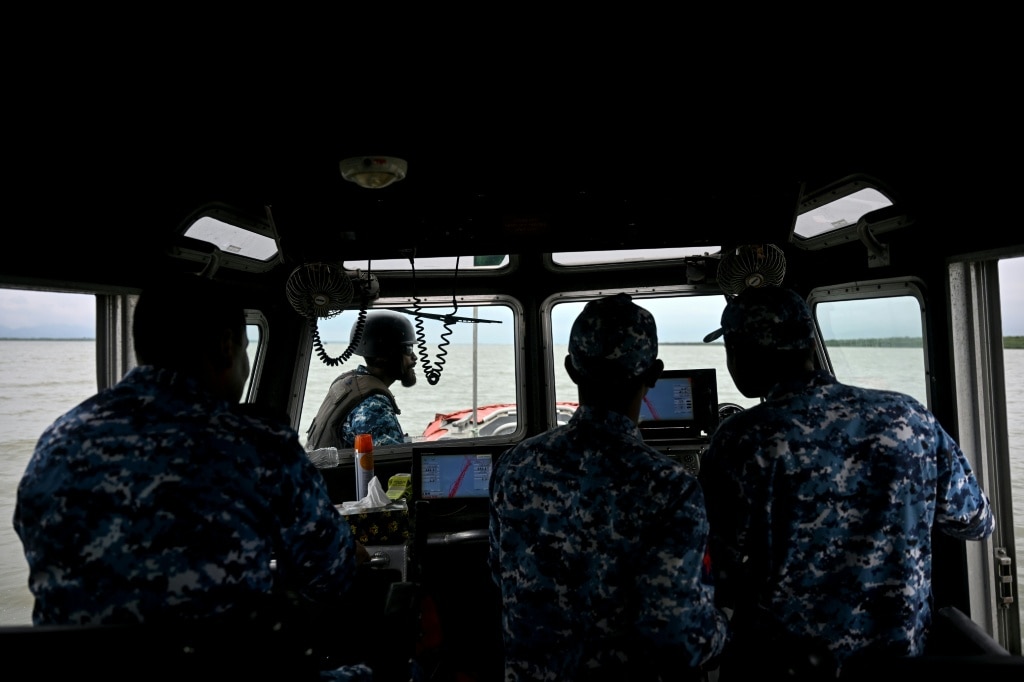
Bangladeshi authorities have declared a “maximum alert” to curb the trafficking surge, but resources and capacity gaps have left them struggling to dismantle powerful transnational criminal networks. Coast Guard Lieutenant Mohammad Rawnak Rahman, who patrols the Naf River border between Bangladesh and Myanmar, says his team has already rescued 618 trafficking victims so far this year, but the crisis continues to outpace their response. Across the border in Rakhine State, ongoing clashes between the ruling Myanmar junta and Arakan Army rebels have added more instability, pushing additional Rohingya to flee toward Bangladesh’s already overstretched camps.
At the Cox’s Bazar courthouse, lead prosecutor Tawhidul Anwar described being overwhelmed by the scale of the crisis, saying his office is currently handling roughly 500 active trafficking cases. “Investigators aren’t very effective, it’s hard to obtain evidence. The traffickers are very powerful,” Anwar explained, noting that even traffickers arrested following high-profile shipwrecks like Begum’s April voyage have been released on bail, despite facing potential life sentences for their crimes. Local police superintendent ANM Sajedur Rahman echoed that frustration, adding that authorities lack the funding and personnel to break up the sprawling trafficking networks.
Sayed Ullah, president of the United Rohingya Council, said the desperation driving refugees to risk their lives at sea should come as no surprise to the international community. “Each person has to survive on two meals a day, and 16 taka ($0.13),” he said. “No one should be surprised that people try to leave, hoping to find something better.” Bangladeshi officials have long argued that easing movement and work restrictions for refugees is unfeasible, as the country’s own limited resources are already stretched thin by hosting more than a million displaced people.
For the Rohingya, community leaders say the only long-term solution is a lasting peace agreement in Myanmar that would allow refugees to return safely to their homes. But that outcome remains distant: the civil conflict ignited by the 2021 military coup in Myanmar continues to rage across the country, with US-based conflict monitoring NGO Acled recording more than 100,000 total deaths from fighting to date.
Back at her makeshift bamboo-and-tarpaulin shelter in Cox’s Bazar, Begum says her dream of freedom sank along with the boat that was supposed to carry her to a better life. “God has granted me peace nowhere in this world,” she said. “Not in my country, not here.”