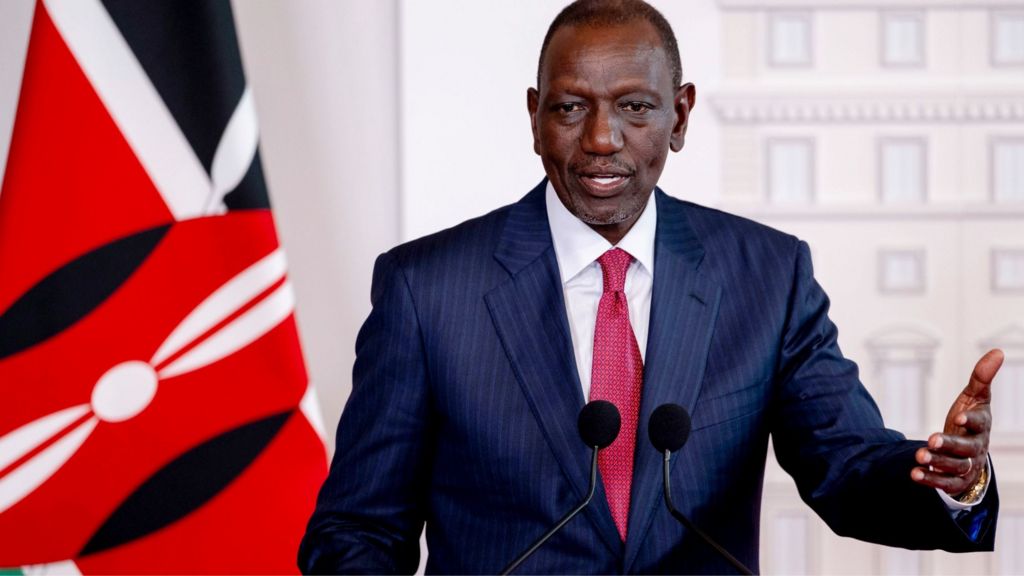
What started as an offhand comment about regional English accents in Africa has erupted into a cross-border social media firestorm, pushing Kenya’s President William Ruto to issue a public clarification to ease growing tensions. Last week, during a private engagement with Kenyan expatriates in Italy, Ruto made remarks that quickly went viral: he boasted that Kenya’s education system produces globally competitive human capital with top-tier English proficiency, then added that listeners often need a translator to understand English spoken with a Nigerian accent.
The comment triggered immediate widespread condemnation online, sparking a heated digital rivalry between citizens of the two East and West African nations. Both Kenya and Nigeria are former British colonies that retain English as an official language, but each has developed distinct accent patterns shaped by their own indigenous linguistic landscapes. Nigeria’s more than 500 native languages have heavily influenced the cadence, intonation, and phonetics of its spoken English, while Kenya’s mix of Bantu, Nilotic, and Cushitic languages has produced its own unique pronunciation style.
The opportunity for clarification came during a mining development conference hosted in Nairobi, Kenya’s capital, where Nigeria’s Minerals Minister Henry Dele Alake was in attendance. Taking the stage after Alake’s lighthearted address — in which Alake noted that Nigeria’s people had tasked him with assuring Ruto that Nigerians speak good English — Ruto leaned into the moment of good-natured banter to set the record straight.
Ruto told the gathered crowd that his original remarks were never meant for public consumption and had been deliberately taken out of context by commentators. He reframed his original point to emphasize that *all* African populations speak high-quality English, regardless of regional variations. The controversial line, he explained, was merely an offhand comparison of differing accent patterns, not an attack on Nigerian English proficiency. He also reminded the audience of his personal family ties to Nigeria: one of his daughters, June, is married to a Nigerian man, making millions of Nigerians his extended in-laws.
In a playful closing quip directed at Alake, Ruto asked the minister to send his greetings to Nigerian President Bola Tinubu, adding, “Tell him I said that in good English… so that there will be no consequences.” He wrapped up his remarks by expressing relief that the misunderstanding could be resolved directly with his Nigerian counterparts, noting, “It is as well that we can have this conversation – my in-laws I hope there will be no consequences for whatever was done.” The lighthearted exchange stood in stark contrast to the harsh wave of criticism Ruto faced in the days after his original comments were leaked and spread online.