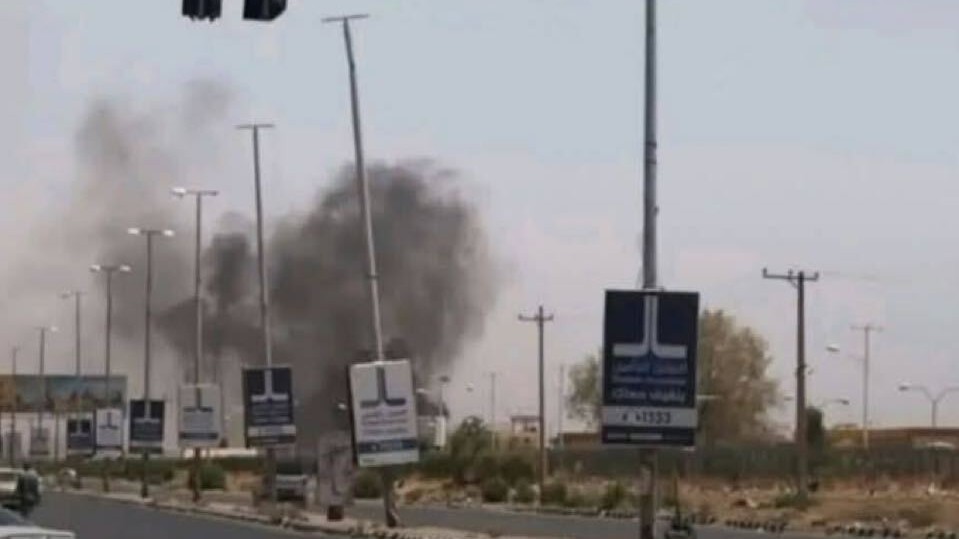
On Monday, five drone attacks targeted Khartoum International Airport, throwing an already volatile region into deeper crisis and pushing already fraught relations between Sudan and its eastern neighbor Ethiopia toward the brink of open confrontation. The incident has also dragged the United Arab Emirates into a fresh wave of mutual accusations, as Sudan’s top military leadership says its forces stand ready to defend national sovereignty against cross-border aggression.
Sudan’s army chief, General Abdel Fattah al-Burhan, confirmed in an interview with Middle East Eye that his command is prepared to safeguard the country’s territorial integrity. If ongoing investigations confirm the drones originated from Ethiopian territory, Burhan noted the Sudanese military will take all appropriate defensive measures in coordination with the international community.
A senior Sudanese intelligence source disclosed to MEE that the Sudanese Armed Forces (SAF) and its Joint Forces partners have begun preparations for a heavy military deployment to Blue Nile State, which shares a long border with Ethiopia, as well as to al-Fashaga, a long-disputed border region between the two nations. The source added that both Sudan’s military and civilian leadership anticipate a rise in cross-border attacks amid rapidly deteriorating bilateral ties, with the risk of full-scale military confrontation growing by the day.
This latest escalation follows an exclusive MEE report last month that revealed the Ethiopian military maintains an operational base in Asosa, located in the country’s Benishangul-Gumuz region, that is used to support the Rapid Support Forces (RSF). The RSF has been locked in a brutal civil war with the SAF since April 2023, and the paramilitary group is openly backed by the UAE, a key diplomatic and military ally of Ethiopia. After that report was published, Sudanese officials say Ethiopia refused to respond directly to repeated requests for clarification on the base’s use, and Ethiopian Prime Minister Abiy Ahmed has still not agreed to a meeting with Burhan to de-escalate tensions.
Following Monday’s attacks, Sudan’s government, military and intelligence officials directly accuse both Ethiopia and the UAE of complicity in the RSF drone strikes. The attacks were carried out by modified CH-series kamikaze drones originating from China, which have been altered to carry up to four missiles and are designed for silent flight. According to Sudanese officials, all five drones were launched from Ethiopia’s Bahir Dar airport. One of the incoming drones was intercepted by Sudanese air defenses before it could reach its target, crashing into a residential home in an eastern Khartoum neighborhood.
During a midnight joint press conference in Khartoum, SAF spokesperson Brigadier General Asim Awad Abdelwahab and Sudanese Foreign Minister Mohieddin Salem went public with their accusations, stating the country holds solid, concrete evidence of foreign involvement. “We have strong and hard evidence proving the involvement of Ethiopia and UAE in this aggression against Sudan, which represents a violation of our sovereignty and of international laws,” Awad told reporters. He added that Sudanese air defense units have intercepted drones launched from Ethiopian territory on multiple occasions since the start of March. On March 1 alone, three drones launched from Bahir Dar struck targets across White Nile, Blue Nile, and both North and South Kordofan states. After a March 17 attack, Awad said military investigators confirmed drone serial number S-88 was owned by the UAE and transferred from Bahir Dar to carry out the strike. He also tied Ethiopia and the UAE to recent RSF drone attacks on Kurmuk in Blue Nile State and el-Obeid in North Kordofan.
Foreign Minister Salem emphasized that cross-border violations from Ethiopia and the UAE have become a repeated pattern, and said Sudan will pursue formal international complaints against both countries. “Ethiopia and the UAE have repeatedly practised these violations against Sudan, and we have the right to react – and they know that when we say it, we mean it,” Salem stated.
In response, Ethiopia’s foreign ministry issued an official statement rejecting the accusations as unfounded. The statement added that Ethiopia has shown significant restraint over past months, choosing not to publicize what it calls repeated violations of Ethiopian territorial integrity and national security by belligerent parties in Sudan’s civil war. The Ethiopian government further accused the SAF of arming, funding, and hosting Tigrayan rebel forces, a claim Sudan has not publicly addressed. The UAE has also consistently denied any involvement in Sudan’s ongoing internal conflict.
A senior official with Sudan’s Civil Aviation Authority told MEE that all incoming and outgoing flights at Khartoum Airport have been suspended indefinitely as a security precaution. The official added that the attacks caused only minor structural damage that could be repaired quickly, but the strike was intentionally timed to disrupt the planned resumption of direct international flights from Khartoum, scheduled to launch May 4 to multiple neighboring countries. Prior to the attacks, the airport had only operated limited local flights, with all international services routed through Port Sudan’s airport.
Additional sources and eyewitnesses confirmed that Monday’s attacks were not limited to Khartoum Airport. Multiple military air bases across the region were also targeted, though SAF ground defenses successfully repelled all other attempted strikes. Separate military sources confirmed that radar and monitoring systems helped intercept a planned strategic drone attack in Blue Nile State near the Ethiopian border, as well as another strike targeting Jabal Awliya, a city south of Khartoum.
Satellite imagery collected between February 26 and May 4 by Yale University’s Humanitarian Research Lab has already confirmed damage consistent with aerial bombardment at a key fuel depot in Kenana, White Nile State, matching recent strike claims from Sudanese military officials.
Civilians across Khartoum and its neighboring twin city of Omdurman described being woken early Monday morning by the sound of massive explosions. “We woke up in the morning with the sounds of the bombs and the ground defence forces coming from around Wadi Seidna military airport in Omdurman,” one local resident told MEE in a phone interview. Another eyewitness, who lives just meters east of Khartoum Airport on Obaid Khatim Street, said, “I heard the bombs and saw the smoke coming from the airport at 12pm on Monday.”
The strikes have sparked widespread panic and unfounded rumors among civilian populations, particularly for the thousands of displaced residents who have only recently returned to their homes in Khartoum as frontlines stabilized in recent weeks. “This has caused panic and spread of rumours among civilians, especially the thousands of people who have recently come back to their homes in Khartoum,” one recently returned civilian told MEE. A Khartoum native who lives just west of the airport added, “I think these attempts are aimed at creating panic among the people and spoiling the attempts of voluntarily returning people to their homes. So, we urge the Rapid Support Forces and those who are supporting it not to attack these civilian locations and complicate the life of the civilians. We also demand that the SAF works seriously on the protection of civilians.”
Two employees at major telecommunications companies operating in Sudan confirmed to MEE that their firms have evacuated all non-essential staff from Khartoum to the safer city of Atbara in River Nile State, including staff from regional giants MTN and Zain.
As of Tuesday, daily life across most of Khartoum and Omdurman has continued largely as normal, but residents and officials warn that the recent strikes threaten to derail the ongoing government and grassroots initiative to encourage displaced civilians to return to their homes in the capital.