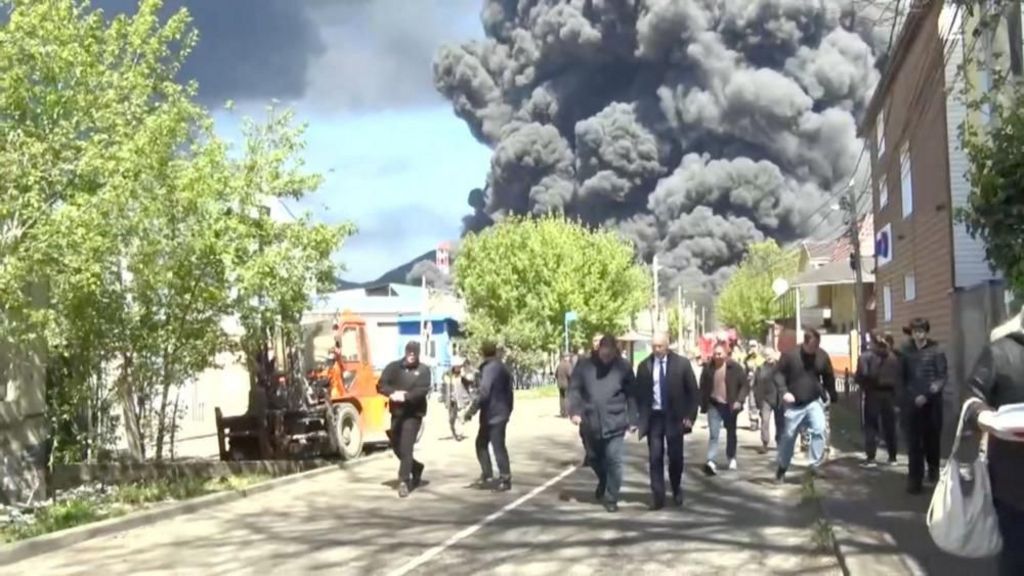
In a continued escalation of cross-border attacks on Russian energy infrastructure, a key oil refinery on Russia’s Black Sea coast has been targeted for the third time in April 2026 by Ukrainian drones, triggering a massive inferno that forced the evacuation of adjacent residential areas, regional Russian officials confirmed Tuesday.
Located in the southern Russian city of Tuapse, the refinery has faced repeated Ukrainian strikes over the past two weeks. Previous attacks already left severe environmental damage in their wake: a large volume of crude oil spilled into the Black Sea, and local residents reported so-called “black rain” falling across the city, leaving sticky oily residue on homes, streets and public spaces.
Ukraine’s military has publicly taken responsibility for the latest strike, framing attacks on Russian energy facilities as a legitimate strategy to cut off funding for Moscow’s full-scale invasion of Ukraine that began in February 2022.
In an update posted to his Telegram channel Tuesday, Krasnodar regional governor Veniamin Kondratyev announced that more than 160 firefighters had been deployed to contain the large-scale blaze. The governor noted that first responders were operating in “extremely difficult conditions” and praised their work as “true heroism”, adding that protecting the lives and health of Tuapse residents and visitors remained the government’s top priority. No fatalities or injuries have been reported from the attack or subsequent fire as of Tuesday’s updates.
Local municipal district head Sergei Boyko ordered residents of streets within the immediate vicinity of the refinery to evacuate the area, while emergency authorities set up a temporary evacuation center at a nearby public school to accommodate displaced residents. The regional crisis center issued public health warnings, alerting residents that harmful combustion byproducts were being released into the atmosphere from the ongoing fire. Local residents were advised to wear protective face masks, keep all windows closed, limit time spent outdoors, and rinse exposed mucous membranes including the nose, eyes and throat after being outside.
Anastasia Troyanova, a local correspondent for Russian independent environmental outlet Kedr, reported from the scene that a massive plume of thick black smoke hung over Tuapse, with a strong acrid smell of burning fuel permeating the entire area. Satellite imagery captured earlier in April already highlighted the extensive damage caused by the two prior strikes on the refinery.
Following the attack, Russian President Vladimir Putin ordered the country’s Minister of Emergency Situations to travel immediately to Tuapse to oversee on-site firefighting operations and post-blaze cleanup efforts. Dmitry Peskov, Putin’s press secretary, accused Kyiv of intentionally targeting energy infrastructure used for export operations, claiming the strikes amount to an attempt to destabilize global energy markets.
For its part, Ukraine’s military reiterated in an official statement that the strike on the Tuapse refinery was part of coordinated, ongoing efforts to “reduce the military-economic potential of the Russian aggressor”. Over the past several months, Ukrainian forces have stepped up long-range drone strikes on critical energy facilities deep within Russian territory, a campaign that Kyiv defends as a legitimate military tactic, since the revenue generated by these oil and gas facilities directly funds Russia’s ongoing war effort.
In a tit-for-tat development that underscores the continuing escalation of reciprocal long-range attacks, a Russian drone strike on Ukraine’s capital Kyiv injured one civilian on the same day as the Tuapse attack, according to Kyiv Mayor Vitaliy Klitschko. Ukrainian officials reported multiple small blazes across the city, including one that broke out at a local cemetery.