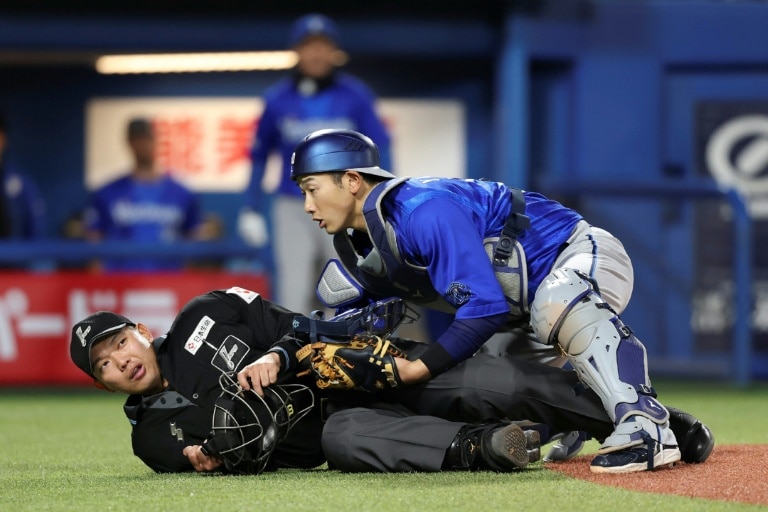
Nearly one month after a catastrophic on-field incident left a top Japanese baseball umpire fighting for recovery, Nippon Professional Baseball (NPB) has implemented sweeping new safety rules aimed at preventing similar tragedies, instituting formal punishments for dangerous bat swings that put players, officials and spectators at risk.
The incident that sparked the rule change unfolded on April 16 during a Tokyo-based league game. While working behind home plate, 30-year-old umpire Takuto Kawakami was struck in the left side of the head by a loose bat that slipped out of the hands of Tokyo Yakult Swallows slugger Jose Osuna, a Venezuelan-born player. Kawakami collapsed immediately on the diamond and was airlifted to a nearby hospital for emergency neurosurgery, after which he was placed in intensive care. As of the latest official updates, Kawakami remains unresponsive and continues to receive ongoing medical treatment.
In the immediate aftermath of the accident, NPB rolled out an interim safety mandate requiring all on-field umpires to wear protective helmets during games. Kawakami had only been wearing a standard face mask and baseball cap at the time of the impact, leaving his head critically unprotected. Last week, the Japanese baseball community showed public solidarity with the injured umpire, with all umpires across the country displaying Kawakami’s jersey number 29 on their new protective helmets.
On Monday, NPB’s governing body formally approved a permanent rule change to codify penalties for dangerous swinging behavior, which will go into effect starting Tuesday. The new framework defines a dangerous swing as any instance where a batter loses control of their bat and releases it mid-swing, whether the slip is accidental or not.
Under the new regulation, players who execute a dangerous swing that does not make contact with any person will receive an official formal warning. A second offense during the same game will result in immediate ejection from the match. Any dangerous swing that results in a person being struck by the loose bat will also lead to instant ejection, regardless of whether it is the player’s first offense.
Following the April incident, Osuna issued a public apology for the accident, expressing his concern for Kawakami’s condition. “I’m very sorry about what happened today when my bat hit the main umpire. I hope he’s well, I’m really sorry,” he wrote in a public post on social media platform X shortly after the game concluded.
The rule change marks one of the most significant updates to NPB’s on-field safety protocols in recent years, drawing widespread attention to the risks that loose bats pose to officials in professional baseball, a hazard that has long been underregulated in many global baseball leagues.