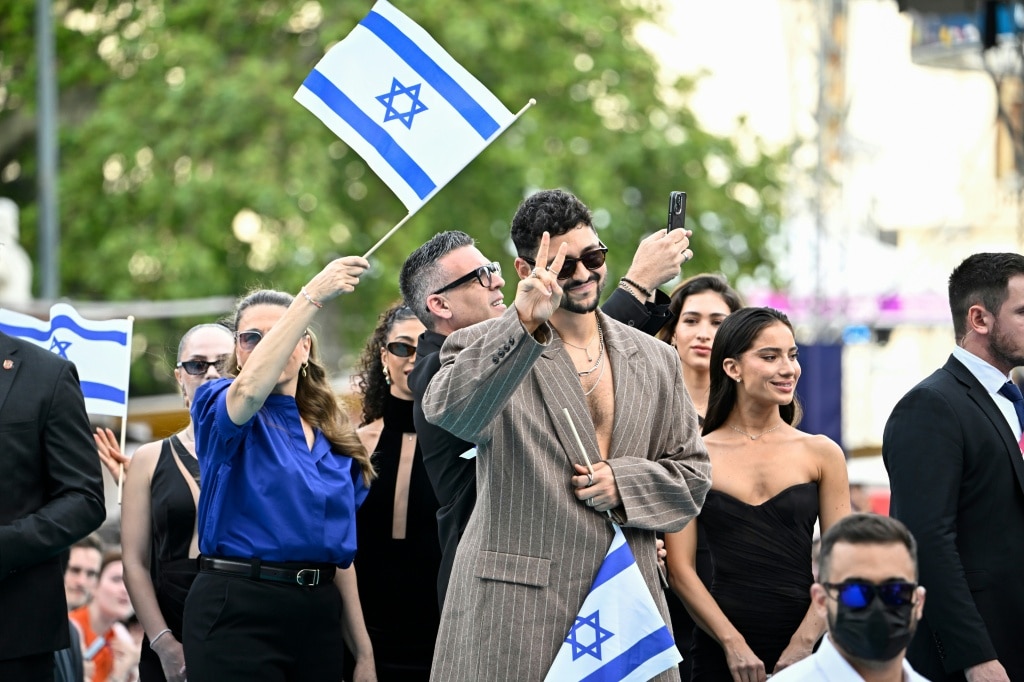
As the curtain prepares to rise on the first semi-final of the 70th Eurovision Song Contest in Vienna on Tuesday, all eyes are not just on the musical performances but on the unprecedented political crisis that has engulfed the world’s largest live televised music event. Israel’s participation this year has triggered the biggest boycott in the contest’s 70-year history, a controversy rooted in the ongoing Israeli military campaign in the Gaza Strip.
Five countries have already pulled out of the annual glitzy extravaganza: Spain, Ireland, Slovenia, the Netherlands and Iceland, with Spain, Ireland and Slovenia going a step further by refusing to broadcast any portion of this week’s competition. The withdrawals have shrunk the total number of participating nations to 37, the smallest field since the contest expanded its entry pool in 2004. The lineup would have been even smaller if Bulgaria, Romania and Moldova had not reversed their initial plans to sit out the event, rejoining the competition at the eleventh hour.
Martin Green, the director general of Eurovision, issued a statement on Monday reaffirming the event’s commitment to reconciliation, saying the organization would do “anything in our power to find a pathway back” for the withdrawing nations.
The controversy extends far beyond non-participation. Pro-Palestinian activist groups have organized mass demonstrations set to coincide with Tuesday’s semi-final, with plans to place symbolic coffins in central Vienna to honor civilian casualties in Gaza. In a public statement, the activists criticized contest organizers, arguing that “despite its crimes, Israel has the opportunity to be celebrated this week in Vienna as a democratic and peaceful rainbow nation.”
Beyond outrage over the Gaza war, withdrawing national broadcasters have raised two additional key concerns: first, widespread suspicion that the public televoting system was manipulated to artificially boost Israel’s standing at the 2025 Eurovision held in Basel, Switzerland, and second, violations of media freedom after Israel blocked international journalists from accessing the Gaza Strip.
Israeli officials have pushed back hard against the boycott, framing the backlash as an expression of bigotry. Amichai Chikli, Israel’s Minister of Diaspora Affairs, condemned what he called a “sharp and coordinated surge in antisemitic and anti-Israel discourse surrounding Eurovision 2026.” He added that the current unrest is a direct consequence of “the conduct of European governments and public bodies, which choose, in a hypocritical and weak manner, to boycott the competition.”
This year’s contest is hosted by Austria, which earned hosting rights after Finnish operatic artist JJ took home the top prize at 2025’s Basel contest with his hit “Wasted Love”. This marks the third time Austria has hosted the event, following stagings in 1967 and 2015.
Fifteen acts will take the stage at Vienna’s iconic Wiener Stadthalle for Tuesday’s first semi-final, with only 10 spots up for grabs in Saturday’s 25-act grand final. Early bookmaker odds mark Finland, Greece, Israel, Sweden and Croatia as the clear front-runners to qualify. Finland’s entry, performed by violinist Linda Lampenius and singer Pete Parkkonen, is the overall fan favorite this year with their high-energy track “Liekinheitin” (translated as “Flamethrower”).
Lampenius told Agence France-Presse that the pair has stayed focused on their craft despite the surrounding political chaos. “We are so much into the music and what we are doing in the numbers, so that’s what we are actually always going for: the feeling. It has to come from here: from the heart,” she said.
Israel’s representative, Noam Bettan, will take the stage with his multilingual entry “Michelle”, which blends lyrics in Hebrew, French and English. Bookmakers predict the toughest fights for qualification will come from San Marino, Georgia and Belgium. Belgian entrant Essyla said he has tried to tune out the outside noise and pressure, telling AFP: “The only stress I put on myself is to want to do things well.”
The first semi-final will kick off at 19:00 GMT, with Moldova earning the honor of opening the show as it returns to the contest after sitting out the 2025 event. A second semi-final featuring another 15 acts will be held on Thursday, with another 10 acts advancing to the grand final.
In a change designed to address long-simmering concerns about televote manipulation, this year’s semi-finals and final will combine public voting with scores from professional juries, marking the first time the combined system has been used since the 2022 contest in Turin. The so-called “Big Five” major financial backers of the contest — Britain, France, Germany and Italy — along with host nation Austria, have all received automatic spots in Saturday’s grand final regardless of semi-final performance.
Organizers have drawn inspiration for this year’s production from one of Vienna’s most iconic cultural institutions: the classic Viennese coffee house. Michael Kroen, the executive producer of Eurovision 2026, explained the creative choice to reporters on Monday, noting that coffee houses have long served as hubs for creativity and intellectual exchange in the city. “The creativity and the intellectuality was based in the coffee houses, and very great people lived in Vienna at the same time and created a lot of good stuff for the world,” Kroen said. “This was our inspiration and we’re trying to uphold this story… and present you modern Vienna.” To bring the theme to life, each competing nation has been given its own dedicated coffee house space in the city where fans can gather to watch screenings and connect ahead of performances.