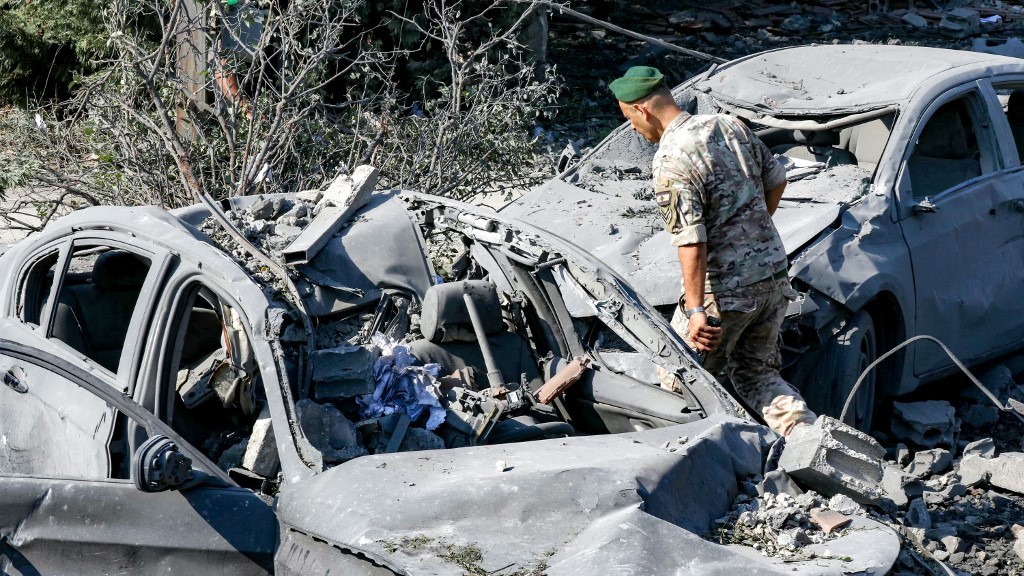
Overnight attacks carried out by Israeli forces on the southern Lebanese town of Kfar Rumman left 11 people dead, including two infants, Lebanese state media confirmed Monday. The violence marks a sharp escalation of hostilities in the region just weeks after a renewed ceasefire between Israel and Lebanese armed group Hezbollah.
According to Lebanon’s official National News Agency (NNA), the first and deadliest strike leveled a three-story residential building in the town, killing nine people and wounding five more. In a separate coordinated attack, an Israeli drone targeted a civilian vehicle in the same town, killing two local paramedics identified as Ali Shahrour and Hadi Farhat. The pair were active volunteers with the Islamic Scout Association, the NNA reported.
By Monday morning, local rescue teams were still sifting through the concrete rubble of the destroyed residential block, searching for any trapped survivors or additional fatalities. Photos from the attack site distributed by international outlets show the entire building collapsed into a pile of debris, scattered with children’s school textbooks and broken household furniture. Adjacent structures also suffered heavy structural damage, forcing dozens of nearby residents to evacuate the area to avoid further risk, Agence France-Presse reported.
Kfar Rumman is located just kilometers from Nabatieh, one of the largest urban centers in southern Lebanon. Many of the town’s residents had only recently returned to their homes after being displaced by months of cross-border fighting, following the truce agreement reached in June. Notably, the Israeli military did not issue any advance evacuation warning to local residents before launching the strikes on Kfar Rumman, in contrast to a separate attack carried out the same period in nearby Deir Zahrani. In that incident, the IDF warned civilians to evacuate a building it claimed housed a Hezbollah facility before destroying it 22 minutes after the alert was sent.
The Israeli military justified the latest wave of attacks by stating it had responded to a drone laden with explosives that was launched toward its troops, though it did not confirm whether the drone caused any Israeli casualties. It added that ongoing Hezbollah activities in southern Lebanon forced it to carry out a forceful response.
The current cycle of cross-border conflict dates back to March 2, when Hezbollah launched strikes on Israel in retaliation for the killing of a senior Iranian leader and repeated Israeli violations of an earlier ceasefire arrangement. Israel responded with widespread air and ground strikes across southern Lebanon, triggering months of sustained fighting.
As of Sunday, Lebanon’s Ministry of Public Health reported that the ongoing conflict has killed 4,362 people and wounded an additional 12,378 since hostilities resumed earlier this year. While fighting calmed after a truce was first reached in April and renewed in June—following a bilateral memorandum between Washington and Tehran to de-escalate broader regional tensions—Israel has continued to carry out frequent strikes across southern Lebanon and maintain military control over a swath of Lebanese territory.
Israeli forces currently occupy a self-declared buffer zone that stretches up to 10 kilometers inside Lebanese territory. A June report from Amnesty International found this zone covers approximately 6% of Lebanon’s total sovereign land. Even after the June 26 renewal of the ceasefire, Israeli strikes have continued: on Sunday alone, attacks killed at least seven people, including two women, and wounded 20 others.
Israeli authorities have ramped up military operations in areas surrounding Nabatieh since last Thursday, when the IDF announced it had seized the strategically important Ali al-Taher ridge from Hezbollah. Hezbollah has not yet issued an official response to Israel’s claim of control over the site.
Israel has repeatedly accused Hezbollah of violating the terms of the ceasefire by attempting to rebuild its military infrastructure in southern Lebanon. “Repeated drone attacks. Weapons storage. Terror infrastructure. Command centres embedded in civilian areas,” Israel’s Ministry of Foreign Affairs wrote in a post to X on Monday. “These violations will not be accepted.” The current ceasefire agreement includes formal provisions requiring Hezbollah to disarm and withdraw its fighters north of the Litani River.
Lebanese President Joseph Aoun has issued an urgent appeal to the United States and the broader international community to intervene immediately to halt Israel’s ongoing attacks. In a statement Sunday, Aoun called the latest strikes—which have damaged official government buildings and destroyed a non-operational hospital—a “dangerous escalation” that now targets Lebanese state institutions and civilian health infrastructure. He called on Washington and other global powers “to urgently act to stop these violations” of Lebanese sovereignty and the existing ceasefire.