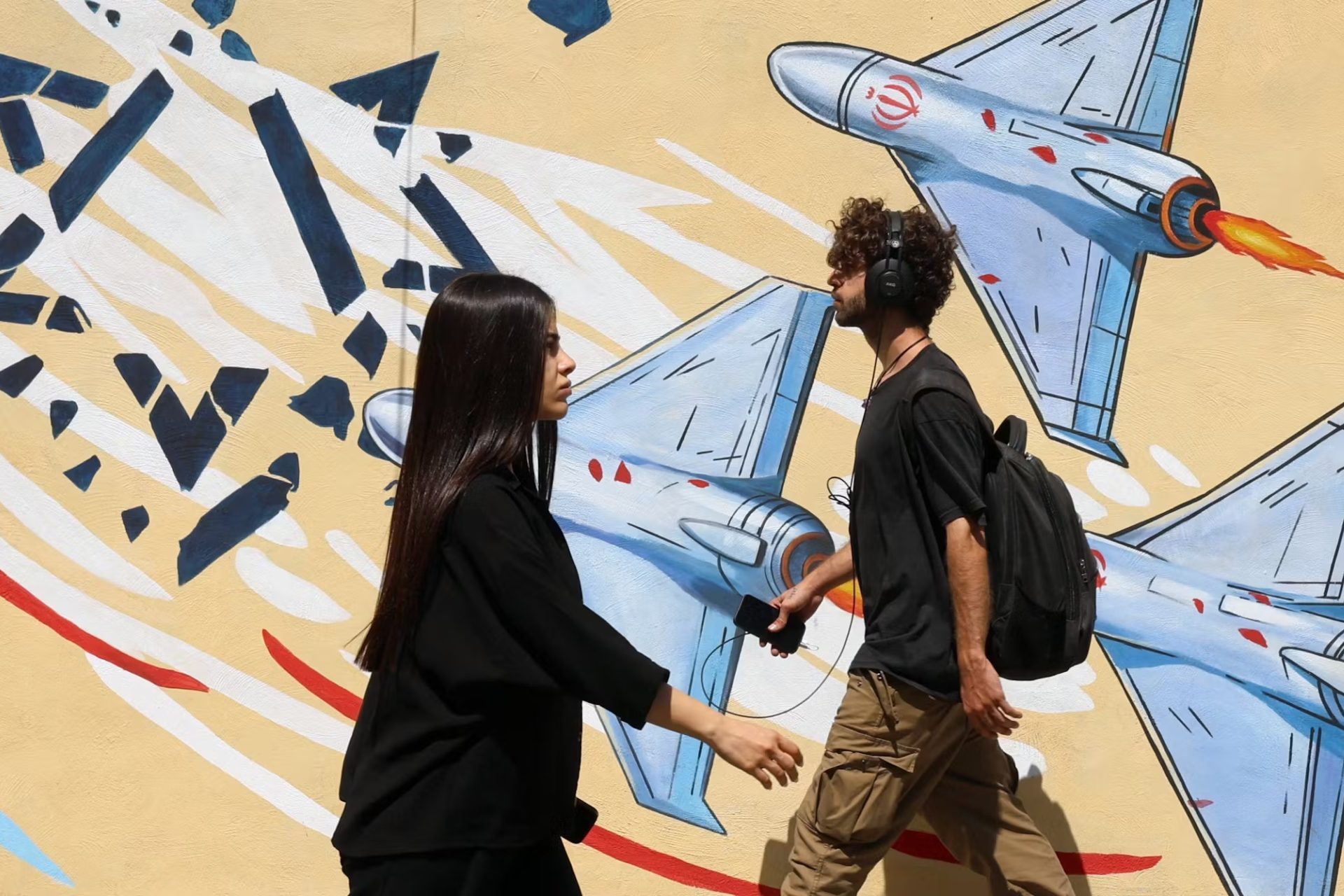
Most global media coverage of the ongoing tensions between Iran, Israel and the United States centers narrowly on military maneuvers, official political statements and high-stakes international diplomatic negotiations. But a quieter, more powerful grassroots movement has been unfolding across Iran’s public spaces and digital platforms, as ordinary citizens and artists push back against the uncertainty and fear of war through intentional collective presence.
History shows that communities facing crisis consistently turn to public gathering as a source of strength: Ukrainian protesters assembled in city squares following Russia’s 2014 invasion, New Yorkers came together across the city after the September 11 attacks, and Londoners gathered in underground stations during the Nazi German Blitz of World War II. In moments when every part of daily life feels unstable and out of control, visible public presence becomes an act of reclamation: it allows civilians to reclaim agency over their own lives and communities. For Iranians navigating the current conflict, this movement has formed across three interconnected, mutually reinforcing spheres: physical public presence, cultural and artistic expression, and digital grassroots storytelling.
## Physical Presence: Defying Fear Through Visibility
Iranians have maintained a steady, noticeable public presence in city streets, neighborhood parks and central public squares since regional tensions escalated. What began as spontaneous gatherings in the immediate aftermath of heightened threats has slowly evolved into a quiet, sustained ritual of community cohesion.
The meaning of these gatherings extends far beyond simple displays of personal courage. During open conflict, empty streets are universally recognized as symbols of fear, societal collapse and government instability. By contrast, consistent public presence sends a clear message of continuity: by refusing to retreat behind closed doors, Iranian citizens are symbolically rejecting the idea that war has completely overtaken their lives and identities.
For most participants, these gatherings are not inherently an act of political alignment with any faction or leader. Instead, they are a defense of the lives, connections and shared histories that bind communities together. Years of personal labor, generations of family history and collective cultural memory all face existential risk from escalating conflict; showing up in public is a quiet act of protecting the things that matter most.
A notable early example came in April, after former U.S. President Donald Trump threatened to attack Iran’s critical civilian infrastructure. Renowned Iranian musician Ali Ghamsari responded by traveling to the Damavand power plant and performing his work directly outside the facility. Images of his performance spread rapidly across social media, becoming a touchstone for conversations about civic solidarity amid crisis. More recently, in July, the strength of mass collective public presence was on full display during funeral ceremonies for Iran’s Supreme Leader Ayatollah Ali Khamenei, when tens of thousands of mourners gathered in Tehran to grieve together in a massive show of shared community.
## Cultural and Artistic Presence: Building Social Cohesion Through Creativity
Iranian artists, musicians and cultural figures have stepped into a central role in shaping the public’s collective response to ongoing conflict. Their work does more than entertain: it fosters a deep sense of belonging and encourages people to stay connected to public life, acting as a form of informal social infrastructure that ties individual people to their broader communities.
Across genres, creative expression has become a way for Iranians to collectively process the fear, grief and uncertainty that come with the threat of war, while also exploring themes of national resilience and shared identity. Music, poetry, religious chanting and visual art all serve this purpose.
One prominent example is the song *Hasbi Allah*, created by Iranian singer-songwriter Mohsen Chavoshi with lyrics by poet Mehdi Abassi. The work draws on centuries of Iranian poetic, musical and spiritual tradition, reflecting on the devastating human cost of war, mourning those who have been harmed, and centering expressions of deep attachment to the Iranian homeland.
Similarly, traditional Shia Islamic mourning chants known as maddahi have become a core part of many public wartime gatherings. Long tied to collective remembrance and mourning in Shia religious practice, these chants have been reimagined for the conflict context, blending traditional religious symbolism with declarations of love for country and willingness to stand together as a community. Many chants also draw on Iran’s long cultural and historical mythology: one viral video references Arash-e Kamangir, the legendary Persian folk hero who famously sacrificed his own life to fire an arrow that defined Iran’s national borders. These creative works weave together religious devotion, centuries of shared historical memory, and modern national identity to build a sense of collective purpose.
## Digital Presence: Grassroots Storytelling for a Global Audience
One of the most distinctive shifts in how Iranians are communicating about this conflict is the rise of AI-generated videos, memes and parody as tools for grassroots wartime storytelling. Unlike the heavily ideological, martyr-focused narratives that defined official Iranian propaganda in past eras of conflict, much of this new content uses the familiar language of contemporary global internet culture.
A series of AI-generated Lego animations have gone viral in recent months, with some amassing hundreds of millions of views across platforms. These videos retell recent military events, while weaving in references to Iranian history and mythology and sharp, playful humor that most often parodies former U.S. President Donald Trump and Israeli Prime Minister Benjamin Netanyahu. Many of the videos are overlaid with English-language popular music and lyrics, indicating that creators intend for them to reach audiences far beyond Iran’s borders. Remarkably, almost all of the creators behind these viral works remain anonymous.
Younger Iranians in particular have embraced irony, meme culture and pop culture references to express their feelings about the conflict. One popular viral video blends overt patriotic themes with playful, self-aware visuals and humor, built around a rap lyric that repeats: “from us remain spirits that live on because they love the homeland.”
These examples mark a clear, significant shift in how wartime narratives are created in Iran. Iranian citizens are no longer passive recipients of official government messaging about the conflict; they are active, independent creators building their own narratives about what the war means for their lives and their country. The most human, compelling stories of this conflict are not coming from battlefields or diplomatic negotiating tables – they are coming from ordinary people who refuse to sit by helplessly as crisis unfolds around them.