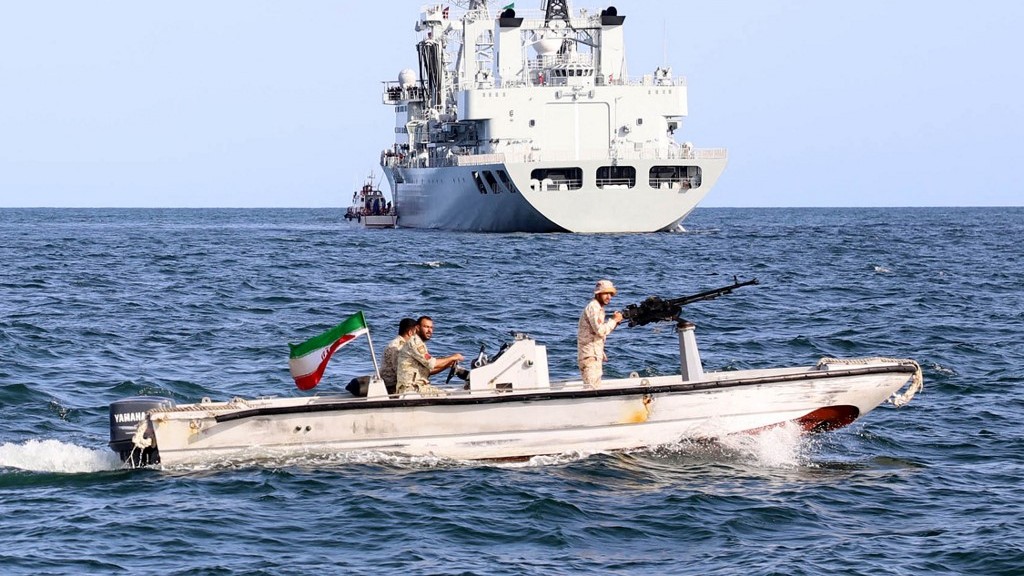
As military clashes between Iran and the United States stretch across neighboring Iraq and Yemen, new developments are shedding light on internal Iranian divides over the conflict, Tehran’s key asymmetric military strategy in the Persian Gulf, and allegations of transnational repression targeting Iranian dissident students abroad.
A prominent Iranian daily with deep official ties to the Islamic Revolutionary Guard Corps (IRGC) has centered its latest front-page coverage on the IRGC’s fleet of small speedboats operating in the Persian Gulf, framing the force as a decisive asymmetric advantage for Tehran amid escalating hostilities. In Wednesday’s coverage, Hamshahri labeled the speedboat fleet Iran’s “winning card” in the Persian Gulf, noting it forms a core component of the country’s deterrence architecture designed to discourage further expansion of U.S. military attacks.
For more than 20 years, the outlet explained, the fleet has posed one of the most persistent and complex threats to U.S. naval forces deployed in the region, built around the effective use of “swarm attack” tactics. Over the past five months, it has also evolved into a key strategic asset for controlling movement through the critical Strait of Hormuz, a chokepoint through which roughly 20% of the world’s global oil supplies pass annually.
Tehran’s naval strategy prioritizes mass production of small, high-velocity, low-cost craft rather than pursuing direct military competition with larger, far more expensive U.S. naval vessels. This approach is intentionally designed to raise the operational and human cost of any confrontation for adversarial forces while restricting their ability to maneuver freely in the Gulf. On the topic of controlling the Strait of Hormuz, Hamshahri added that the speedboat fleet complements other Iranian military assets including naval mines, cruise and ballistic missiles, and unmanned aerial vehicles to complete Tehran’s strategic ability to block access to the waterway if needed.
Amid rising hardline pressure to continue military clashes, a senior former IRGC commander has broken ranks to join growing calls for a cessation of hostilities with the U.S., arguing that genuine national victory for Iran only comes through the restoration of regional peace and stability. Brigadier General Hossein Alaei, the inaugural commander of the IRGC Navy and a former senior Iranian defense official who led IRGC naval forces during the 1980–1988 Iran-Iraq War, shared his perspective on the ongoing conflicts that have pitted Iran against the U.S. and Israel since 2025.
“While Iran has every right to defend itself, maintain its position, and respond to enemy attacks, the simple reality is that ongoing war causes irreversible harm to the Iranian people,” Alaei stated. The former commander also criticized the collapse of the earlier bilateral memorandum of understanding (MoU) between Tehran and Washington, describing the now-defunct agreement as a clear strategic win for Iran and a major setback for Israel.
Alaei emphasized that Iran conceded virtually no critical ground under the terms of the deal: “The U.S. claims it has degraded, damaged, and effectively dismantled Iran’s nuclear program. The maximum concession Iran made was agreeing to open discussions on the nuclear issue in the future, which aligns with Iran’s long-stated public position that it has no intention to develop nuclear weapons.” He added that the agreement also successfully pressured Israel to pause its frequent military strikes on Lebanon, a major win for regional stability: “Israel was launching strikes on Lebanon daily before the MoU; through that agreement, we halted those daily attacks. That is a very significant victory.”
Since large-scale military clashes resumed between Iran and the U.S. on July 7, hardline political and military factions within Iran have pushed to cut off all diplomatic negotiations with Washington and continue offensive operations. But Alaei is among a cohort of older-generation IRGC leaders who are publicly advocating for an end to the fighting.
Separately, a new investigation by BBC Persian has uncovered allegations that Belarusian security services have carried out a coordinated campaign of interrogation, detention, and deportation against Iranian students studying in Belarus who posted social media content critical of the Islamic Republic. The students have directly accused the Iranian Embassy in Minsk of collaborating with Belarusian security forces to enable this cross-border repression of Iranian government critics.
Khatereh Khodadadi, a dental student who spoke to the outlet, said she was arrested at her home by masked security agents just days after she posted a message expressing joy on Instagram following the killing of former Iranian supreme leader Ali Khamenei by U.S.-Israeli forces. She told reporters that agents interrogated her extensively about her views on Islam and the Iranian government before convicting her of “deliberate disobedience” and sentencing her to 15 days in prison. Khodadadi said she ultimately spent 45 days in detention, held in poor, unsanitary conditions, before being deported to a third country and issued a 30-year ban on reentering Belarus.
Another Iranian student, identified only by the first name Pezhman, alleged that the Iranian ambassador personally provided Belarusian authorities with a target list of Iranian dissident students living in the country, falsely labeling them as plotters to carry out an arson attack on the Iranian Embassy. Similar coordinated repression allegations have also emerged from other regional states: in Armenia, Iranian dissident protesters claim local authorities seized their passports in a coordinated action organized by the Iranian Embassy in Yerevan.
In additional new details on a previously unconfirmed Iranian military operation, local media has named Brigadier General Majid Kazemi as one of two pilots killed when Iranian Su-24 tactical bombers were shot down during an attack on a U.S. military base in Qatar on March 2. The strike was carried out in retaliation for earlier U.S. and Israeli attacks on Iranian targets, but no official details of the operation had been released publicly prior to this disclosure.
Recent independent reports confirm the two Su-24 aircraft were struck down while returning to Iranian airspace after carrying out bombing runs on the large U.S. Al Udeid Air Base in Qatar. The bombers took off from a major IRGC military base outside the southern Iranian city of Shiraz, according to the accounts. Iranian authorities have not yet released any public information identifying the second pilot killed in the downing or shared any official confirmation of the operation. Iranian state television has previously reported on a separate retaliatory strike carried out by Iranian F-5 fighter jets against a U.S. military base located in Kuwait, marking a series of escalating cross-border attacks on U.S. assets in the Persian Gulf region.