Escalating tensions in the Middle East have taken a sharp turn as former U.S. President Donald Trump has publicly threatened a forthcoming military strike on Pickaxe Mountain, a heavily fortified underground nuclear facility that lies at the heart of fresh Israeli claims about Iran’s contested nuclear program. Speaking on Tuesday, amid ongoing U.S. military operations targeting Iranian assets, Trump stated bluntly: “We’ll be hitting that area very probably pretty soon. And there’s not a thing they can do about it.”
In response to the threat, Tehran has issued a stern warning that any attack on its sovereign nuclear facilities will trigger a broadening of the ongoing regional conflict, raising fears of a wider war that could engulf the entire Middle East. The core of the current dispute centers on Israeli allegations that Iran relocated enriched uranium stocks and advanced centrifuges to the Pickaxe Mountain facility after earlier joint U.S.-Israeli strikes damaged other key Iranian nuclear sites. Notably, Israel has yet to release any verifiable evidence to support these claims, and Trump himself has openly acknowledged that U.S. intelligence agencies cannot confirm Jerusalem’s assertion.
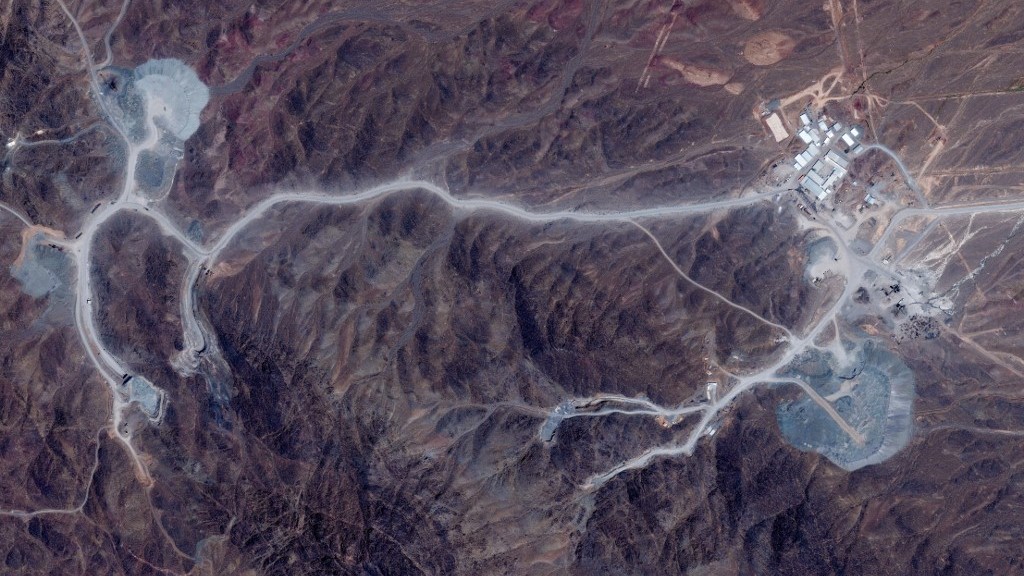
Located just 1.6 kilometers south of the Natanz uranium enrichment complex in central Iran – a site that was heavily bombed by U.S. and Israeli forces in June 2025 – Pickaxe Mountain is purpose-built to withstand military attack. Carved at least 100 meters beneath the surface of Kuh-e Kolang Gaz La, a mountain named for the Persian word for “pickaxe”, the facility is nearly impervious to conventional air strikes and would pose enormous challenges to any ground incursion. Construction of the site first began in 2020, following a damaging explosion at a centrifuge assembly workshop within the original Natanz complex. Iran formally notified the International Atomic Energy Agency (IAEA) that the facility was intended to manufacture centrifuges for uranium enrichment operations.
Analysis of satellite imagery conducted by the Institute for Science and International Security reveals an extensive network of tunnels, a broad heavily guarded security perimeter, and blast-resistant concrete-reinforced entrances designed to survive heavy air bombardment. As of current reporting, construction work remains ongoing, and no public evidence has emerged to confirm that the complex has begun full operations. Satellite imagery captured by Vantor on June 21, 2026, shows visible vehicle activity at the western entrance of the tunnel complex, confirming that work at the site has accelerated dramatically in the year following the June 2025 U.S.-Israeli attacks on Natanz and other Iranian nuclear sites.
The Center for Strategic and International Studies has outlined two leading explanations for the increased activity at Pickaxe Mountain: Iran may be accelerating completion of the declared centrifuge assembly plant it initially announced, or it has simply moved critical nuclear operations to the secured underground site after other facilities were damaged in the earlier bombings.
A key unresolved question hangs over the fact that the U.S. and Israel chose not to target Pickaxe Mountain during their 12-day offensive against Iranian nuclear infrastructure in 2025, raising doubts about the site’s purported strategic importance to Iran’s program at that time. During that earlier campaign, Israel first struck Iran’s core nuclear sites at Natanz, Isfahan and Fordow, killing multiple civilian Iranian nuclear scientists, before the U.S. joined the conflict, launching heavier bombing raids on the same three targets. Trump initially claimed the attacks had completely “obliterated” Iran’s nuclear capabilities, but subsequent assessments from U.S. and United Nations experts found that while the strikes caused extensive damage, significant portions of Iran’s nuclear program survived.
Since the 2025 offensive, Washington and Jerusalem have focused intense pressure on Iran over its existing stockpile of nearly 450 kilograms of highly enriched uranium, demanding that Tehran either surrender the material or permanently dispose of it. When pressed by reporters on whether Iran had indeed moved advanced centrifuges to Pickaxe Mountain, Trump contradicted Israel’s unsubstantiated claims, admitting: “We don’t have it on record.”
Iran has repeatedly denied conducting any undeclared nuclear activities at the Pickaxe Mountain site. The Iranian government maintains that its entire nuclear program is oriented toward peaceful civilian energy goals, and says it plans to expand its nuclear power fleet to meet growing domestic electricity demand, freeing up more of its oil reserves for export to global markets. The latest threat of a new strike has sent shockwaves through the international community, with experts warning that further escalation could have catastrophic consequences for global energy security and regional stability.